The Machine-Native Economy, Separated From the Forecast
A plain-language breakdown of the machine-native economy thesis: which parts of AI-agent payments, stablecoins, and compute are real, and which are forecast.

I spent a stretch of September and October 2026 reading two things side by side: a widely-discussed BlackRock research report arguing that AI and digital assets are structurally converging into a "machine-native economy," and a more skeptical independent analysis checking the same claims against the available evidence. I wanted to know, plainly, how much of this was already true.
Here's the short version, before the long version: the infrastructure for a machine-programmable economy is real and moving fast. The evidence that this infrastructure has become economically significant — that AI agents are a material source of demand for stablecoins, blockchain settlement, or financialized compute — is thin. Both are true at the same time, and most of the public conversation collapses them into one claim.
This piece is my attempt to keep them separated.
The core claim, in one sentence
BlackRock's framing is that AI represents "machine-native intelligence" and digital assets represent "machine-native money," and because both large language models and blockchains rely on tokenization — converting real-world inputs into standardized, machine-readable units — their convergence is structurally inevitable. As agentic AI spreads, the argument goes, it will generate durable demand for programmable payment rails, stablecoins, blockchain settlement, tokenized real-world assets, and decentralized compute markets.
It's a clean thesis. The tokenization analogy, though, is worth pausing on: converting language into numerical tokens and converting a financial asset into a blockchain-based token are doing genuinely different things — one is a modeling convenience, the other is a legal and technical claim about ownership. The fact that both processes use the word "tokenization" is a linguistic coincidence dressed up as an architectural one. That doesn't make the broader thesis wrong. It does mean the thesis needs to stand on its actual evidence, not on the wordplay.
So: what's the actual evidence?
What's actually built: the protocol stack
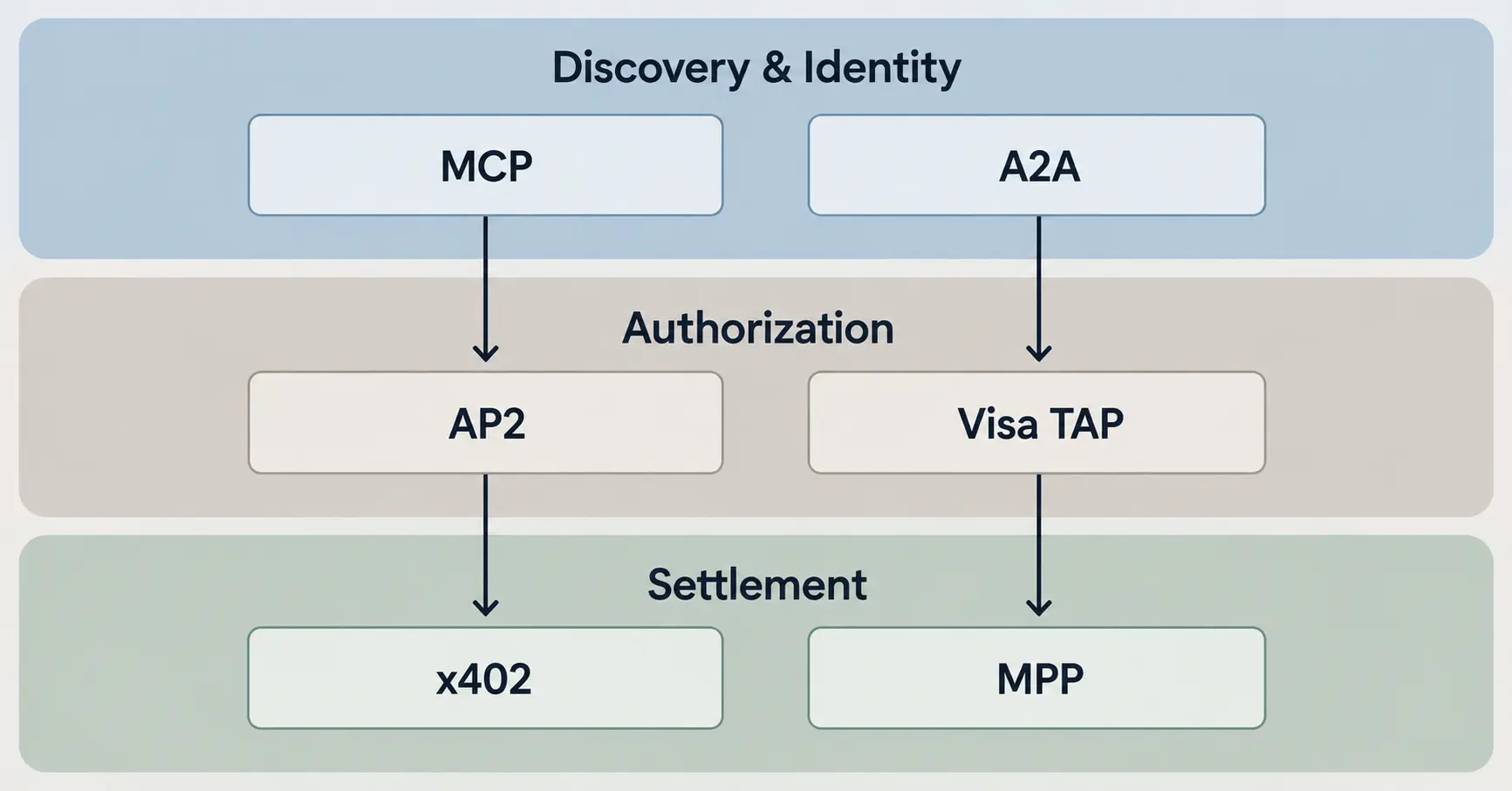
By late 2026, the tooling for agents to discover, authorize, and settle transactions has genuinely matured, and it splits into three layers that get talked about as one:
- Discovery and connectivity — MCP (Anthropic's Model Context Protocol, now under Linux Foundation governance) lets an agent find and use external tools and data. A2A (Google, April 2025) lets agents coordinate with other agents. Neither moves money; both sit underneath everything that does.
- Authorization — proving an agent is allowed to act. Google's AP2, launched September 2025 with more than sixty partner organizations including Mastercard and PayPal, uses cryptographically signed "mandates" to prove a human authorized a spending pattern. Visa's Trusted Agent Protocol solves the merchant-side version: distinguishing a legitimate registered agent from a bot at checkout.
- Settlement — actually moving value. x402, Coinbase's protocol reviving the dormant HTTP 402 status code, embeds stablecoin payment authorization directly in HTTP headers for sub-cent transactions. Stripe and Tempo's Machine Payments Protocol (MPP) launched its own purpose-built Layer-1 blockchain in March 2026, explicitly rail-agnostic — supporting cards, stablecoins, and wallets.
This stack is real, well-funded, and backed by companies that don't build infrastructure lightly. It's also, notably, mostly rail-agnostic. AP2 works over cards, stablecoins, or bank transfers interchangeably. MPP is explicitly designed to be payment-method-neutral. The idea that agents structurally require a blockchain doesn't hold up against how the people actually building this infrastructure designed it.
What's not yet built: verified, organic volume
Here's where the thesis gets thinner. x402 is regularly cited as having processed more than 130 million transactions — a number used as evidence that agentic commerce has "arrived." A population-scale academic study went and checked the underlying transaction graph rather than accepting the headline figure. It found that 84.9% of that volume was operator-internal: relayer networks paying themselves to test their own infrastructure, not third-party agents transacting with each other.
This pattern — real infrastructure, unverified organic demand — repeats across the whole thesis. Visa reported completed secure agent-initiated transactions through its protocols; the disclosure demonstrates the flow works end to end, not that it works at commercial scale. India's UPI Circle enabled human-to-human payment delegation in August 2024, but its software/IoT extension (the part relevant to autonomous agents) remained a closed pilot as of this writing. Stripe and Tempo's MPP launched with more than 100 compatible services in its directory — a measure of supply-side readiness, not of transactions actually flowing.
None of this means the claims are false. It means the honest answer, for almost every headline metric in this space, is: the plumbing exists; the verified demand doesn't yet, or hasn't been disclosed.
Stablecoins: real growth, from a narrower base than the big number suggests
Stablecoins are the part of this thesis with the most genuine traction — and the most commonly misquoted evidence. Total stablecoin supply sat around $305–307 billion in September 2026. Gross on-chain stablecoin volume in 2025 was roughly $35 trillion. That $35 trillion figure gets used as proof of a payments revolution.
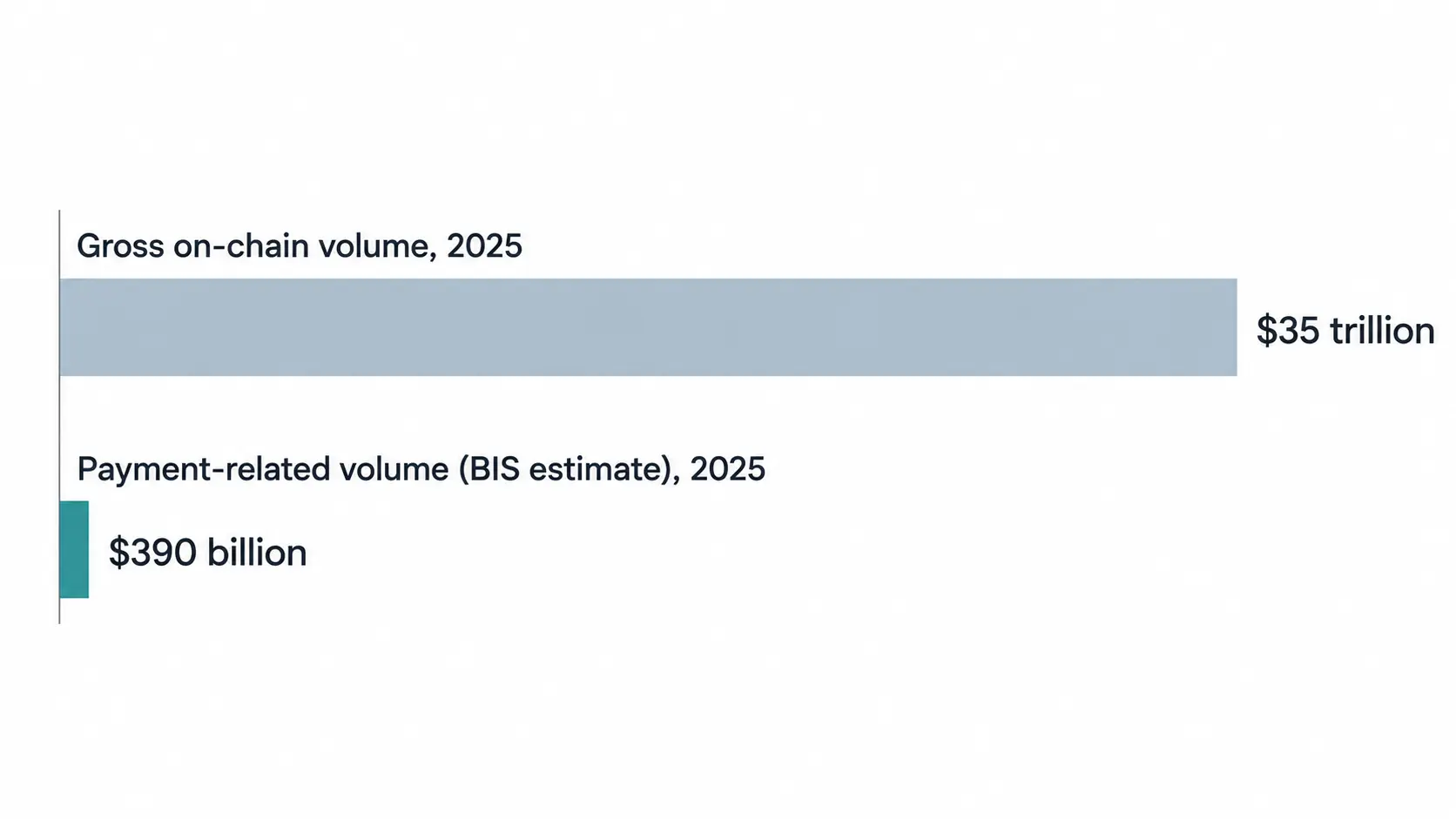
The Bank for International Settlements went looking for how much of that gross figure represented an actual payer paying an actual payee for goods, services, payroll, or remittance. Its estimate: about $390 billion — roughly 1% of the gross number. The Boston Consulting Group ran a separate methodology and estimated $350–550 billion of observable bilateral commerce out of about $62 trillion in gross transfers, putting the "real economic activity" share at around 7% under its framework. The two estimates disagree on the exact ratio — worth flagging plainly, since neither the research documents nor this piece should paper over that — but they agree on the order of magnitude: gross stablecoin volume massively overstates commercial payment activity.
What's growing genuinely, from a smaller and more credible base, is cross-border B2B stablecoin payments: one industry study (Artemis, based on data from 20 participating fintech companies) estimated more than $3 billion in monthly B2B stablecoin volume in early 2025, up from under $100 million two years earlier. That's real, measurable growth. It's also not primarily AI-agent-driven — no dataset reviewed for this piece separately identifies AI agents as a distinct source of stablecoin demand. The GENIUS Act, signed into US law in July 2025, gave the space a real regulatory floor: mandatory 1:1 reserve backing, monthly audited disclosures, and an explicit ban on paying yield to holders.
Where the value actually goes: the "Fat App" problem
Even in the scenario where agents do drive significant stablecoin and blockchain usage, there's a separate, under-discussed question: does that activity make blockchain tokens (like ETH or SOL) more valuable? The evidence, as of this research, says probably not automatically.
Over 90% of Ethereum's transaction execution has migrated to Layer-2 networks following the EIP-4844 data-availability upgrade. Median Ethereum mainnet transaction fees collapsed from over $2 to under $0.02, and by mid-2026 Ethereum's daily mainnet revenue fell to a multi-year low of roughly $330,000. Meanwhile, the ratio of application-layer revenue to base-layer network revenue hit a record 1.58 — the "Fat App" thesis, where value migrates to the applications and issuers sitting on top of the chain rather than the chain itself.
Tempo, the Layer-1 built specifically for machine payments, makes this concrete: it launched with no native gas token. Fees are paid in stablecoins. If the blockchain purpose-built for the exact use case this thesis depends on doesn't need its own token for value accrual, that's a meaningful signal about where the money actually flows — toward stablecoin issuers (who earn yield on their reserve assets), application-layer orchestrators, and payment processors, not toward base-layer blockchain tokens by default.
Compute: financeable, not yet a commodity
The compute side of the thesis follows a similar shape: real financing activity, much weaker evidence of true commoditization. CoreWeave's $7.5 billion GPU-backed debt facility (2024) proved that compute generates predictable enough cash flows to be financed like an asset. Decentralized compute networks — Akash, io.net — genuinely offer spot capacity at 50–85% discounts to major cloud providers.
The commoditization case runs into a hardware-heterogeneity problem that isn't going away with more scale. A GPU's economic value depends on its generation, its interconnect, its location, its latency to the model weights it's serving, its uptime, and its software stack — none of which standardize the way a barrel of oil does. The evidence for this friction is concrete: Akash Network reported only 84 active GPUs out of 334 listed as available in a single quarter of 2026, despite crossing $5 million in cumulative compute spend. io.net separately dealt with Sybil attacks inflating its reported provider counts before tightening its auditing.
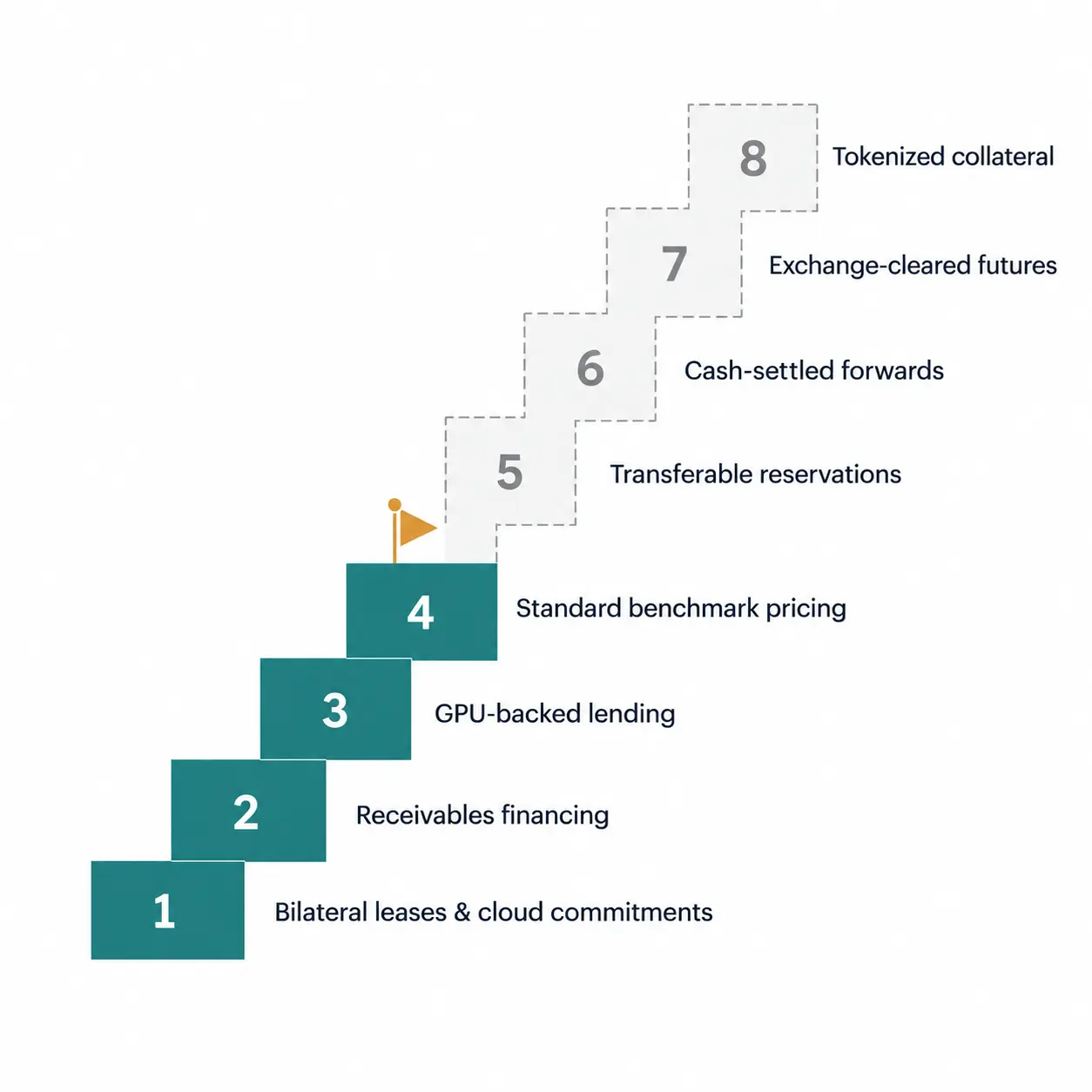
A useful way to think about how financialized compute actually is: picture an eight-rung ladder, from bilateral leases and cloud commitments, through receivables financing and GPU-backed lending, up through standardized benchmark pricing, transferable reservations, cash-settled forwards, exchange-cleared futures, and finally tokenized collateral accepted outside the issuing platform. The market, as of this research, sits at roughly rungs one through four. CoreWeave's debt facility is a rung-three instrument. Nobody has built a credible rung six yet, and rungs seven and eight remain theoretical.
The trust problem underneath all of it
One finding from this research deserves its own section because it complicates every number above: even where the payment infrastructure works flawlessly, there's a separate, unsolved question about whether the decision behind a given payment was ever trustworthy. Google's AP2 protocol uses signed cryptographic mandates specifically because language models produce probabilistic outputs and financial authorization needs deterministic enforcement. Red-teaming research found that prompt injection — hiding manipulative instructions inside external content an agent reads — can hijack an agent's reasoning before it signs a mandate. The resulting signature is completely valid. The decision it represents was never actually the human's.
This is why the dominant production pattern in 2026 is what researchers call "bounded autonomy": hard spending caps, approved merchant lists, and human confirmation for anything above a threshold. It's a sensible mitigation for a problem that isn't solved yet, not a sign that the underlying issue has been fixed.
Key takeaways
- The protocol layer (MCP, A2A, AP2, x402, MPP, Visa TAP) is genuinely mature and mostly payment-rail-agnostic — none of it makes blockchain structurally necessary.
- The headline volume metrics in this space (x402's 130M+ transactions, stablecoins' $35T gross volume) substantially overstate verified, organic, third-party economic activity once independently measured.
- Stablecoins are growing for reasons that are mostly unrelated to AI agents today — regulatory clarity (GENIUS Act), cross-border B2B settlement, dollar access — and could plausibly become AI-agent-driven later, but no current dataset shows that transition happening yet.
- Blockchain settlement growing doesn't automatically mean blockchain tokens capture the value; L2 fee compression and stablecoin-native chains like Tempo point value elsewhere.
- Compute is financeable (debt, leases) but not yet a liquid, standardized commodity, due to genuine hardware and network heterogeneity, not just immature markets.
- The most underrated risk in the whole thesis is the gap between cryptographic execution integrity and actual decision integrity — a gap current mandate-based systems don't close.
FAQ
Is the "machine-native economy" real?
Parts of it are built and working — the protocol infrastructure for AI agents to discover tools, prove authorization, and settle small payments is mature. The economically significant part — AI agents as a measurable, material driver of stablecoin or compute demand — isn't demonstrated yet by the available evidence as of September 2026.
Do AI agents need blockchain to make payments?
No protocol reviewed for this piece makes blockchain structurally required. AP2, MPP, and Visa's Trusted Agent Protocol are all designed to work across cards, bank transfers, and stablecoins interchangeably. Blockchain rails (particularly stablecoins on Layer-2 networks) currently have a real cost advantage for sub-cent, cross-border, always-on transactions — a narrower and more specific advantage than "agents require crypto."
What is the 84.9% x402 statistic?
It refers to a population-scale academic study's finding that 84.9% of measured x402 transaction volume was operator-internal (relayer networks paying themselves to test infrastructure) rather than genuine third-party agent-to-agent commerce.
Will AI agents drive stablecoin demand?
It's plausible — the protocol infrastructure (x402, MPP) is built around stablecoins for cost reasons — but not yet demonstrated. No dataset reviewed for this research separately identifies AI agents as a distinct, measurable source of stablecoin volume or supply growth.
Can compute become a tradeable financial commodity like oil?
Not with current technology and market structure. Compute is financeable (GPU-backed loans, leasing) but resists commoditization because a GPU's real economic value depends on interconnect, location, and workload fit in ways a barrel of oil doesn't. The market is at an early stage of a longer financialization process.
Related Writing
- technology
I Built My WordPress Theme to Be Read by Machines
Why designing a WordPress theme for AI agents instead of humans produced a cleaner, faster, more honest architecture.