The Jobs That Aren't Jobs
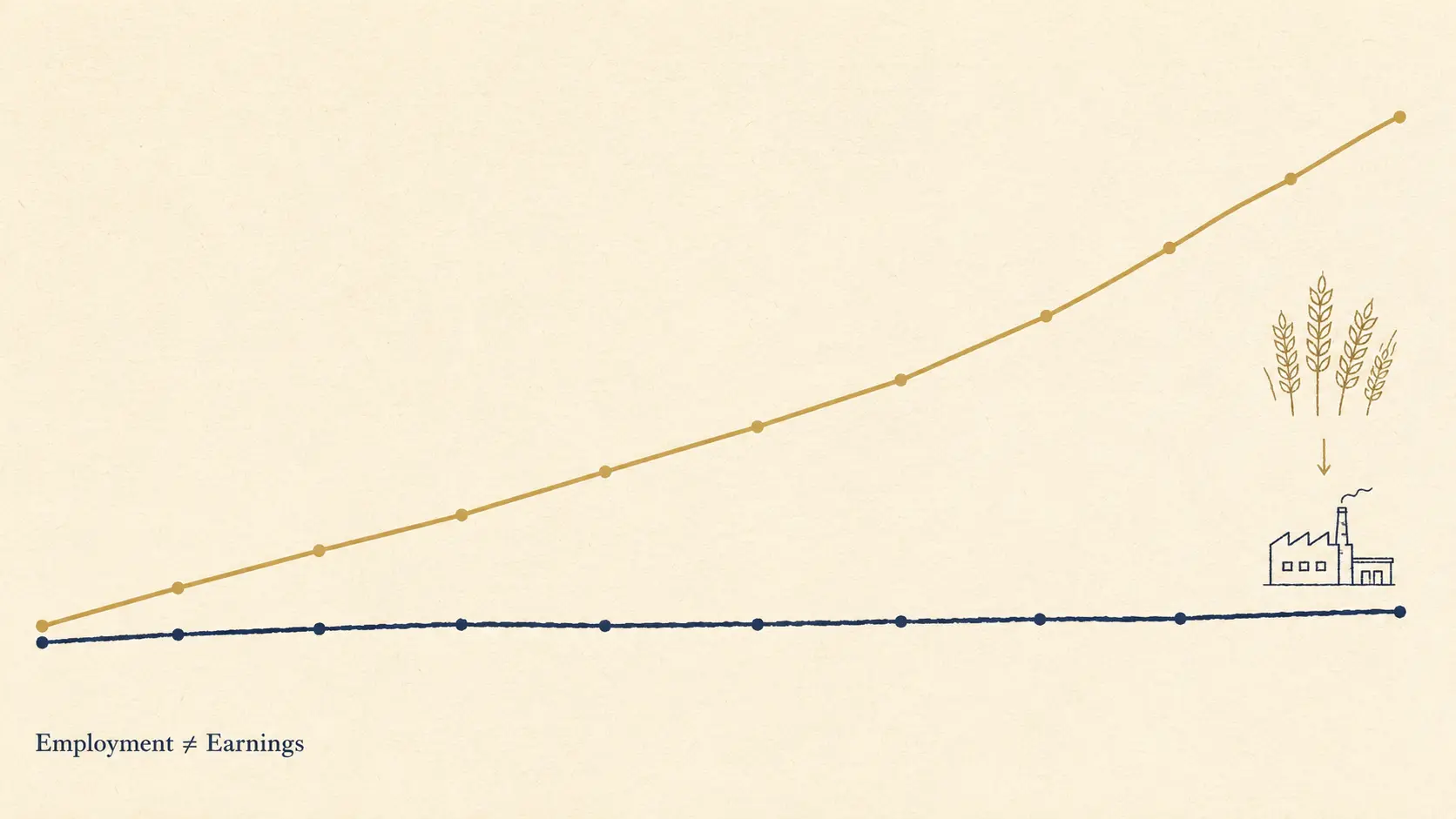
India's unemployment rate fell from 6.0% to 3.2% between 2017–18 and 2023–24. Real wages barely moved. A data-first look at why.
Introduction
I started pulling India's Periodic Labour Force Survey (PLFS) numbers into a spreadsheet for an unrelated reason and ended up staring at two columns that didn't agree with each other. Unemployment, by the headline measure, had improved substantially. Real wages, over the same years, hadn't moved. This piece is the full version of that spreadsheet — the numbers, the mechanism, and what I think it changes about how to read a national employment statistic.
The headline number
India's unemployment rate (for people aged 15 and above) fell from 6.0% in 2017–18 to 3.2% in 2023–24, according to PLFS data. Over the same period, labour force participation rose from 49.8% to 60.1%, and female labour force participation nearly doubled, from 23.3% to 41.7%. By almost any conventional reading, this looks like a genuinely strong six years for India's labor market.
Where wages went instead
Real wage growth — wages adjusted for inflation — was largely flat across most segments of the workforce over the same period. The clearest exception was administrative and managerial roles, which saw meaningful real gains. For most other workers, take-home pay after inflation barely shifted.
This matters because it breaks the standard mechanism economists expect. The Phillips Curve, in its simplest form, predicts that falling unemployment should tighten the labor market and hand workers more bargaining power, pushing wages up. Indian data across multiple decades shows this relationship is weak and inconsistent at best — one long-run study estimating the unemployment-inflation slope for 1955–2015 found it small and not statistically significant. The 2017–24 period is a fresh, sharp example of the same pattern: unemployment falling substantially, wages barely responding at all.
Why "employed" doesn't mean what it implies
Two structural shifts explain most of the gap.
Agriculture absorbed more of the workforce, not less. Agricultural employment's share of total employment rose from 44.1% in 2017–18 to 46.1% in 2023–24, while manufacturing's share fell from 12.1% to 11.4%. An economy transitioning toward higher productivity would typically move workers out of agriculture and into industry or services. This period moved in the opposite direction.
A meaningful share of new "employment" is self-employment, including unpaid family labor. Someone helping run a family farm or shop, without drawing an independent wage in any conventional sense, is counted as employed under PLFS methodology — which follows international labor statistics conventions, not a uniquely Indian quirk. It's a defensible way to measure labor force activity. It's also a category that carries essentially no wage-bargaining leverage.
Layered on top of both: roughly 80% of India's workforce operates without a formal contract, employer-provided social security, or access to collective bargaining structures. Even in a genuinely tightening labor market, a worker with no formal contract and no union access has limited means of translating that tightness into a wage increase. Informal employment doesn't respond to labor-market slack the way formal employment does, because the mechanisms that would normally transmit bargaining power — legal protections, union negotiation, enforceable minimum wages — mostly don't reach it.

The employability number that reframes everything else
The Economic Survey 2024–25 reports that only about 8.25% of Indian graduates work in a role that actually matches their qualification. This is a genuinely different failure mode than an unemployment statistic can capture. Those graduates are, by definition, employed — they show up as a win in the headline number. But they're also evidence of a labor market that isn't placing skilled workers where their training has value, which is a distinct and arguably more consequential problem than joblessness itself.
Put together, the unemployment improvement, the agriculture-manufacturing shift, the informality share, and the graduate-employability number tell a consistent story: aggregate employment statistics improved substantially over six years largely by absorbing more people into categories — agriculture, self-employment, informal work, skill-mismatched formal jobs — that don't carry the bargaining power the headline number implies they do.

What this doesn't mean
This is not evidence of a deliberately engineered outcome. PLFS methodology is standard, transparent, and internationally comparable — it isn't designed to mislead. Central bank and government policy in India has, per the broader research on this topic, focused on inflation stability and growth targets rather than on any stated employment-suppression strategy; there's limited direct evidence supporting a conspiratorial reading of unemployment policy.
It's also not evidence that nothing has improved. Labour force participation genuinely rising, and female labour force participation nearly doubling, are real structural shifts worth taking seriously on their own terms, independent of the wage story.
The revised question
The useful question isn't "is unemployment up or down." It's closer to: what share of measured employment actually carries wage-bargaining power, formal protection, and skill-matching — and is that share growing or shrinking, independent of the headline rate? I haven't found a single official series tracking that composite cleanly. Until one exists, the unemployment rate alone will keep looking better than the underlying labor market it's meant to represent.
FAQ
Did India's unemployment rate actually improve, or is the data unreliable? The improvement is real by PLFS's own methodology, which follows standard international conventions. The debate isn't about data reliability — it's about what the measured "employment" actually consists of, and whether that composition carries the wage and bargaining implications the headline number implies.
Why didn't wages rise if unemployment fell? Most of the employment increase came from agriculture, self-employment, and informal work — categories with limited or no wage-bargaining mechanisms, rather than from higher-paying formal-sector job creation.
What percentage of India's workforce is informal? Approximately 80%, operating without formal contracts, employer-based social security, or collective bargaining access, according to labor market research cited in this analysis.
Is this specific to India, or does it happen elsewhere? The general flattening of the relationship between unemployment and wage growth has been observed in many advanced economies since the 1990s, driven by globalization, technology, and anchored inflation expectations. India's version of the pattern is shaped specifically by its scale of informality and agricultural absorption, which is more pronounced than in most high-income economies.
Related Writing
- business strategy
Structure, Not Conspiracy
Regulatory compliance, protest movements, and poverty data all point to the same conclusion about India's political economy since 1991.
- business strategy
Baliyatra and the Arithmetic of Disappearing Craft
Baliyatra draws record crowds and revenue, yet traditional Odia crafts are vanishing from its stalls. Here's the economic logic behind why.