India's Digital Governance Ecosystem Evaluation
An empirical evaluation of India's Digital Public Infrastructure, assessing economic impact, digital divides, privacy, and cybersecurity.
Show case file details
Method
Empirical Evaluation
Length
15 minutes.Source Material
- Source 1: A Decade of Digital Governance Strategic Evolution of ICT Tools in India with special reference to 2014 to 2025 - Atlantis Press
- Source 2: (PDF) Understanding the Digital Governance and India's Digital Transformation Since 2014
- Source 3: State of DPI in India, 2025 - IIM Bangalore
- Source 4: IIMB to release 'State of DPI in India 2025' report on 4 December 2025 | IIM Bangalore
- Source 5: Visegrad Four and India: Searching for collaboration agenda amid global geopolitical upheaval - CEIAS
- Source 6: (PDF) Cyberdiplomacy and the New Digital Non-Alignment in the Global South: India as a Case Study of Technological Sovereignty in the Age of AI - ResearchGate
- Source 7: View of Big Data Discourses| Data in India's Digital Public ...
- Source 8: India's Digital Public Infrastructure: a Success Story for the World ...
- Source 9: IIM Bangalore and Protean release the inaugural 'State of DPI in India' report
- Source 10: As India Digitises, Cyber Governance Moves From Backroom To Centre - BW Businessworld
- Source 11: Full article: Hybridizing CSR governance in post-rentier states: comparative insights from Qatar and Singapore - Taylor & Francis
- Source 12: India's Glorious Success in UPI Adoption: What is Working, What is Not and What Can be Done Better? - IJFMR
- Source 13: Measuring the Economic Impact of India's Digital Public ... - CSEP
- Source 14: Is the digital stack of India a model for Africa? | NTU-SBF Centre for African Studies (CAS) | NTU Singapore
- Source 15: All Developments in ONDC in 2024 - Protean eGov Technologies
- Source 16: The State of India's Digital Economy (SIDE) 2025 Report - Prosus
- Source 17: India - EGOVKB | United Nations > Data > Country Information
- Source 18: UN E-Government Survey 2024 - Public Institutions
- Source 19: E-Government Development Index (EGDI) - Public Institutions - the United Nations
- Source 20: India Open Data Inventory Profile
- Source 21: 2025 open data maturity assessment – how did European countries do?
- Source 22: Global rankings - Open Data Barometer -
- Source 23: AI@Work: Driving Productivity, Jobs, and Innovation - PIB
- Source 24: Government AI Readiness Index 2024 - Oxford Insights
- Source 25: The discrepancies in India's new GDP data - CivilsDaily
- Source 26: PhonePe and Google Pay Lead UPI Ecosystem in December 2025 - Angel One
- Source 27: UPI transactions cross 20 billion in August; PhonePe, Google Pay lead market | DD News
- Source 28: India's digital public infrastructure: Analyzing UPI and Aadhaar in GDP growth and cost optimization
- Source 29: Direct Benefit Transfer in India: Progress, Challenges, and the Path Forward - ResearchGate
- Source 30: Direct Benefit Transfer 2.0: Transforming Welfare Delivery In India
- Source 31: India's DBT: Boosting Welfare Efficiency
- Source 32: Digital Divide, Aspects, Causes, Impact, Reforms and Initiatives
- Source 33: Bridging Digital Divide
- Source 34: Digital Technology as an Instrument to Bridge the Gender Gaps in Access to Labour Markets pdf (2.2 MB)
- Source 35: THE GREAT DIGITAL DIVIDE: AN ANALYSIS OF THE WIDENING GAP AND DIVERGENT TRENDS IN INDIA'S URBAN AND RURAL PAYMENT ECOSYSTEMS
- Source 36: View of The Uneven Web: Digital Literacy, Access, and Exclusion in Marginalized India
- Source 37: (PDF) The digital revolution in India: bridging the gap in rural technology adoption
- Source 38: Aadhar and Algorithmic Exclusion from Welfare: Case Study from Jharkhand
- Source 39: The Aadhaar Paradox – Domestic Failures and Global Success | TechPolicy.Press
- Source 40: Infrastructures of exclusion: How e-KYC impacts access to food - IDR
- Source 41: Aadhaar that doesn't exclude - Ideas for India
- Source 42: Digital-ID: exclusions and adverse inclusion - Institute of ...
- Source 43: (PDF) Adoption, digital health literacy, and patient satisfaction of Ayushman Bharat Digital Mission: an analytical cross-sectional study among outpatient department attendees - ResearchGate
- Source 44: Perception towards electronic health records & uptake of digital health IDs among the urban residents in northern India: A mixed methods study - PMC
- Source 45: Digital Transformation of Healthcare Access: A Comparative Time Series Analysis of Online Versus Conventional OPD Registrations at a Tertiary Care Hospital - PMC
- Source 46: Government e-Market Place facilitates orders worth Rs 5.42 lakh crore in 2024-25
- Source 47: GeM: Transforming Public Procurement in India Through Digital Transformation By - NeGD
- Source 48: REVOLUTIONIZING PUBLIC PROCUREMENT IN INDIA: THE IMPACT OF THE GOVERNMENT E-MARKETPLACE (GeM) - INSPIRA
- Source 49: The Strategic Impact of GeM on India's Economy - PIB
- Source 50: CPGRAMS Annual Report 2024 (20.01 MB) - darpg
- Source 51: parliament question: digital grievance redressal through central platforms - PIB
- Source 52: The Department of Administrative Reforms and Public Grievances (DARPG) released the 43rd Monthly Report on Centralized Public Grievance Redress and Monitoring System (CPGRAMS) for Central Ministries - PIB
- Source 53: Spillovers in State Capacity Building: Evidence from the Digitization of Land Records in Pakistan - Yale Department of Economics
- Source 54: Going Digital: Credit Effects of Land Registry Computerization in India - World Bank Document
- Source 55: Transformation of Land Records: The 21st Century Digital Era - Semantic Scholar
- Source 56: impact of digitalisation of land records on the concept of ownership - a critical analysis authored by - n.k. sharithira & dr. p. brinda
- Source 57: LAND: GOVERNANCE, DIGITIZATION AND HUMAN RIGHTS – A COMPARATIVE STUDY
- Source 58: How OCEN can revolutionise in India's MSME lending ecosystem - DBS Bank
- Source 59: Role of AA in OCEN
- Source 60: The Transformative Impact of the Account Aggregator Framework on Financial Inclusion in India: A Multi-sectoral Study of MSMEs, Microfinance, and Personal Lending | Advances in Consumer Research
- Source 61: Credit Reimagined - Account Aggregator Report H2 FY25 (Abridged) - Sahamati
- Source 62: India delays UPI market share cap deadline by 2 years - CoinGeek
- Source 63: NPCI To Delay Market Share Caps On UPI, Benefiting Google Pay And PhonePe | Medial
- Source 64: View of Building Accountability in e-government Services: Inputs for Policy - Australasian Journal of Information Systems
- Source 65: Data protection laws in India
- Source 66: With rules finalized, India's DPDPA takes force | IAPP
- Source 67: India's Digital Personal Data Protection Act 2023 brought into force - Hogan Lovells
- Source 68: Consent Management Under India's DPDP Act: Best Practices for Compliance - DPO India
- Source 69: The Digital Personal Data Protection Act, 2023: Comprehensive Framework, Latest Developments, and Compliance Roadmap - Legal 500
- Source 70: Digital Personal Data Protection (DPDP) Rules, 2025 - A Deep Dive - Treelife
- Source 71: India's data privacy shift: Steering the DPDP compliance and readiness - EY
- Source 72: Comments to the Government of India on the Digital Personal Data Protection Rules - International Trademark Association
- Source 73: India's Personal Data Protection Act and the Politics of Digital Governance - Atlantic Council
- Source 74: Understanding India's New Data Protection Law
- Source 75: Why cyber resilience will define India's digital economy in 2026 - ET CISO
- Source 76: Mapping India's Cybersecurity Administration in 2025
- Source 77: The State of digital and cybersecurity risks in India: Breaches, threat trends, and sectoral impact | Daily Pioneer
- Source 78: Assessing Legal and Policy Gaps in India's Cybersecurity Governance of Digital Commerce - INSPIRA
- Source 79: Welcome to the New World of Risk: Wake-up Call for Digital India Inc? - SECURITY TODAY
- Source 80: Governance Framework of Digital India: Fit for the Era of Convergence? - CSEP
- Source 81: CYBERDIPLOMACY AND THE NEW DIGITAL NON-ALIGNMENT IN THE GLOBAL SOUTH: INDIA AS A CASE STUDY OF TECHNOLOGICAL SOVEREIGNTY IN T - IJCD
- Source 82: Innovative Public Infrastructure for the Common Good - FP Analytics - Foreign Policy
- Source 83: The Future of Digital Public Infrastructure: A Thesis for Rapid Global Adoption
- Source 84: Decoding the G20 Consensus on Digital Public Infrastructure: A Key Outcome of India's Presidency | Carnegie Endowment for International Peace
- Source 85: Stacking up the Benefits: Lessons from India's Digital Journey - IMF
- Source 86: Navigating trade-offs in Digital Public Infrastructure regulation - UNCDF Policy Accelerator
- Source 87: Cross-Border Data Transfer Regimes: Current Landscape and Outlook Ahead
- Source 88: Cross-Border Data Transfers: Reconciling Indian Law with Global Privacy Regimes
- Source 89: DPDPA's Global Reach: Cross-Border Data, AI Impact, and International Alignment
- Source 90: India's Cross-Border Data Transfer Regulation | Knowledge Base Articles | Jun 9, 2025 | ITIF
- Source 91: DPDP Rules 2025- Analysis of Industry implications and Compliance Guidance
- Source 92: Oxford's Government AI Readiness Index 2025 released - CADE
- Source 93: India's Technology Services – Reimagination Ahead - NITI Aayog
- Source 94: The future of jobs in India: drive to boost tech talent - The World Economic Forum
- Source 95: Global Innovation Index 2025 - GII 2025 results - WIPO
- Source 96: Global R&D and International Comparisons - NCSES - NSF
- Source 97: Indian Information Technology Sector and Its Growth - IBEF
Introduction: The Deliberative Policy Ecology of the Middle Path
Over the past decade, the foundational architecture of public administration, welfare delivery, and economic exchange in India has undergone a profound structural metamorphosis. Transitioning from paper-based, highly intermediated bureaucratic systems to a ubiquitous, data-driven digital framework, India has actively positioned itself at the vanguard of digital governance.1 This transformation is anchored by the conceptual and operational deployment of Digital Public Infrastructure (DPI), a sovereign technological stack designed to reconcile the vast scale of state-led infrastructural provisioning with the agility of market-led innovation.3 As the global digital economy increasingly fragments into diametrically opposed regulatory models—predominantly the market-dominated, laissez-faire approach characteristic of the United States, and the state-centric, authoritarian technological surveillance model of China—India has cultivated its DPI framework as a normative "middle path".4
This middle-path paradigm, often analyzed through the theoretical lens of the Deliberative Policy Ecology Approach, purports to deliver citizen-centric services, preserve digital sovereignty, and democratize innovation through open Application Programming Interfaces (APIs), interoperable data layers, and public-private partnerships.7 By dismantling proprietary technological silos, the state attempts to create a digital commons where private enterprise can build value-added services atop public regulatory rails.9 The Indian approach conceptualizes a hybrid ecosystem where state ambition and market dynamics co-evolve, moving the digital governance conversation from the periphery of administrative reform to the absolute center of macroeconomic and geopolitical strategy.10
However, the aggressive deployment of these population-scale systems across a sub-continent defined by vast socio-economic, geographic, educational, and infrastructural disparities introduces a highly complex matrix of governance trade-offs.2 While proponents and state authorities champion DPI as a catalyst for unprecedented financial inclusion, transparency, and administrative efficiency, rigorous empirical scrutiny reveals profound structural tensions.3 These tensions manifest in the persistent conflation of technological adoption with genuine macroeconomic outcomes, the exacerbation of localized digital divides, the tragic phenomenon of algorithmic exclusion in welfare delivery, and the precarious, often adversarial balance between seamless data interoperability and fundamental privacy rights.7
This exhaustive evaluation systematically dissects India's digital governance ecosystem. It critically assesses the architectural efficacy of the India Stack, explores the stark realities of digital inclusion and algorithmic exclusion, analyzes the state's evolving institutional capacity, and interrogates the complex regulatory paradigms governing data protection, cybersecurity, and cross-border data flows in the era of artificial intelligence.
Architectural Foundations: The India Stack and Global Benchmarks
The Four Layers of the Digital Public Infrastructure
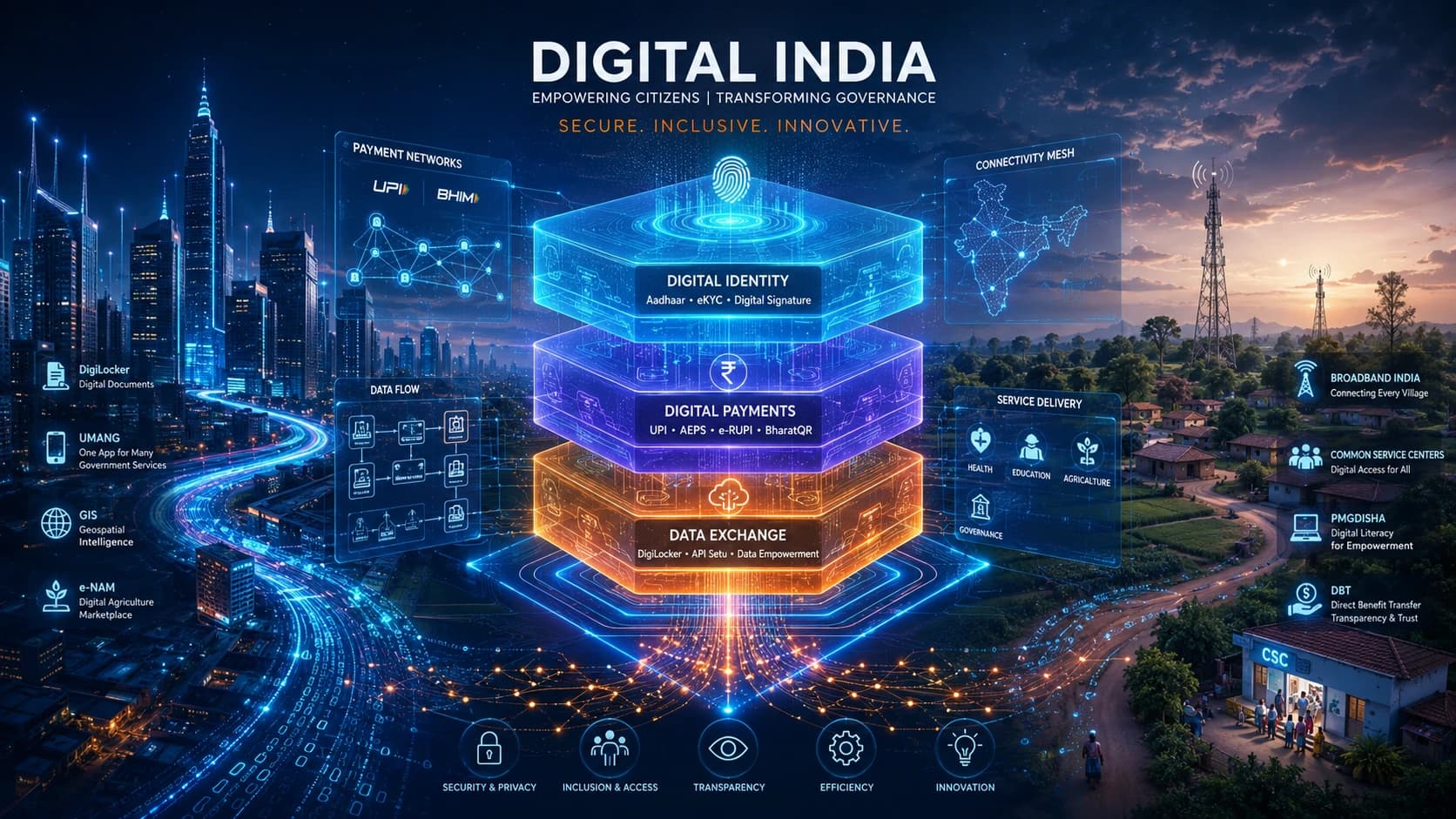
The operational core of India’s digital governance is the "India Stack," a layered, open-source architectural framework originally conceptualized in 2006 and formalized over subsequent years to facilitate population-scale digital interactions.7 The India Stack is meticulously structured across four distinct technological layers, each designed to solve a specific friction point in public and private service delivery:
- The Presence-less Layer: Anchored by the Aadhaar biometric digital identity system managed by the Unique Identification Authority of India (UIDAI). By assigning a unique 12-digit number backed by biometric data (fingerprints and iris scans), this layer allows individuals to authenticate their identity universally without requiring physical presence or traditional paper documentation.14
- The Paperless Layer: Facilitated by platforms such as DigiLocker and eSign, this layer enables the secure storage, issuance, and verification of digital documents and certificates, eliminating the need for physical paperwork in institutional processes.3
- The Cashless Layer: Dominated by the Unified Payments Interface (UPI) and the Aadhaar Enabled Payment System (AePS), this interoperable payment settlement infrastructure allows for instant, real-time, low-cost digital financial transactions between disparate banking entities.3
- The Consent Layer: Operationalized through the Data Empowerment and Protection Architecture (DEPA) and the Account Aggregator (AA) framework. This layer provides the protocols for secure, user-consented sharing of personal and financial data across institutional boundaries, transforming data from a siloed corporate asset into a portable user utility.3
Having achieved near-universal foundational inclusion—with 97% of the population enrolled in Aadhaar, over 530 million Jan Dhan bank accounts operational, and 420 million active UPI accounts by the 2024 fiscal year—the Indian state is currently executing a strategic pivot.13 The focus has shifted from foundational digital identity toward deploying complex, sector-specific digital architectures.13 This evolution includes the Open Network for Digital Commerce (ONDC) designed to dismantle e-commerce monopolies, the Ayushman Bharat Digital Mission (ABDM) for interoperable national health records, and the Open Credit Enablement Network (OCEN) for democratizing flow-based lending.3
Global Indices and the Evaluation Discrepancy
Despite the domestic ubiquity and massive scale of the India Stack, the ecosystem's performance on traditional global governance metrics often presents a contradictory narrative. Standardized global indices frequently under-represent India's digital capacity, leading to academic debates regarding measurement methodologies and the biases inherent in metrics designed primarily for high-income, legacy-infrastructure economies.16
| Global Evaluation Framework | India's Rank / Score | Analytical Context and Methodological Critique |
|---|---|---|
| UN E-Government Development Index (EGDI) 2024 | Rank 97 of 193 (Score: 0.6678) 17 | Measures online services, telecom connectivity, and human capacity. India improved from Rank 105 in 2022, entering the High EGDI (HEGDI) group, but struggles with the human capacity and traditional telecommunications pillars compared to developed nations.17 |
| UN E-Participation Index (EPART) 2024 | Rank 61 of 193 (Score: 0.6575) 17 | Reflects moderate success in utilizing digital tools to engage citizens in policy-making, though structural barriers limit deeper deliberative democracy.17 |
| Global Data Barometer (GDB) 2024 | Rank 105 of 198 (Overall Score: 54) 20 | Assesses data openness and coverage. India ranks high regionally (1st in Southern Asia) but globally struggles with comprehensive data openness (Rank 104) compared to top-tier EU nations.20 |
| Oxford Government AI Readiness Index 2025 | Rank 27 of 195 (Score: 66.55) 23 | Evaluates government, technology sector, and data infrastructure. India leads South and Central Asia, scoring well above the emerging economy average (42.1), reflecting strong national AI strategy and institutional momentum.23 |
To counter the limitations of indices like the EGDI, alternative measurement frameworks such as the CHIPS (Connect, Harness, Innovate, Protect, and Sustain) methodology have been proposed. Under the CHIPS aggregate scale metric, India ranks as the third-largest digitalized economy globally, trailing only the United States and China, capturing the sheer volume and scale of its digital transactions which traditional indices systematically discount.16
Macroeconomic Efficacy, Measurement Discrepancies, and Fiscal Optimization
The Methodological Crisis in Estimating Digital GDP
As the digital governance ecosystem matures, a fierce empirical and academic debate has emerged regarding its actual contribution to India's Gross Domestic Product (GDP). The assessments are characterized by profound methodological disparities, resulting in wildly divergent estimates that complicate macroeconomic policy formulation.13
The core of the discrepancy lies in the varying definitions of the "digital economy" and the pervasive conflation of technological adoption with macroeconomic outcomes.13 Adoption indices meticulously record staggering volumes; for instance, the UPI platform processed over 20 billion transactions in August 2025 alone, and in December 2025, it handled 9.81 billion transactions worth ₹13.61 lakh crore.26 However, treating transaction volume as a proxy for net economic growth represents a fundamental analytical error.13
| Evaluating Entity | Methodology Employed | Estimated Economic Contribution | Key Methodological Limitations and Critiques |
|---|---|---|---|
| NASSCOM / Arthur D. Little | Direct value-add and indirect time/cost savings (Aadhaar, UPI, FASTag) 13 | ~0.9% of India's GDP (FY22) 13 | Relies on highly aggressive assumptions, such as translating all time saved at FASTag tolls directly into incremental national productivity, ignoring broader economic friction.13 |
| RBI Researchers (Gajbhiye et al.) | Input-Output (I-O) Tables utilizing Gross Value Added (GVA) multipliers 13 | 8.49% of GVA (2019) 13 | Plagued by inclusion errors; the model incorporates general telecommunication services and non-digital support manufacturing into the pure digital aggregate.13 |
| MeitY (2018 Assessment) | Sector-Specific Aggregation (IT-BPM, telecom, e-commerce, electronics) 13 | US 0.5 trillion by 2025 13 0.5 trillion by 2025 13 | Fails to distinguish between digital service provision and traditional ICT hardware manufacturing.13 |
| CSEP Empirical Assessment (2025) | Critique of Users-Volume-Value (UVV) indices; State-wise correlation modeling 13 | DPI is not an independent engine of growth; net contribution is highly fractional (<1%) 13 | Emphasizes the substitution effect; traditional methodologies fail to measure net impact and ignore value destroyed in legacy sectors during digital transition.13 |
Empirical analysis by the Centre for Social and Economic Progress (CSEP) demonstrates that a vast majority of DPI transactions merely represent a substitution effect. The exponential growth in UPI has overwhelmingly replaced low-value cash and debit card transactions rather than generating net-new economic activity or expanding the production frontier.13 Consequently, rigorous state-wise econometric comparisons reveal no statistically significant correlation between the adoption of DPI and the growth of Net State Domestic Product (NSDP).13 The national accounts also reveal massive statistical discrepancies—ranging from zero in FY23 to a projected ₹4.9 lakh crore in FY26—between GDP estimated via the production method versus the expenditure method, further obfuscating the true value of the digital economy.25
The Currency in Circulation (CIC) Paradox
The narrative of a digital, cashless revolution is directly challenged by the "Currency in Circulation (CIC) Paradox." Despite the meteoric rise of digital payment volumes, aggregate CIC relative to National Disposable Income has remained steadfastly stable over the decade.13 Absolute rises in cash usage continue, driven by inflation and rising aggregate income levels.13 This dynamic suggests a bifurcated economy: high-frequency, low-value consumption and retail transactions have migrated to digital platforms (UPI), while high-value economic activities, informal market bulk trades, and wealth storage remain deeply entrenched in the cash economy.13 This reality underscores a critical measurement limitation: existing indices fail to account for the duality of the Indian market, overestimating the net macroeconomic dividend of consumer digitalization.13
Fiscal Prudence and Direct Benefit Transfers (DBT)
Where the digital governance ecosystem demonstrates unequivocal, measurable macroeconomic utility is in the optimization of fiscal management through the Direct Benefit Transfer (DBT) framework. By structurally linking the Aadhaar biometric database with individual Jan Dhan bank accounts, the state has engineered a highly efficient, disintermediated conduit for welfare distribution, fundamentally restructuring public expenditure.28
The DBT architecture has expanded aggressively, scaling from a mere 28 schemes in 2013-2014 to over 320 stabilized schemes by the 2024-2025 fiscal year, serving hundreds of millions of unique, digitally verified beneficiaries.29 The integration of Aadhaar has effectively curtailed subsidy leakages, eliminated millions of "ghost" beneficiaries, and bypassed local bureaucratic rent-seeking structures. Cumulative exchequer savings attributed directly to DBT mechanisms reached an estimated ₹3.48 lakh crore by the end of 2024.30
| Sectoral Welfare Program | Cumulative DBT Savings (as of 2024) | Primary Mechanism of Fiscal Efficiency |
|---|---|---|
| Public Distribution System (PDS) / Food Subsidies | ₹1.85 lakh crore (53% of total DBT savings) 30 | Mandatory Aadhaar-linked ration card biometric authentication at the point of sale.30 |
| MGNREGS (Rural Employment Guarantee) | ₹42,534 crore 30 | Timely, direct wage transfers bypassing local panchayat intermediaries; achieving 98% accountability tracking.30 |
| PM-KISAN (Agricultural Income Support) | ₹22,106 crore 30 | Algorithmic deletion of 2.1 crore ineligible, deceased, or duplicate beneficiaries from state registries.30 |
| Fertilizer Subsidies | ₹18,699.8 crore 30 | Targeted, identity-verified disbursement, reducing illicit market diversion by over 158 lakh metric tonnes.30 |
These sweeping efficiencies have resulted in a profound macroeconomic realignment: subsidy allocations as a percentage of total government expenditure have halved, dropping from 16% in the pre-DBT era (2009–2013) to just 9% by 2023-2024.30 While UPI drives transactional efficiency and velocity in the private market, Aadhaar-enabled DBT acts as a structural macroeconomic growth catalyst by freeing up critical fiscal space for sovereign capital expenditure.28 However, as examined in the subsequent section, this fiscal optimization carries severe, often localized human costs, exposing the fragility of the DPI ecosystem when deployed among marginalized, infrastructure-poor populations.
Adoption Dynamics, Digital Divides, and Algorithmic Exclusion
Geographic and Gender Disparities in Digital Inclusion
India’s digital revolution, while unprecedented in aggregate scale, operates upon deeply entrenched socio-economic fault lines, resulting in a pronounced digital divide across geographic, gender, and income parameters.32 Policy interventions have undeniably democratized basic access; telecom reforms have driven data costs down to roughly $0.10 per GB in 2025-2026, propelling broadband subscriptions past the 1 billion mark, a massive leap from 13.15 crore a decade earlier.33 However, raw connectivity does not seamlessly translate into meaningful digital inclusion or economic empowerment.
The gendered digital divide remains a stark reality. While basic mobile telephony has reached near parity—with 75% of women in India owning a mobile phone compared to 85% of men—a mere 35% of women possess a smartphone capable of accessing the advanced DPI ecosystem.34 This critical hardware deficit severely restricts female participation in the modern digital economy, confining their digital footprint to basic communication while locking them out of digital credit, e-commerce, advanced tele-health services, and gig-economy platforms.34
Furthermore, the rural and urban digital ecosystems are diverging rapidly into distinct typologies of usage, representing a qualitative, rather than merely quantitative, divide.35 Urban ecosystems are characterized by high-frequency, low-value discretionary transactions, fueled by ubiquitous merchant QR codes, robust 4G/5G infrastructure, and high digital literacy.13 Conversely, rural digital adoption is driven primarily by necessity rather than convenience. Rural users transact less frequently but handle higher financial volumes, heavily concentrated around agricultural supply chains, government DBT disbursements, and familial remittances.35
Empirical surveys assessing the barriers to digital inclusion in marginalized communities reveal that infrastructural and capacity deficits remain paramount. A comprehensive study indicated that poor infrastructure and internet connectivity restrict 70% of rural populations, while a lack of relevant digital training impacts 65%.36 Cultural and gender constraints actively inhibit 50% of the surveyed demographic from full digital participation.36 Another micro-level empirical survey conducted in Abul Fazal Enclave, New Delhi, underscored these nuances; while UPI adoption was near-universal among the youth, pervasive challenges such as low digital literacy, frequent application transaction failures, and a profound lack of trust continued to alienate the elderly and the unbanked, leaving them reliant on cash and traditional intermediaries.2 Conversely, studies in the Kalahandi District of Odisha challenged traditional narratives, revealing unexpectedly high rates of digital technology adoption among educated rural females, suggesting that targeted initiatives like the Digital India Program (DIP) can bridge gender gaps when supported by baseline education.37
The Tragedy of Algorithmic Exclusion: Biometric Failures in the PDS
Perhaps the most critical, and heavily critiqued, governance trade-off in India’s digital trajectory is the phenomenon of algorithmic exclusion, manifesting most visibly and devastatingly within the Aadhaar-enabled Public Distribution System (PDS).38 The state's relentless drive to optimize fiscal databases, eliminate corruption, and remove "ghost" beneficiaries has inadvertently transformed fundamental, life-sustaining welfare entitlements into conditional rights, heavily mediated by the technological reliability of biometric sensors and telecommunication networks.38
The Aadhaar identification algorithm governing welfare access operates through a strict tripartite system: demographic seeding (matching names and details), biometric authentication (fingerprint or iris scans), and localized PDS point-of-sale (PoS) rules.38 In rural and tribal hinterlands, where a lifetime of manual agricultural labor degrades fingerprints, and telecommunication networks are highly intermittent, the e-KYC infrastructure systematically fails the populations most in need of subsidized food.38
| State / Region | Reported Biometric Failure Rate (Baseline Studies) | Primary Technical and Demographic Causes of Authentication Failure |
|---|---|---|
| Jharkhand | 49% 38 | Chronic poor internet connectivity causing PoS timeouts, worn fingerprints from manual labor, demographic seeding spelling errors.38 |
| Rajasthan | 37% 38 | High rates of biometric mismatch, hardware degradation at dusty rural PoS centers.38 |
| Gujarat | 6% 38 | Relatively better telecommunication infrastructure, though marginal exclusion of the elderly persists.38 |
| Andhra Pradesh | 5% 38 | Stronger state-level digital capacity, robust network reliability, and better PoS maintenance.38 |
The human cost of these technological failures is profound. Independent empirical investigations, including exhaustive studies by the Right to Food Campaign, have directly linked biometric authentication failures to starvation deaths, documenting at least 19 fatalities between 2015 and 2018 directly resulting from Aadhaar-related denial of PDS rations.38 In areas where biometric authentication was rigidly mandated for every transaction, researchers documented exclusion errors soaring as high as 20%.41
The deployment of DPI in these vulnerable contexts acts as an "infrastructure of exclusion" or "adverse inclusion." The burden of proof for survival is shifted entirely onto the citizen, demanding that their physical bodies be flawlessly machine-readable to a fragile, often poorly maintained technological apparatus.40 The lack of a robust, universally respected localized fallback mechanism (such as manual overrides based on community verification) highlights a severe design flaw in the state's techno-solutionist approach, wherein systemic fiscal efficiency is relentlessly prioritized over fundamental human security.41
Sectoral Expansions: Evaluating Healthcare and Commercial DPI
Digital Health and the Ayushman Bharat Digital Mission (ABDM)
While foundational DPIs like UPI and Aadhaar have reached maturation, the Indian state is currently attempting to replicate this success in highly complex, deeply fragmented sectors such as healthcare.3 The Ayushman Bharat Digital Mission (ABDM) represents an ambitious effort to establish a unified digital health ecosystem, centered around the creation of the Ayushman Bharat Health Account (ABHA) IDs, electronic health records (EHR), and the integration of diverse healthcare providers.43
However, empirical evidence suggests that healthcare digitalization is navigating a steep adoption curve. A cross-sectional empirical study conducted between 2024 and 2025 across three tertiary care hospitals in Agra evaluated the real-world adoption of ABHA ID registration services among outpatient department (OPD) attendees.43 Out of 537,278 total OPD visits, only 129,007 completed ABHA ID registrations, representing a below-average monthly adoption rate of 23.96%.43
The barriers to adoption are intimately linked to digital capacity. The study assessed digital health literacy using the 21-item Digital Health Literacy Instrument (DHLI), revealing a moderate overall mean score of 2.94 (out of 5) among attendees.43 Crucially, while users demonstrated adequate operational skills to navigate the applications (scoring 2.38), they exhibited significant weaknesses in evaluating the reliability of health information (2.18) and protecting their digital privacy (2.22).43 Education levels showed the strongest positive correlation with higher DHLI scores, while advanced age showed a negative correlation, underscoring the risk of excluding elderly populations from digital health ecosystems.43 Furthermore, qualitative interviews identified a profound lack of awareness, low digital literacy, and skepticism regarding the utility and security of electronic records as primary barriers to voluntary health ID uptake.44
Despite these adoption hurdles, the administrative efficiency gains for those who successfully navigate the system are undeniable. A detailed time and motion study comparing online ABHA registration with conventional offline OPD registration quantified these benefits.45
| Registration Modality | Average Processing Time | Standard Deviation | Primary Administrative Bottleneck |
|---|---|---|---|
| Conventional Offline OPD Registration | 10.37 minutes 45 | 3.54 minutes 45 | Physical queue waiting time (averaging 9 minutes).45 |
| Online ABHA Registration | 4.15 minutes 45 | 1.28 minutes 45 | Application download and initial token generation.45 |
The data demonstrates a statistically significant 60% reduction in time, primarily driven by virtually eliminating the physical waiting queue (reduced from nine minutes to one minute).45 ARIMA forecasting models predict that as the system matures, online registration times will stabilize around four minutes, offering immense scalability for India's overburdened tertiary healthcare infrastructure.45
Democratizing E-Commerce: The ONDC Framework
Parallel to healthcare, the Open Network for Digital Commerce (ONDC) represents a critical structural intervention in the commercial sector. Historically, India's e-commerce ecosystem has been dominated by a duopoly of platform-centric marketplaces (Amazon and Flipkart).15 These closed ecosystems created systemic market distortions: exacting exorbitant commission rates (up to 25-30%) that decimated MSME profit margins, utilizing algorithmic bias to prioritize prominent in-house brands over smaller sellers, and enforcing strict vendor and consumer lock-in.15
ONDC functions as a market-correcting digital public good. By establishing open protocols, it shifts the paradigm from platform-centric monopolies to a decentralized network.15 Multiple buyer applications and seller applications can interface seamlessly, allowing an MSME registered on one platform to be visible to consumers using entirely different applications.15 This protocol-driven approach aims to foster hyper-local commerce, drive down commission costs through unbundled logistics and service provision, and reclaim data agency for smaller merchants who were previously blinded to consumer insights by proprietary platforms.15
Institutional Capacity, Public Administration, and MSME Credit Expansion
Revolutionizing Public Procurement and Grievance Redressal
To mitigate administrative friction, enhance institutional capacity, and combat systemic corruption, the Indian government has engineered massive digital platforms that centralize procurement and grievance redressal. The Government e-Marketplace (GeM), launched in 2016, represents a complete paradigm shift in public procurement. By transitioning from opaque, localized, paper-based tenders to a unified API-first digital ecosystem, GeM has catalyzed exponential growth in transaction volume.
In the 2024-2025 fiscal year, GeM facilitated procurement transactions worth ₹5.42 lakh crore, reflecting a staggering growth trajectory from ₹4.04 lakh crore in 2023-2024 and ₹1.06 lakh crore in 2021-2022.46 The platform dismantles information asymmetry by providing real-time price comparisons across over 11,000 product categories and 340 service categories.47 By integrating seamlessly with the Public Financial Management System (PFMS), the State Bank Multi Option System, and identity databases like Aadhaar and PAN, GeM ensures cashless, time-bound payments and end-to-end traceability.47 Every transaction creates an immutable, auditable record, drastically reducing the scope for bureaucratic rent-seeking, favoritism, and corruption that historically plagued public procurement.48 Furthermore, GeM has aggressively democratized state procurement access; as of 2025, over 1.77 lakh Udyam-verified women-led micro and small enterprises (MSEs) were registered, fulfilling cumulative orders worth ₹46,615 crore.49
Similarly, the Centralized Public Grievance Redress and Monitoring System (CPGRAMS) has been modernized to enforce bureaucratic accountability. Following a comprehensive 10-step reform process incorporating API-based integration with disparate state and central portals, the system's efficiency has improved dramatically.50 In 2025, the average grievance disposal time for Central Government Ministries was reduced to an unprecedented 15 days, with 82.1% of all grievances resolved within the prescribed 21-day timeline.51 In November 2025 alone, over 1.42 lakh grievances were successfully redressed, marking the 41st consecutive month where disposal exceeded 1 lakh cases.52
The Complexities of Bureaucratic Agency: Digitizing Land Records
However, the assumption that digitizing public administration automatically translates to enhanced state capacity is challenged when applied to historically entrenched systems, such as land registry. Empirical studies examining the digitization of land records provide a highly nuanced view of these limitations, highlighting the tension between technological standardization and bureaucratic agency.
In Punjab, Pakistan, a rigorous empirical evaluation revealed that the staggered rollout of land record digitization actually had a paradoxical negative effect on agricultural tax collection.53 This decline was not attributable to a shrinking tax base. Instead, the rigid digital system disrupted the organizational capacity, informal knowledge networks, and discretionary agency of local bureaucrats tasked with collection, demonstrating that technological imposition without organizational alignment can degrade state capacity.53
Conversely, evidence from India’s state of Andhra Pradesh under the early Computer-Assisted Registration of Deeds (CARD) program demonstrated positive outcomes. Digitizing encumbrance certificates and streamlining property valuation yielded a statistically significant, albeit quantitatively modest, increase in credit access in urban areas by clarifying property rights and reducing expropriation risk.54
Yet, broader national implementations under the contemporary Digital India Land Records Modernization Programme (DILRMP) continue to face severe operational bottlenecks. Existing physical records are often plagued by historical inaccuracies, missing spatial data, and fragmented ownership details.55 Without addressing the underlying legal validity of the data, digitizing land records merely digitizes historical disputes. Furthermore, centralized land portals present massive new attack surfaces; the hacking of the Telangana state land portal, where malicious actors transferred government land titles to private individuals, exposes the severe cybersecurity risks inherent in centralized administrative databases.57
Flow-Based Lending: Bridging the MSME Credit Gap
Perhaps the most transformative intersection of institutional capacity, DPI, and economic growth is the deployment of the Account Aggregator (AA) framework. India's MSME sector has historically operated in the informal economy, suffering from a persistent credit crunch with an estimated financing gap of over $500 billion.58 Traditional banking models, reliant on physical collateral and formal credit histories, excluded the vast majority of these enterprises, with only 11% availing formal credit.58
The AA framework, operating via the Data Empowerment and Protection Architecture (DEPA), fundamentally alters this dynamic. It permits the secure, explicit, consent-based sharing of encrypted financial data between Financial Information Providers (FIPs, such as banks or GST networks) and Financial Information Users (FIUs, such as lending institutions).58 Coupled with the Open Credit Enablement Network (OCEN)—which provides standardized APIs bridging lenders and Loan Service Providers (LSPs)—the ecosystem allows underwriters to utilize high-fidelity, non-traditional cash-flow data (such as GST receipts or digital payment histories) to assess risk, rather than demanding physical collateral.58
By September 2025, the adoption of the AA framework had reached critical mass. Over 112 million individual and corporate users were linked to the system, with more than 2.2 billion accounts technically enabled to share data.60
| Account Aggregator Metrics | Volume / Value (as of late 2024 / mid 2025) | Market Penetration Insight |
|---|---|---|
| AA-Linked Users | ~112 million 60 | Rapid adoption scaling among individuals and micro-enterprises transitioning to formal finance.60 |
| Loan Value via AA (FY 2024-25) | ₹1.6 lakh crore 60 | Represents the mainstreaming of digital credit protocols beyond experimental trial phases.60 |
| Total Loan Accounts (FY 2024-25) | 1.89 crore 60 | Indicates a high volume of low-ticket disbursements tailored to micro-needs.60 |
| MSME Share of AA Loan Value | ~25% 60 | Critical for enabling flow-based lending to sole proprietors without physical assets.60 |
Despite massive success in the unsecured personal and consumer loan segments (which achieved a 9% market penetration rate), the framework currently struggles to disrupt secured lending markets (such as home or auto loans). Secured lending languishes at less than 0.5% penetration via AA, primarily due to the persistent requirement for physical asset verification and legacy paper-based legal workflows.61
Market Concentration and Regulatory Intervention in UPI
While expanding credit, regulators must simultaneously manage systemic risks related to market concentration in the digital payments space. The UPI ecosystem, despite being an open public infrastructure, has witnessed severe monopolization at the application layer by foreign-backed entities. As of December 2025, Walmart-backed PhonePe processed 9.81 billion transactions, capturing a massive 45.35% market share by volume and 48.68% by value.26 Google Pay maintained the second position with a 34.64% volume share, while domestic player Paytm trailed significantly at 7.65%.26
Recognizing the concentration risk this duopoly poses to national financial stability, the National Payments Corporation of India (NPCI) formulated a regulation capping the market share of any single Third-Party Application Provider (TPAP) at 30%.62 However, enforcing this cap without disrupting the 20 billion-transaction-per-month ecosystem has proven exceptionally difficult. In a concession to market realities, the NPCI was forced to extend the compliance deadline for the 30% market share cap by an additional two years, pushing enforcement to December 31, 2026, granting PhonePe and Google Pay a prolonged regulatory reprieve.62
Governance Trade-Offs: Privacy vs. Interoperability
The Architecture of Extraction and the Privacy Deficit
At the philosophical and operational core of India’s digital architecture lies a fundamental tension between seamless data interoperability and the principles of data minimization.7 The DPI ecosystem is engineered for maximum interoperability. The DEPA layer uses standardized APIs to make citizen data highly liquid and portable across governmental and private platforms.7 Proponents laud this as the ultimate mechanism for "consumer empowerment," breaking down data monopolies held by legacy institutions.7
However, critical civil society scholars argue that this relentless pursuit of interoperability has effectively sidelined the foundational privacy principle of data minimization.7 The architecture facilitates what has been termed "extraction biopolitics," wherein the state solidifies its digital sovereignty by perpetually harvesting the bodily, financial, and behavioral data of its citizens.7 By prioritizing seamless data flows over localized, secure data silos, the systemic risk profile of the entire ecosystem is magnified. A security vulnerability in one node can compromise the wider network, a theoretical risk validated by massive, highly publicized data breaches associated with the CoWIN vaccination portal and other centralized Aadhaar-linked databases in late 2023.7 The prevailing architecture assumes that digital consent mechanisms are a sufficient proxy for comprehensive privacy, thereby transferring the immense cognitive burden of data protection onto end-users who frequently lack baseline digital literacy.7
The Digital Personal Data Protection Act (DPDPA) 2023/2025
Following years of jurisprudential evolution—triggered by the landmark 2017 Puttaswamy Supreme Court judgment which enshrined privacy as a fundamental constitutional right—the Indian state enacted the Digital Personal Data Protection Act (DPDPA) in August 2023.65 The operational draft rules were subsequently finalized and notified in November 2025, moving India away from the antiquated Information Technology Rules of 2011 into a modern privacy regime.66
The regulatory framework mandates a phased implementation, balancing civil liberties with the need to prevent paralyzing the digital economy. The ecosystem has been granted a 12-to-18-month runway to achieve technical readiness, with full compliance mandates taking effect by May 2027.66 The DPDPA establishes explicit consent as the absolute bedrock of lawful processing, demanding that it be "free, specific, informed, unconditional, and unambiguous," effectively outlawing bundled consent or pre-ticked boxes.68 It also introduces "Consent Managers"—highly regulated entities requiring a minimum net worth of ₹2 crore, mandatory Indian incorporation, and rigorous independent audits—to act as centralized, interoperable dashboards for citizens to manage their digital footprints across fiduciaries.66
The Act imposes a draconian financial penalty structure designed to compel corporate compliance, reflecting a zero-tolerance approach to systemic data negligence.
| DPDPA Violation Category | Maximum Financial Penalty |
|---|---|
| Failure to maintain reasonable security safeguards | ₹250 Crore 70 |
| Failure to notify the Board or affected individuals of a data breach | ₹200 Crore 70 |
| Violations relating to processing children's personal data | ₹200 Crore 70 |
| Non-compliance with obligations of Significant Data Fiduciaries (SDFs) | ₹150 Crore 70 |
| Failure to fulfil obligations of Data Principals (e.g., ignoring grievance redressal) | ₹10,000 70 |
Despite this punitive framework, empirical data highlights a severe readiness gap in the private sector. A comprehensive survey by EY in late 2025 indicated that over 83% of Indian organizations have not begun comprehensive implementation of the Act's requirements.71 Furthermore, nearly 81% have not drafted DPDPA-aligned privacy policies, and only 48% have initiated preliminary gap assessments.71 Industry groups, such as the International Trademark Association (INTA), have also voiced concerns that the strict privacy rights must be balanced with mechanisms that allow brand owners and law enforcement to access records necessary to combat fraud and counterfeiting.72
Institutional Design: The Flaws of the Data Protection Board (DPB)
The enforcement of the DPDPA is entrusted to the newly established Data Protection Board (DPB) of India. However, the institutional design of the DPB has drawn severe, sustained critique from legal scholars and civil liberties advocates.73 Operating as a compact four-person entity, the DPB's functional independence is highly compromised by the central government's unconstrained statutory authority to appoint its members, dismiss them, and unilaterally dictate the terms of their service.73
Crucially, the legislation mandates that only one member of the DPB possess formal legal expertise.74 This is viewed as a glaring structural deficiency for a quasi-judicial body empowered to adjudicate complex technical disputes and levy ₹250 crore penalties.74 Furthermore, Section 37 of the Act grants the executive branch the extreme power to block public access to the digital platforms of repeat offenders, based purely on references from the DPB.74 Critics argue this introduces a mechanism for state censorship under the politically palatable guise of data protection.74 Coupled with sweeping exemptions that allow the state to process personal data without user consent for broad "lawful purposes" (such as national security, anti-fraud measures, or the provision of state subsidies), the architecture of the DPB skews the balance of power heavily toward the state.8 This dynamic significantly undermines the legislation's capacity to serve as a genuine check against government surveillance, reflecting the tension between individual rights and the state's drive for totalizing digital visibility.8
Cybersecurity Resilience and Geopolitical Sovereignty
The Escalating Cyber Threat Landscape
As the surface area of India's digital governance ecosystem expands, cyber risk has evolved from an episodic, technical IT issue into a systemic, borderless threat to national security and macroeconomic stability.10 Between 2019 and 2023, cyber attacks explicitly targeting Indian government infrastructure surged by an alarming 138%.76 Concurrently, the average financial cost of a corporate data breach in India escalated to over INR 200 crore, factoring in remediation, operational downtime, and severe reputational damage.77
The threat vectors are sector-specific. Financial services remain the most targeted domain due to high transaction volumes and complex third-party API dependencies, prompting the Reserve Bank of India (RBI) to issue repeated warnings regarding outsourcing vulnerabilities and AI-driven fraud.77 Healthcare institutions, burdened by legacy systems and possessing near-zero tolerance for operational downtime, have become prime targets for paralyzing ransomware attacks (such as the high-profile breach at AIIMS).8 Educational networks face high malware exposure, while critical manufacturing infrastructure is increasingly vulnerable due to the convergence of IT and Operational Technology (OT).77
In response to this borderless threat, the state has elevated its institutional response. The Indian Cyber Crime Coordination Centre (I4C), established in 2018, was officially elevated in July 2024 to an Attached Office under the Ministry of Home Affairs.10 This institutional promotion signifies a strategic shift away from fragmented, reactive, localized policing toward a continuous, centralized, and strategic national architecture for cybercrime deterrence.10 While India achieved Tier 1 status in the ITU Global Cybersecurity Index in 2024—lauded for its legal and technical frameworks—empirical evaluations reveal a vast chasm between legislative intent and ground-level enforcement capacity.76 Statistical modeling demonstrates that enforcement capacity deficiencies account for nearly 46.3% of the negative impact on cybercrime deterrence, proving that the state's vulnerabilities are overwhelmingly operational and implementational rather than legislative.78
Platform Dependency and Service Continuity Risks
The systemic vulnerability of platform dependency in an interconnected global economy was starkly illustrated by a recent geopolitical incident involving Microsoft and Nayara Energy. Microsoft abruptly suspended essential enterprise digital services to Nayara—which operates India's second-largest private oil refinery—due to European Union sanctions levied against Nayara's Russian shareholder, Rosneft.79
Despite holding fully paid, legally acquired software licenses, the Indian energy firm was instantaneously locked out of its own operational data, proprietary tools, and internal communication platforms (Outlook, Teams).79 While services were eventually restored following legal challenges in the Delhi High Court, the incident served as a severe, incontrovertible wake-up call regarding service continuity risks.79 It demonstrated that absolute reliance on foreign digital infrastructure and operating systems can instantaneously neutralize critical domestic corporate operations and energy security in the event of geopolitical crossfire or extraterritorial sanctions.79 Consequently, urgent policy discourse has emerged advocating for true digital independence, with proposals suggesting the establishment of a unified Ministry of Digital Ecosystem (MoDE) to consolidate fragmented cybersecurity responses, eliminate institutional silos, and aggressively champion sovereign digital infrastructure.79
Global Export, Cross-Border Data Flows, and the AI Frontier
Exporting DPI: The Global "Middle Path"
Despite domestic controversies regarding privacy and algorithmic exclusion, India has aggressively and successfully weaponized its DPI architecture as an instrument of global techno-diplomacy, framing it as the preeminent technological model for the developing world.8 By championing an open-source, interoperable framework, India offers nations in Africa, Latin America, and Southeast Asia a highly scalable alternative to the exorbitant software licensing fees of Western "Big Tech" monopolies, and the opaque, debt-trap technological infrastructure exported by Beijing.5
This "DPI-as-a-Service" (DaaS) model—which packages technological architecture with policy frameworks and implementation protocols—achieved unprecedented geopolitical validation during India's 2023 G20 Presidency.83 The multilateral consensus formally recognized DPI as a foundational enabler for achieving the UN Sustainable Development Goals (SDGs).83
| DPI Component | Nature of Export and Global Integration | Key Adopting Nations / International Partners |
|---|---|---|
| Unified Payments Interface (UPI) | Cross-border retail payment linkages, establishing international merchant acceptance networks for low-friction remittances.8 | Fully operational in UAE, Singapore, Bhutan, Oman. Pilot phases completed in France, Mauritius, Sri Lanka, Nepal.8 |
| MOSIP (Modular Open Source Identity Platform) | Open-source, foundational digital identity architecture heavily modeled on the Aadhaar experience.8 | Adopted by over 20 countries (e.g., Ethiopia, Guinea, Philippines), currently serving over 121 million global users.8 |
| Bilateral Capacity Building | Formal Memoranda of Understanding (MoUs) to share DPI governance frameworks, API specifications, and technical assistance.8 | Trinidad & Tobago, Kenya, Colombia, Armenia, Tanzania, Papua New Guinea, Suriname, Barbados.8 |
However, exporting the India Stack invariably entails exporting its inherent structural vulnerabilities and governance trade-offs. International observers and policy analysts warn that deploying DPI in nations without robust pre-existing institutional safeguards, sustained financial resources, and strict, enforceable privacy laws can result in the precise issues currently plaguing the Indian domestic market: mass data breaches, loss of citizen agency, and severe algorithmic exclusion.8 Furthermore, the long-term financial viability of these exports remains precarious; scaling DPI implementations to 100 countries by 2030 will necessitate sustainable, blended-finance models involving public-private partnerships, rather than relying indefinitely on state-subsidized goodwill or philanthropic backing.8
Navigating Cross-Border Data Governance
In the realm of global digital trade, India’s cross-border data transfer regime reflects a delicate, highly contested balancing act between asserting sovereign control and maintaining economic integration.87 Diverging sharply from the European Union's GDPR—which utilizes an "adequacy list" (a whitelist) permitting data transfers only to jurisdictions proven to have equivalent privacy standards—India's DPDPA implements a "negative list" or blacklist approach.89 By default, the foreign transfer of Indian personal data is permitted to any nation globally, except those explicitly prohibited and gazetted by the central government.89
While this permissive default stance seemingly favors multinational operations and minimizes immediate compliance friction for the IT sector, it introduces profound, systemic regulatory unpredictability.89 The government retains unfettered, opaque discretion to alter the blacklist without providing formal justifications, impact assessments, or advance notice.90 Compounding this uncertainty, the DPDPA lacks the established alternative transfer mechanisms widely recognized in international digital trade law, such as Standard Contractual Clauses (SCCs) or Binding Corporate Rules (BCRs), leaving global enterprises without stable, predictable legal safe harbors.90
Adding to this regulatory complexity, Rule 12 of the draft rules subtly reintroduces data localization mandates specifically targeting Significant Data Fiduciaries (SDFs)—the large tech platforms processing massive volumes of data.90 The government retains the authority to dictate that SDFs cannot transfer specific categories of sensitive personal and traffic data outside India, effectively forcing multinational companies to construct and maintain costly, localized dual-infrastructure models to operate within the Indian market.90
Technological R&D, AI Readiness, and the Talent Transition
As the digital governance ecosystem matures, artificial intelligence (AI) has emerged as the definitive next frontier of global competition. According to Oxford Insights' Government AI Readiness Index 2025, India ranks 27th globally with a score of 66.55, securing its position as the undisputed technological leader in South and Central Asia.23 With an aggregate score substantially higher than the 42.1 average for emerging and developing economies, India demonstrates robust institutional readiness, driven by clear national AI strategies and policy coherence, to integrate AI into public service delivery.23
However, sustaining this momentum and translating policy readiness into economic reality requires an immense, structural recalibration of India's technology workforce. The technology services sector, which currently contributes nearly 7% to India’s GDP and generates annual revenues of $265 billion, faces an existential inflection point catalyzed by the advent of generative AI.93 To achieve the NITI Aayog's ambitious target of driving sector revenues to $750–$850 billion annually by 2035, the industry must pivot radically. It must move away from traditional "effort-based" billing models—reliant on labor arbitrage and bespoke manual coding—toward "outcome-based" models powered by Agentic AI, SaaS productization, and sovereign AI infrastructure.93
This transition mandates reskilling the workforce at an unprecedented, national scale. Effective AI integration requires workers to develop high-level problem-solving capabilities, complex business judgment, and algorithmic orchestration skills, moving beyond basic programming competencies.93 Compounding this reskilling challenge is a severe, ongoing talent hemorrhage; approximately 18 million highly skilled individuals emigrate from India annually—including a staggering one-third of top graduates from premier Indian Institutes of Technology (IITs)—creating a critical domestic deficit in advanced, high-value disciplines such as LLMOps, cybersecurity architecture, and advanced data engineering.94
Overcoming the R&D Deficit
To secure genuine technological sovereignty and move beyond merely consuming global technology, India must urgently address its persistent deficit in Research and Development (R&D) intensity. While nations like the United States, China, and the Republic of Korea consistently dominate global R&D expenditure—driving foundational innovation in semiconductors, AI architecture, and telecommunications—India’s Business Enterprise R&D (BERD) remains disproportionately and historically low.93
The Indian government has initiated critical strategic interventions to stimulate domestic innovation. These include a ₹2,000 crore budgetary allocation specifically for AI infrastructure development in FY26, the establishment of a ₹500 crore Center of Excellence in AI for education, and aggressive Production Linked Incentive (PLI) schemes that have generated over ₹10,000 crore in IT hardware production as of late 2024.97 However, state capital and subsidies alone are insufficient to close the global innovation gap. Overcoming the R&D deficit requires the private sector to aggressively co-invest in deep tech, shifting capital away from low-margin services toward establishing vertical-specific Centers of Excellence in high-growth areas like healthcare, defense, and cybersecurity.93 Without this massive mobilization of private R&D capital, India risks remaining a sophisticated, high-volume consumer and outsourcer of foreign intellectual property, rather than evolving into the primary architect of the next-generation global digital economy.93
Works cited
- A Decade of Digital Governance Strategic Evolution of ICT Tools in India with special reference to 2014 to 2025 - Atlantis Press, accessed on March 28, 2026, https://www.atlantis-press.com/article/126020141.pdf
- (PDF) Understanding the Digital Governance and India's Digital Transformation Since 2014, accessed on March 28, 2026, https://www.researchgate.net/publication/399646196_Understanding_the_Digital_Governance_and_India's_Digital_Transformation_Since_2014
- State of DPI in India, 2025 - IIM Bangalore, accessed on March 28, 2026, https://www.iimb.ac.in/cdpg/pdf/State-India-DPI_Report.pdf
- IIMB to release 'State of DPI in India 2025' report on 4 December 2025 | IIM Bangalore, accessed on March 28, 2026, https://www.iimb.ac.in/iimb-release-state-dpi-india-2025-report
- Visegrad Four and India: Searching for collaboration agenda amid global geopolitical upheaval - CEIAS, accessed on March 28, 2026, https://ceias.eu/wp-content/uploads/2025/08/CEIAS_India-V4-paper.pdf
- (PDF) Cyberdiplomacy and the New Digital Non-Alignment in the Global South: India as a Case Study of Technological Sovereignty in the Age of AI - ResearchGate, accessed on March 28, 2026, https://www.researchgate.net/publication/395782716_Cyberdiplomacy_and_the_New_Digital_Non-Alignment_in_the_Global_South_India_as_a_Case_Study_of_Technological_Sovereignty_in_the_Age_of_AI
- View of Big Data Discourses| Data in India's Digital Public ..., accessed on March 28, 2026, https://ijoc.org/index.php/ijoc/article/view/23924/5192
- India's Digital Public Infrastructure: a Success Story for the World ..., accessed on March 28, 2026, https://www.institutmontaigne.org/en/expressions/indias-digital-public-infrastructure-success-story-world
- IIM Bangalore and Protean release the inaugural 'State of DPI in India' report, accessed on March 28, 2026, https://www.iimb.ac.in/iimb-protean-release-state-dpi-india-report
- As India Digitises, Cyber Governance Moves From Backroom To Centre - BW Businessworld, accessed on March 28, 2026, https://www.businessworld.in/article/as-india-digitises-cyber-governance-moves-from-backroom-to-centre-592711
- Full article: Hybridizing CSR governance in post-rentier states: comparative insights from Qatar and Singapore - Taylor & Francis, accessed on March 28, 2026, https://www.tandfonline.com/doi/full/10.1080/21665095.2025.2606682
- India's Glorious Success in UPI Adoption: What is Working, What is Not and What Can be Done Better? - IJFMR, accessed on March 28, 2026, https://www.ijfmr.com/papers/2025/3/45688.pdf
- Measuring the Economic Impact of India's Digital Public ... - CSEP, accessed on March 28, 2026, https://csep.org/wp-content/uploads/2025/05/Measuring-the-Economic-Impact-of-Indias-Digital-Public-Infrastructure-An-Assessment-1.pdf
- Is the digital stack of India a model for Africa? | NTU-SBF Centre for African Studies (CAS) | NTU Singapore, accessed on March 28, 2026, https://www.ntu.edu.sg/cas/news-events/news/detail/is-the-digital-stack-of-india-a-model-for-africa
- All Developments in ONDC in 2024 - Protean eGov Technologies, accessed on March 28, 2026, https://www.proteantech.in/articles/important-ondc-2024-developments/
- The State of India's Digital Economy (SIDE) 2025 Report - Prosus, accessed on March 28, 2026, https://www.prosus.com/~/media/Files/P/Prosus-CORP/documents/the-state-of-indias-digital-economy-side-2025-report.pdf
- India - EGOVKB | United Nations > Data > Country Information, accessed on March 28, 2026, https://publicadministration.un.org/egovkb/en-us/Data/Country-Information/id/77-India
- UN E-Government Survey 2024 - Public Institutions, accessed on March 28, 2026, https://publicadministration.un.org/egovkb/en-us/Reports/UN-E-Government-Survey-2024
- E-Government Development Index (EGDI) - Public Institutions - the United Nations, accessed on March 28, 2026, https://publicadministration.un.org/egovkb/en-us/About/Overview/-E-Government-Development-Index
- India Open Data Inventory Profile, accessed on March 28, 2026, https://odin.opendatawatch.com/country-profiles/IND?year=2024
- 2025 open data maturity assessment – how did European countries do?, accessed on March 28, 2026, https://data.europa.eu/en/open-data-maturity/2025
- Global rankings - Open Data Barometer -, accessed on March 28, 2026, https://opendatabarometer.org/2ndEdition/analysis/rankings.html
- AI@Work: Driving Productivity, Jobs, and Innovation - PIB, accessed on March 28, 2026, https://www.pib.gov.in/PressNoteDetails.aspx?id=157310&NoteId=157310&ModuleId=3®=44&lang=1
- Government AI Readiness Index 2024 - Oxford Insights, accessed on March 28, 2026, https://oxfordinsights.com/wp-content/uploads/2024/12/2024-Government-AI-Readiness-Index-2.pdf
- The discrepancies in India's new GDP data - CivilsDaily, accessed on March 28, 2026, https://www.civilsdaily.com/news/the-discrepancies-in-indias-new-gdp-data/
- PhonePe and Google Pay Lead UPI Ecosystem in December 2025 - Angel One, accessed on March 28, 2026, https://www.angelone.in/news/economy/phonepe-and-google-pay-lead-upi-ecosystem-in-december-2025
- UPI transactions cross 20 billion in August; PhonePe, Google Pay lead market | DD News, accessed on March 28, 2026, https://ddnews.gov.in/en/upi-transactions-cross-20-billion-in-august-phonepe-google-pay-lead-market/
- India's digital public infrastructure: Analyzing UPI and Aadhaar in GDP growth and cost optimization, accessed on March 28, 2026, https://emerginginvestigators.org/articles/25-046/pdf
- Direct Benefit Transfer in India: Progress, Challenges, and the Path Forward - ResearchGate, accessed on March 28, 2026, https://www.researchgate.net/publication/391698722_Direct_Benefit_Transfer_in_India_Progress_Challenges_and_the_Path_Forward
- Direct Benefit Transfer 2.0: Transforming Welfare Delivery In India, accessed on March 28, 2026, https://www.impriindia.com/insights/dbt-2-0-transforming-welfare-delivery/
- India's DBT: Boosting Welfare Efficiency, accessed on March 28, 2026, https://static.pib.gov.in/WriteReadData/specificdocs/documents/2025/apr/doc2025421543101.pdf
- Digital Divide, Aspects, Causes, Impact, Reforms and Initiatives, accessed on March 28, 2026, https://vajiramandravi.com/current-affairs/digital-divide/
- Bridging Digital Divide, accessed on March 28, 2026, https://www.pib.gov.in/PressReleasePage.aspx?PRID=2236529
- Digital Technology as an Instrument to Bridge the Gender Gaps in Access to Labour Markets pdf (2.2 MB), accessed on March 28, 2026, https://www.undp.org/sites/g/files/zskgke326/files/2025-02/undp-icrier_policy_brief_31.pdf
- THE GREAT DIGITAL DIVIDE: AN ANALYSIS OF THE WIDENING GAP AND DIVERGENT TRENDS IN INDIA'S URBAN AND RURAL PAYMENT ECOSYSTEMS, accessed on March 28, 2026, https://www.abacademies.org/articles/the-great-digital-divide-an-analysis-of-the-widening-gap-and-divergent-trends-in-indias-urban-and-rural-payment-ecosyste.pdf
- View of The Uneven Web: Digital Literacy, Access, and Exclusion in Marginalized India, accessed on March 28, 2026, https://ignited.in/index.php/jasrae/article/view/16104/31471
- (PDF) The digital revolution in India: bridging the gap in rural technology adoption, accessed on March 28, 2026, https://www.researchgate.net/publication/380573562_The_digital_revolution_in_India_bridging_the_gap_in_rural_technology_adoption
- Aadhar and Algorithmic Exclusion from Welfare: Case Study from Jharkhand, accessed on March 28, 2026, https://nickledanddimed.com/2025/12/31/aadhar-and-algorithmic-exclusion-from-welfare-case-study-from-jharkhand/
- The Aadhaar Paradox – Domestic Failures and Global Success | TechPolicy.Press, accessed on March 28, 2026, https://www.techpolicy.press/the-aadhaar-paradox-domestic-failures-and-global-success/
- Infrastructures of exclusion: How e-KYC impacts access to food - IDR, accessed on March 28, 2026, https://idronline.org/article/rights/infrastructures-of-exclusion-how-e-kyc-impacts-access-to-food/
- Aadhaar that doesn't exclude - Ideas for India, accessed on March 28, 2026, https://www.ideasforindia.in/topics/poverty-inequality/aadhaar-that-doesn-t-exclude
- Digital-ID: exclusions and adverse inclusion - Institute of ..., accessed on March 28, 2026, https://www.ids.ac.uk/events/digital-id-exclusions-and-adverse-inclusion/
- (PDF) Adoption, digital health literacy, and patient satisfaction of Ayushman Bharat Digital Mission: an analytical cross-sectional study among outpatient department attendees - ResearchGate, accessed on March 28, 2026, https://www.researchgate.net/publication/401610768_Adoption_digital_health_literacy_and_patient_satisfaction_of_Ayushman_Bharat_Digital_Mission_an_analytical_cross-sectional_study_among_outpatient_department_attendees
- Perception towards electronic health records & uptake of digital health IDs among the urban residents in northern India: A mixed methods study - PMC, accessed on March 28, 2026, https://pmc.ncbi.nlm.nih.gov/articles/PMC11463868/
- Digital Transformation of Healthcare Access: A Comparative Time Series Analysis of Online Versus Conventional OPD Registrations at a Tertiary Care Hospital - PMC, accessed on March 28, 2026, https://pmc.ncbi.nlm.nih.gov/articles/PMC12063933/
- Government e-Market Place facilitates orders worth Rs 5.42 lakh crore in 2024-25, accessed on March 28, 2026, https://m.economictimes.com/news/india/government-e-market-place-facilitates-orders-worth-rs-5-42-lakh-crore-in-2024-25/articleshow/120340081.cms
- GeM: Transforming Public Procurement in India Through Digital Transformation By - NeGD, accessed on March 28, 2026, https://negd.gov.in/wp-content/uploads/2026/01/GeM-Case-study-Solution-Draft-ver4-2.pdf
- REVOLUTIONIZING PUBLIC PROCUREMENT IN INDIA: THE IMPACT OF THE GOVERNMENT E-MARKETPLACE (GeM) - INSPIRA, accessed on March 28, 2026, https://www.inspirajournals.com/uploads/Issues/1699939265.pdf
- The Strategic Impact of GeM on India's Economy - PIB, accessed on March 28, 2026, https://www.pib.gov.in/PressReleasePage.aspx?PRID=2107510
- CPGRAMS Annual Report 2024 (20.01 MB) - darpg, accessed on March 28, 2026, https://darpg.gov.in/sites/default/files/CPGRAMS_Annual_Report_2024.pdf
- parliament question: digital grievance redressal through central platforms - PIB, accessed on March 28, 2026, https://www.pib.gov.in/PressReleasePage.aspx?PRID=2241740®=6&lang=1
- The Department of Administrative Reforms and Public Grievances (DARPG) released the 43rd Monthly Report on Centralized Public Grievance Redress and Monitoring System (CPGRAMS) for Central Ministries - PIB, accessed on March 28, 2026, https://www.pib.gov.in/PressReleasePage.aspx?PRID=2203902®=3&lang=1
- Spillovers in State Capacity Building: Evidence from the Digitization of Land Records in Pakistan - Yale Department of Economics, accessed on March 28, 2026, https://economics.yale.edu/sites/default/files/2024-11/ARM_statecapacity_Jun24.pdf
- Going Digital: Credit Effects of Land Registry Computerization in India - World Bank Document, accessed on March 28, 2026, https://documents1.worldbank.org/curated/en/222621468275076021/pdf/748120REVISED00inal0With0Disclaimer.pdf
- Transformation of Land Records: The 21st Century Digital Era - Semantic Scholar, accessed on March 28, 2026, https://pdfs.semanticscholar.org/de3b/8b4846929471fd78675d55657f78547143a0.pdf
- impact of digitalisation of land records on the concept of ownership - a critical analysis authored by - n.k. sharithira & dr. p. brinda, accessed on March 28, 2026, https://www.ijlra.com/details/impact-of-digitalisation-of-land-records-on-the-concept-of-ownership-a-critical-analysis-authored-by-n-k-sharithira-dr-p-brinda
- LAND: GOVERNANCE, DIGITIZATION AND HUMAN RIGHTS – A COMPARATIVE STUDY, accessed on March 28, 2026, https://apcz.umk.pl/CLR/article/download/49860/40473/165558
- How OCEN can revolutionise in India's MSME lending ecosystem - DBS Bank, accessed on March 28, 2026, https://www.dbs.com/india/newsroom_media/how-ocen-can-revolutionise-in-indias-msme-lending-ecosystem.page
- Role of AA in OCEN, accessed on March 28, 2026, https://ocen.dev/blog/role-of-ocen-in-aa/
- The Transformative Impact of the Account Aggregator Framework on Financial Inclusion in India: A Multi-sectoral Study of MSMEs, Microfinance, and Personal Lending | Advances in Consumer Research, accessed on March 28, 2026, https://acr-journal.com/article/the-transformative-impact-of-the-account-aggregator-framework-on-financial-inclusion-in-india-a-multi-sectoral-study-of-msmes-microfinance-and-personal-lending-1852/
- Credit Reimagined - Account Aggregator Report H2 FY25 (Abridged) - Sahamati, accessed on March 28, 2026, https://sahamati.org.in/wp-content/uploads/2025/10/Credit-Reimagined-H2-FY25-Abridged-1.pdf
- India delays UPI market share cap deadline by 2 years - CoinGeek, accessed on March 28, 2026, https://coingeek.com/india-delays-upi-market-share-cap-deadline-by-2-years/
- NPCI To Delay Market Share Caps On UPI, Benefiting Google Pay And PhonePe | Medial, accessed on March 28, 2026, http://medial.app/news/npci-to-delay-market-share-caps-on-upi-benefiting-google-pay-and-phonepe-4b2ba2cfd1610
- View of Building Accountability in e-government Services: Inputs for Policy - Australasian Journal of Information Systems, accessed on March 28, 2026, https://ajis.aaisnet.org/index.php/ajis/article/view/5175/1505
- Data protection laws in India, accessed on March 28, 2026, https://www.dlapiperdataprotection.com/?t=law&c=IN
- With rules finalized, India's DPDPA takes force | IAPP, accessed on March 28, 2026, https://iapp.org/news/a/with-rules-finalized-india-s-dpdpa-takes-force
- India's Digital Personal Data Protection Act 2023 brought into force - Hogan Lovells, accessed on March 28, 2026, https://www.hoganlovells.com/en/publications/indias-digital-personal-data-protection-act-2023-brought-into-force-
- Consent Management Under India's DPDP Act: Best Practices for Compliance - DPO India, accessed on March 28, 2026, https://www.dpo-india.com/Blogs/consent-management-india-dpdp-act/
- The Digital Personal Data Protection Act, 2023: Comprehensive Framework, Latest Developments, and Compliance Roadmap - Legal 500, accessed on March 28, 2026, https://www.legal500.com/developments/thought-leadership/the-digital-personal-data-protection-act-2023-comprehensive-framework-latest-developments-and-compliance-roadmap/
- Digital Personal Data Protection (DPDP) Rules, 2025 - A Deep Dive - Treelife, accessed on March 28, 2026, https://treelife.in/compliance/digital-personal-data-protection-dpdp-rules-2025/
- India's data privacy shift: Steering the DPDP compliance and readiness - EY, accessed on March 28, 2026, https://www.ey.com/en_in/insights/cybersecurity/india-s-data-privacy-shift-steering-the-dpdp-compliance-and-readiness
- Comments to the Government of India on the Digital Personal Data Protection Rules - International Trademark Association, accessed on March 28, 2026, https://www.inta.org/wp-content/uploads/public-files/advocacy/testimony-submissions/20250220_INTA-Submission-DPDP-Rules-India_FINAL.pdf
- India's Personal Data Protection Act and the Politics of Digital Governance - Atlantic Council, accessed on March 28, 2026, https://www.atlanticcouncil.org/wp-content/uploads/2023/05/Indias_Data_Protection_Act.pdf
- Understanding India's New Data Protection Law, accessed on March 28, 2026, https://carnegieendowment.org/research/2023/10/understanding-indias-new-data-protection-law
- Why cyber resilience will define India's digital economy in 2026 - ET CISO, accessed on March 28, 2026, https://ciso.economictimes.indiatimes.com/news/brand-solution/cyber-resilience-the-backbone-of-indias-digital-economy-by-2026/128112041
- Mapping India's Cybersecurity Administration in 2025, accessed on March 28, 2026, https://carnegieendowment.org/research/2025/09/mapping-indias-cybersecurity-administration-in-2025
- The State of digital and cybersecurity risks in India: Breaches, threat trends, and sectoral impact | Daily Pioneer, accessed on March 28, 2026, https://dailypioneer.com/news/the-state-of-digital-and-cybersecurity-risks-in-india-breaches-threat-trends-and-sectoral-impact
- Assessing Legal and Policy Gaps in India's Cybersecurity Governance of Digital Commerce - INSPIRA, accessed on March 28, 2026, https://inspirajournals.com/uploads/Issues/389333599.pdf
- Welcome to the New World of Risk: Wake-up Call for Digital India Inc? - SECURITY TODAY, accessed on March 28, 2026, https://www.securitytoday.in/welcome-to-the-new-world-of-risk-wake-up-call-for-digital-india/
- Governance Framework of Digital India: Fit for the Era of Convergence? - CSEP, accessed on March 28, 2026, https://csep.org/blog/governance-of-digital-india-fit-for-the-era-of-convergence/
- CYBERDIPLOMACY AND THE NEW DIGITAL NON-ALIGNMENT IN THE GLOBAL SOUTH: INDIA AS A CASE STUDY OF TECHNOLOGICAL SOVEREIGNTY IN T - IJCD, accessed on March 28, 2026, https://ijcd.ici.ro/documents/63/Art._Daria-Elena_Popescu.pdf
- Innovative Public Infrastructure for the Common Good - FP Analytics - Foreign Policy, accessed on March 28, 2026, https://fpanalytics.foreignpolicy.com/2025/02/05/digital-public-infrastructure/
- The Future of Digital Public Infrastructure: A Thesis for Rapid Global Adoption, accessed on March 28, 2026, https://carnegieendowment.org/research/2024/02/the-future-of-digital-public-infrastructure-a-thesis-for-rapid-global-adoption
- Decoding the G20 Consensus on Digital Public Infrastructure: A Key Outcome of India's Presidency | Carnegie Endowment for International Peace, accessed on March 28, 2026, https://carnegieendowment.org/research/2023/09/decoding-the-g20-consensus-on-digital-public-infrastructure-a-key-outcome-of-indias-presidency
- Stacking up the Benefits: Lessons from India's Digital Journey - IMF, accessed on March 28, 2026, https://www.imf.org/-/media/files/publications/wp/2023/english/wpiea2023078-print-pdf.pdf
- Navigating trade-offs in Digital Public Infrastructure regulation - UNCDF Policy Accelerator, accessed on March 28, 2026, https://policyaccelerator.uncdf.org/whats-new/navigating-tradeoffs-dpi-regulation
- Cross-Border Data Transfer Regimes: Current Landscape and Outlook Ahead, accessed on March 28, 2026, https://www.cigionline.org/documents/3743/Paper_No.350_Kalash.pdf
- Cross-Border Data Transfers: Reconciling Indian Law with Global Privacy Regimes, accessed on March 28, 2026, https://www.dpo-india.com/Blogs/cross-border-data-transfers/
- DPDPA's Global Reach: Cross-Border Data, AI Impact, and International Alignment, accessed on March 28, 2026, https://trustarc.com/resource/dpdpas-global-reach-cross-border-data-ai/
- India's Cross-Border Data Transfer Regulation | Knowledge Base Articles | Jun 9, 2025 | ITIF, accessed on March 28, 2026, https://itif.org/publications/2025/06/09/india-cross-border-data-transfer-regulation/
- DPDP Rules 2025- Analysis of Industry implications and Compliance Guidance, accessed on March 28, 2026, https://www.dpdpa.com/blogs/DPDP%20Rules%202025-%20Analysis%20of%20Industry%20implications.html
- Oxford's Government AI Readiness Index 2025 released - CADE, accessed on March 28, 2026, https://cadeproject.org/updates/oxfords-government-ai-readiness-index-2025-released/
- India's Technology Services – Reimagination Ahead - NITI Aayog, accessed on March 28, 2026, https://niti.gov.in/sites/default/files/2026-02/Technology-Services-Reimagination-Ahead.pdf
- The future of jobs in India: drive to boost tech talent - The World Economic Forum, accessed on March 28, 2026, https://www.weforum.org/stories/2025/04/the-future-of-jobs-in-india-employers-seek-to-boost-tech-talent-to-drive-ai-and-digital-technology-growth/
- Global Innovation Index 2025 - GII 2025 results - WIPO, accessed on March 28, 2026, https://www.wipo.int/web-publications/global-innovation-index-2025/en/gii-2025-results.html
- Global R&D and International Comparisons - NCSES - NSF, accessed on March 28, 2026, https://ncses.nsf.gov/pubs/nsb20257/global-r-d-and-international-comparisons-2
- Indian Information Technology Sector and Its Growth - IBEF, accessed on March 28, 2026, https://www.ibef.org/industry/information-technology-india