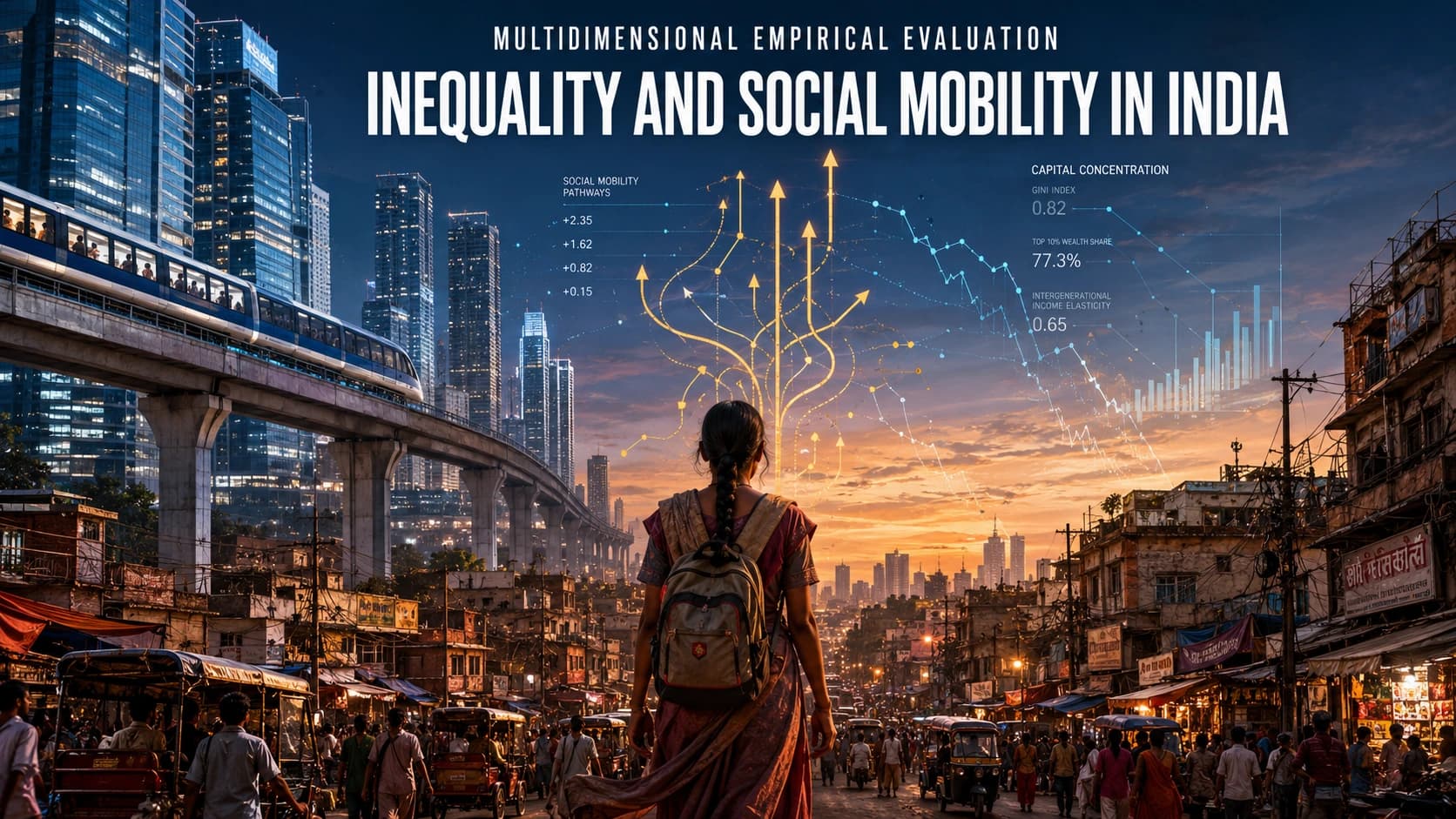
Multidimensional Empirical Evaluation of Inequality and Social Mobility in India
An empirical evaluation of economic inequality, intergenerational social mobility, spatial divergence, and welfare policies in contemporary India.
Show case file details
Method
Empirical Evaluation
Length
18 minutes.Source Material
- Source 1: INCOME AND WEALTH INEQUALITY IN INDIA, 1922-2023: - World Inequality Lab
- Source 2: WIL-Activity-Report-2024.pdf - World Inequality Database
- Source 3: Inequality in 2024: a closer look at six regions - WID
- Source 4: India - WID - World Inequality Database
- Source 5: Growth, inequality and innovation: A CGE analysis of India
- Source 6: Wealth inequality, intergenerational transfers, and family background - Oxford Academic
- Source 7: Intergenerational Wealth
- Source 8: Inheritance Law Reform and Women's Access to Capital - World Bank Open Knowledge Repository
- Source 9: How to Tax Wealth in: IMF How To Notes Volume 2024 Issue 001 (2024) - IMF eLibrary
- Source 10: Long-Term Trends in the Distribution of Wealth and Inheritance - ifo Institut
- Source 11: Taxation of Wealth and Wealth Transfers* | Miles Corak
- Source 12: (PDF) Inequality and intergenerational mobility in India - ResearchGate
- Source 13: NBER WORKING PAPER SERIES UPWARD MOBILITY IN ...
- Source 14: Intergenerational Income Mobility around the World - Documents & Reports
- Source 15: Generational Aspects of Inclusive Growth in - IMF eLibrary
- Source 16: Does A Good Father Now Have To Be Rich ... - ISI Delhi
- Source 17: Intergenerational Educational Mobility in South Asia - Documents & Reports - World Bank
- Source 18: Intergenerational Mobility in the Land of Inequality - IZA Institute of Labor Economics
- Source 19: ESSAYS IN INTERGENERATIONAL MOBILITY AND PUBLIC ECONOMICS - Instituto Escolhas
- Source 20: The geography of intergenerational mobility in South Africa - unu-wider
- Source 21: Intergenerational Mobility in India: New Measures ... - Charlie Rafkin
- Source 22: Intergenerational Mobility in India: New Measures and Estimates across Time and Social Groups - American Economic Association
- Source 23: Inequality of opportunity in India - IDEAS/RePEc
- Source 24: Inequality of Opportunity in Indian Society
- Source 25: Social Identity, Gender and Unequal Opportunity of Earning in Urban India: 2017–2018 to 2019–2020 - PMC
- Source 26: Becoming a High-Income Economy in a Generation - The World Bank
- Source 27: Economic inequality and crime across cities in India: Evidence using ...
- Source 28: (PDF) Economic inequality and crime across cities in India: Evidence using nighttime lights data - ResearchGate
- Source 29: ASER 2024: Key Insights and Implications for Indian Education
- Source 30: Tracking Regional Disparities in Learning Outcomes - Observer Research Foundation
- Source 31: ASER 2024: More than a post-pandemic recovery in learning - Ideas for India
- Source 32: Annual Status of Education Report (Rural) 2023
- Source 33: India's Services Sector: Insights from Employment ... - NITI Aayog
- Source 34: Making Youth Employable: Analysis of Skill Development ... - ISEC
- Source 35: Essays on informality and social protection in developing countries - Usiena air
- Source 36: Job creation and job destruction in the presence of informal markets - ResearchGate
- Source 37: MIGRATION, INSTITUTIONS AND DEVELOPMENT - Economic ...
- Source 38: Community Networks and the Process of Development - IDEAS/RePEc
- Source 39: Inequality's Economic and Social Roots: the Role of Social Networks and Homophily - arXiv
- Source 40: (PDF) Caste disparities in institutional credit access and their implications for sustainable development in rural India - ResearchGate
- Source 41: Equilibrium Effects of Financial Affirmative Action: Evidence from India
- Source 42: World Bank Document
- Source 43: Credit Constraint, Mothers' Work and Gender Disparity in Intrahousehold Time Allocation
- Source 44: Family Background and Intergenerational Persistence in Education: Evidence from Sibling Correlations in India - Munich Personal RePEc Archive
- Source 45: Economic Inequality and Social Trust: Evidence from Changes Observed in 19 Countries between 1990 and 2020 - Revista Española de Investigaciones Sociológicas
- Source 46: Trust in public institutions, inequality, and digital interaction: Empirical evidence from European Union countries - IDEAS/RePEc
- Source 47: Attitudes to Income Inequality: Experimental and Survey Evidence
- Source 48: India Country Report 2026 - BTI Transformation Index
- Source 49: REPORT 2023/2024 | Human Development Reports - United Nations Development Programme
- Source 50: Income Inequality, Life Satisfaction Inequality and Trust: A Cross Country Panel Analysis
- Source 51: Income Inequality, Life Satisfaction Inequality and Trust: A Cross Country Panel Analysis
- Source 52: Why are some countries rich and others poor? development and validation of the attributions for Cross-Country Inequality Scale (ACIS) - PMC
- Source 53: Perceived Inequality and Trust in Elections: The Role of Subjective Class Consciousness
- Source 54: SOCIETY POLITICS BETWEEN ELECTIONS - Lokniti
- Source 55: Caste, Politics, and Development (Chapter 3) - Democracy and Inequality in India
- Source 56: General Elections 2024: An Analytical Study of Electoral Dynamics, Identity Politics, and Democratic Implications in India - ResearchGate
- Source 57: Democracy and Inequality in India: Political Economy of a Troubled Giant - DOKUMEN.PUB
- Source 58: Three Essays in Political Economy - Clemson OPEN
- Source 59: Misinformation, Narratives, and Intergroup Attitudes: Evidence from India | The Journal of Politics: Vol 87, No 2
- Source 60: Beyond echo chambers: How network homophily and algorithmic recommendations shape political polarization among young Indian voters - ResearchGate
- Source 61: The Effect of Narrative in Indian Politics: Analytical Study On Strategic Communication And Its Impact On Voter Behavior - IJFMR
- Source 62: The Nexus between Crime Rates, Poverty, and Income Inequality: A Case Study of Indonesia - MDPI
- Source 63: Impact of Income Inequality on Crime Rates in Urban Areas | European Journal of Sociology
- Source 64: Effect of police expenditure on crime rate in India | Safer Communities - Emerald Publishing
- Source 65: Full article: The effect of the Mahatma Gandhi National Rural Employment Guarantee Act on the size of outstanding debts in rural India - Taylor & Francis
- Source 66: An evaluation of India's National Rural Employment Guarantee Act - World Bank
- Source 67: An Empirical Study on the Effectiveness of PMJDY in Achieving Financial Inclusion for Women in the Informal Economy of Bengaluru - Jetir.Org
- Source 68: Financial Inclusion in India: Inching Closer to the Last Mile - EAC-PM
- Source 69: The role of ICDS services on early childhood development: A cross-sectional study in Hyderabad, Telangana - PMC
- Source 70: Evaluating the Role of PMKVY in Skill Development and Employment Generation in India - ResearchGate
- Source 71: An Introduction to MGNREGA Innovations and their Potential for India-Africa Linkages on Public Employment Programming1 - GIZ
- Source 72: The Continuing Relevance of MGNREGA - The India Forum
- Source 73: Report as on March 25 - NITI Aayog
- Source 74: Socio-Economic Aspects and Effectiveness of Skill Development Training Programmes in India: A Case Study of Bihar - RSIS International
- Source 75: Pradhan Mantri Jan-Dhan Yojana (PMJDY): A Step Towards Financial Inclusion in India - Research Journal of Humanities and Social Sciences
- Source 76: The impact of pradhan mantri jandhan yojana on financial inclusion and socio-economic development in India - ResearchGate
- Source 77: Efficiency of Indian banks in fostering financial inclusion: an emerging economy perspective
- Source 78: Evaluation Report on Integrated Child Development Services
- Source 79: Evaluation of ICDS Scheme of India - NITI Aayog
- Source 80: Utilization of Integrated Child Development Services in India: Programmatic Insights from National Family Health Survey, 2016 - PMC
Introduction
The macroeconomic trajectory of India over the past three decades presents a profound developmental paradox. Unprecedented rates of aggregate economic growth, catalyzed by the structural liberalizations of the early 1990s, have run parallel to an acute and systemic escalation in socioeconomic inequality. While globalization and domestic market reforms have undeniably expanded the absolute size of the Indian economy and lifted millions out of multidimensional poverty, the distributional dynamics of this aggregate growth have been exceptionally skewed. The transition from a predominantly agrarian economy to a services-led growth model has largely bypassed the traditional structural transformation pathways characterized by mass absorption into formal manufacturing. Instead, this trajectory has left a vast majority of the workforce entrenched in low-productivity, informal sectors, while the dividends of growth have been disproportionately captured by the uppermost deciles of the income and wealth distributions.
A rigorous, expert-level understanding of this phenomenon requires moving beyond static, point-in-time measures of income inequality, such as the Gini coefficient, to explore the deeply multidimensional nature of economic stratification. This encompasses the empirical study of intergenerational mobility, equality of opportunity, and the structural constraints that govern long-term economic participation. In the Indian context, inequality is not merely an outcome of frictionless market forces; rather, it is deeply mediated by historical hierarchies of caste, religion, geographic origin, and gender. These socio-demographic variables act as powerful structural determinants of an individual's life chances, heavily influencing their capacity for human capital acquisition, their access to formal credit markets, and their integration into high-wage labor networks.
This report provides an exhaustive empirical evaluation of inequality and social mobility in India. It synthesizes recent econometric evidence, interval-censored administrative data, and longitudinal household surveys to deconstruct the mechanisms driving the current era of wealth concentration. The analysis examines the persistence of socioeconomic status across generations, the spatial divergence of regional economies, the systemic barriers embedded within informal labor markets, and the socio-political externalities of inequality, including the erosion of institutional trust and the escalation of political polarization. Furthermore, the report evaluates the efficacy of contemporary compensatory policy interventions aimed at bridging these expanding divides, ultimately providing a comprehensive diagnostic of India's structural economic rigidities.
Distributional Dynamics: The Trajectory of Income and Wealth Concentration
The empirical assessment of inequality in India has historically been hampered by the poor quality and opaque nature of official economic data, a challenge that has persisted and even intensified in recent years.1 However, recent methodological advancements by the World Inequality Lab (WIL) have combined national income accounts, wealth aggregates, tax tabulations, rich lists, and household surveys on consumption and income into a consistent, long-run framework. These analyses have illuminated the stark reality of India's distributional dynamics, charting a U-shaped trajectory of inequality over the past century.1
The data indicates that economic inequality in India declined steadily in the post-independence period until the early 1980s.1 This period was characterized by state-led development, heavy market regulation, and socialist-leaning economic policies that, while arguably suppressing aggregate growth rates, succeeded in compressing the income distribution. However, following the initial waves of economic liberalization and accelerating rapidly into the 2000s, inequality began a relentless ascent.1 By the 2022–2023 period, the concentration of wealth and income at the top of the distribution reached its highest historical levels, entirely reversing the egalitarian gains of the mid-20th century.1
The contemporary economic landscape, frequently characterized in current econometric literature as the "Billionaire Raj," is now demonstrably more unequal than the British colonial Raj.3 The uppermost echelon of the Indian population currently commands an exorbitant share of national resources, making India's top 1% income share among the very highest in the world.1
| Economic Metric (2022-2023) | Top 1% Share | Top 10% Share | Bottom 50% Share |
|---|---|---|---|
| National Income | 22.6% | ~57.0% | ~13.0% |
| National Wealth | 40.1% | ~65.0% | ~6.0% |
Table 1: Distribution of National Income and Wealth in India (2022-2023). Data synthesized from the World Inequality Database (WID) and World Inequality Lab reports.1
Structural Drivers of Wealth Concentration
The extreme concentration of wealth and income is driven by a confluence of structural, technological, and policy-related factors that disproportionately reward capital owners and highly skilled professionals over unskilled labor.
First, the acceleration of wage inequality has been largely attributed to capital-biased technological change and an increasing skill premium.5 Econometric analyses utilizing Computable General Equilibrium (CGE) models demonstrate that wage inequality in urban India began increasing even before the 1991 reforms, driven primarily by increases in the returns to specialized skills.5 The demand shift toward skilled labor, necessitated by technological changes within formal manufacturing and modern services, has heavily favored a small, educated elite.5 While macroeconomic simulations indicate that Hicks-neutral technological progress can act as an inequality-mitigating factor if applied broadly, the current concentration of innovation in high-end sectors has primarily been inequality-augmenting.5
Second, the financialization of the economy and the dynamics of capital returns have outpaced aggregate economic growth. The Indian income tax system, when evaluated through the lens of net wealth, functions regressively at the very top of the distribution.1 Because capital gains and corporate profits are often taxed at preferential rates compared to equivalent labor income, the accumulation of capital by the ultra-rich compounds rapidly, free from the progressive constraints that govern standard wage earnings.1
Third, the intergenerational transfer of wealth serves as a major vector for the persistence of inequality.6 Familial transfers, including inheritances and inter vivos gifts, dictate the initial capital endowments of the next generation. While legislative interventions, such as the amendments to the Hindu Succession Act, have marginally increased daughters' likelihood of inheriting land and stimulated alternative channels of wealth transfer like educational investments, substantial gender and class biases persist.8 Crucially, the absence of a robust inheritance or estate tax in India allows dynastic wealth to accumulate unchecked across generations.9 The literature stresses that taxing transfers of wealth is vital to addressing the buildup of dynastic capital; without such mechanisms, the divide between capital-owners and wage-earners becomes structurally permanent.9
Intergenerational Mobility and the Great Gatsby Curve
While point-in-time inequality metrics measure the static distance between the rich and the poor, intergenerational mobility measures the fluidity of the social structure. It quantifies the extent to which an individual's economic outcomes in adulthood are deterministically linked to their parents' socioeconomic status. In macroeconomic theory, high point-in-time inequality is frequently accompanied by low intergenerational mobility, a heavily documented empirical regularity known as the "Great Gatsby Curve".12
India occupies a highly rigid and extreme position on the Great Gatsby Curve, exhibiting astronomical inequality coupled with stubbornly low socioeconomic mobility.12 The mechanisms underlying this negative relationship between inequality and mobility include societal stratification, pervasive credit constraints that prevent poor families from investing in human capital, and the hoarding of opportunities by elite networks.13
Global Comparative Estimates of Intergenerational Income Elasticity (IGE)
Intergenerational Income Elasticity (IGE) is the standard econometric metric for assessing mobility. It represents the log-log relationship between parent and child income; a higher IGE coefficient indicates lower mobility and higher intergenerational persistence of economic status.
Empirical estimations of IGE in India, drawing from the Global Database of Intergenerational Mobility (GDIM) and specific panel datasets like the India Human Development Panel Survey (IHDS), reveal severe rigidities.14 In cross-country comparative analyses, India frequently records the lowest level of income mobility in the South Asian region, trailing significantly behind neighboring nations such as Bhutan and Sri Lanka.14
| Country / Region | Estimated IGE Coefficient | Mobility Classification |
|---|---|---|
| Nordic Countries (e.g., Denmark, Norway) | < 0.20 | Extremely High Mobility |
| United States | 0.34 - 0.51 | Moderate to Low Mobility |
| India (Rural Estimates - OLS) | 0.28 - 0.37 | Low Mobility |
| India (Aggregate/Broad Estimates) | 0.50 - 0.61+ | Extremely Low Mobility |
| Brazil | 0.50 - 0.54 | Extremely Low Mobility |
| South Africa | > 0.60 | Extremely Low Mobility |
Table 2: Comparative Intergenerational Income Elasticity (IGE) Estimates. Higher values indicate greater persistence of parental income and lower social mobility.14
For rural India specifically, Ordinary Least Squares (OLS) estimates of IGE utilizing panel data range between 0.28 and 0.37, heavily contingent upon the parameters used to model the costs of raising children and the economies of scale within co-resident households.16 However, OLS estimators frequently suffer from attenuation bias due to measurement errors in lifetime income. When applying Two-Stage Least Squares (2SLS) instrumental variable approaches, or when analyzing broader samples that include urban populations, the estimates of income persistence in India rise sharply. Studies indicate an IGE of 0.55 for marginalized caste households and 0.61 for non-marginalized households, placing India's overall mobility levels in the same rigid neighborhood as highly unequal economies like Brazil and South Africa.16 In contrast to the high mobility observed in East Asian "Tiger" economies, India's economic expansion has failed to dismantle the deterministic link between birth and economic destiny.12
Demographic Heterogeneity in Upward Mobility
To overcome the severe data constraints inherent in developing countries—such as interval-censored survey data, the predominance of agricultural labor, and the difficulty of accurately measuring lifetime income for informal workers—recent econometric advancements have deployed rank-based mobility metrics. The most robust of these is the "bottom-half mobility" measure, which calculates the expected educational or income rank of a child born to parents situated in the bottom 50th percentile of the national distribution.21
A rigorous application of this rank-rank methodology to Indian administrative and survey data reveals that the aggregate rate of intergenerational mobility in India has remained constant and uniformly low since before the onset of economic liberalization.21 Although absolute mobility has occurred—meaning average levels of education, consumption, and income have risen across the board—relative rank mobility has stagnated. The probability of an individual fundamentally altering their relative socioeconomic position compared to their peers remains exceedingly low.21
Crucially, however, the aggregate national averages obscure profound heterogeneity and diverging trajectories across different social groups, castes, and religions.
The Upward Trajectory of Scheduled Castes and Tribes
Among sons, the most substantial positive changes in mobility over the past several decades have been observed within the Scheduled Castes (SCs) and Scheduled Tribes (STs).21 Sons from these historically disadvantaged groups have managed to close 50% and 30% of the upward mobility gap with Forward Castes, respectively.21 Currently, a son born to SC parents in the bottom half of the distribution can expect to reach the 38th percentile in adulthood.21
This measurable improvement is largely attributed to the sustained impact of affirmative action policies, specifically the constitutionally mandated reservations in higher education and public sector employment.21 Natural experiments in the data, such as the 1977 legislative addition of numerous castes to the official SC lists, demonstrate the causal efficacy of these policies. Newly assigned SC groups experienced a 7 to 8 rank point increase in upward mobility over the subsequent two decades compared to identical groups that did not receive the classification.21
The Systemic Decline of Muslim Mobility
In stark and troubling contrast, upward mobility for Muslim sons in India has experienced a steady and systemic decline since the 1960s.21 The expected educational and economic rank for a Muslim man born in the bottom half of the distribution fell from between the 31st and 34th percentiles down to merely the 29th percentile in recent cohorts.21
Consequently, Muslim sons now exhibit significantly worse upward mobility than historically marginalized SCs and STs, despite STs frequently residing in much more remote and less economically integrated geographic areas.21 To contextualize the severity of this immobility, a rank of 29 is substantially lower than the comparable rank-mobility figure for Black men born in the bottom half of the distribution in the United States (who reach the 35th percentile).21 This data indicates severe, compounding systemic exclusion from opportunity structures, formal credit, and high-wage labor networks for the Muslim demographic in India.
Forward Castes and Gender Stagnation
Despite populist political narratives suggesting that affirmative action has structurally disadvantaged upper-caste groups, the empirical data demonstrates that Forward Castes have maintained constant and high upward mobility over time.21 The probability of a child from a poor Forward Caste household ascending the socioeconomic ladder remains significantly higher than that of their peers in minority or marginalized groups.21
When examining mobility through the lens of gender, the data reveals that intergenerational mobility for daughters is systematically and persistently lower than for sons.21 An Indian daughter born in the bottom half of the distribution reaches only the 36th percentile on average, compared to the 38th percentile for sons.21 Furthermore, there is substantially less cross-group variation over time for daughters than for sons.21 Daughters from poor Muslim, SC, and ST households exhibit persistently lower mobility than those from Forward castes, with virtually no convergence over the sample period.21 This indicates that patriarchal norms, early marriage pressures, and severe structural barriers to female labor force participation exert a universally dampening effect on female mobility that transcends caste and religious boundaries.21
Equality of Opportunity and the Lottery of Birth
The normative economic concept of "Equality of Opportunity" (EOp), rooted heavily in Roemer’s framework, distinguishes between economic inequality arising from "circumstances" and inequality arising from "effort." Circumstances are defined as factors entirely beyond an individual's control—such as race, caste, gender, geographic region of birth, and parental background. Effort encompasses the individual choices, investments, and labor supplied by the person. In a perfectly mobile and just society, an individual's circumstances should account for zero percent of the variation in their economic outcomes.
In India, empirical analyses deploying both parametric and non-parametric methodologies on data from the National Sample Survey (NSS) reveal that circumstances dictate a massive and deterministic proportion of economic destiny.23 The "opportunity share" of total consumption expenditure inequality due to a defined set of circumstances—comprising caste, religion, geographic region, parental education, and parental occupation—ranges from 16% to 25% in urban India, and 20% to 23% in rural India.23 When these analyses are extended to long-term outcomes like wage earnings and educational attainment, the data is even more severe: more than one-fourth of total inequality in wages and education is directly attributable to unequal circumstances at birth.24
The Hierarchy of Circumstances
Regression tree analyses and Shapley value decompositions have successfully mapped the relative contribution of various specific circumstances to overall inequality, revealing a strict hierarchy of structural advantages 24:
- Parental Education and Occupation: Parental educational background emerges uniformly as the single most critical circumstance dictating opportunity.23 It serves as the primary gateway for early childhood cognitive development, spatial sorting into higher-quality school districts, and the intergenerational transfer of soft skills. It plays a highly significant role in contributing to unequal opportunities for both regular salaried professionals and self-employed workers.25
- Caste and Geographic Region: While parental education dominates the opportunity tree in urban India, caste identity and the geographic region of birth play equally determinative roles in rural India.23 The rural economy remains deeply embedded in traditional hierarchical structures, where caste dictates land ownership, access to village commons, and social capital.
- Gender Segmentation: For casual wage workers—who constitute a massive portion of the Indian labor force—gender difference is the most vital circumstance explaining unequal earning opportunities.25 This reflects severe segmentation in informal labor markets, where women are routinely relegated to the lowest-paying, most precarious forms of manual labor, subject to systemic wage discrimination even when performing identical tasks to men.25
These econometric findings conclusively demonstrate that the "lottery of birth" remains the primary allocator of economic resources and life trajectories in India. The sheer weight of circumstantial inequality heavily constrains the capacity of individual effort, merit, or labor to alter long-term socioeconomic outcomes.
Spatial Divergence and the Geography of Unequal Opportunity
India's aggregate economic inequality is inextricably linked to severe spatial polarization. The World Bank's 2024 India Country Economic Memorandum highlights a critical macroeconomic challenge: while regional divergence often precedes convergence in the early stages of a country's development (as observed historically in the US, UK, and Japan), the spatial income gaps in India have widened to extreme thresholds.26 In 2023, real per capita income exhibited massive variance, ranging from INR 32,174 in the historically underdeveloped state of Bihar to INR 295,114 in the affluent state of Goa.26
The Phenomenon of Club Convergence
In the post-1991 liberalization period, Indian states have fundamentally failed to achieve absolute economic convergence. Instead, macroeconomic data points to a distinct pattern of "club convergence" or "group convergence".26 States are converging within their respective income groups, but these groups are rapidly diverging from one another, leading to a highly polarized distribution of state per capita income.26
States situated in the higher-income convergence clubs are characterized by a set of mutually reinforcing economic advantages. They feature higher employment shares in formal manufacturing, significantly higher mean years of schooling, a lower share of agriculture in their Gross Value Added (GVA), and higher levels of public capital spending.26 Furthermore, these affluent states consistently outscore lower-income states on policy indices regarding innovation enablers, export preparedness, land availability for industrial zones, and financial depth.26
Conversely, the lower-income states—which collectively account for over 64% of India's population and more than 75% of its absolute poor—remain trapped in low-level economic equilibriums.26 This spatial divergence is robustly corroborated by alternative proxy metrics for economic activity, such as satellite data on nightlight luminosity. Statistical analyses of nighttime lights confirm that sub-national economic activity is intensely concentrated in specific geographic clusters, driving massive inter-state and intra-state inequalities that cannot be rectified by market forces alone.27
Educational Stratification and Human Capital Gaps
This spatial economic divide is perfectly mirrored, and ultimately perpetuated, by profound disparities in human capital formation. The Annual Status of Education Report (ASER) 2023 and 2024 reveals alarming regional disparities in foundational literacy and numeracy (FLN) among Indian youth.29
While national school enrollment rates remain high, learning outcomes are highly stratified. ASER 2024 demonstrates that in many rural areas, a significant proportion of Class 3 students cannot read a Class 2-level text, and a vast number of Class 5 students struggle with fundamental arithmetic.29 However, these deficits are not evenly distributed. Southern and certain Northern states, such as Kerala, Tamil Nadu, and Himachal Pradesh, consistently showcase strong foundational skill development.29 In contrast, the populous lower-income states of the Hindi heartland—including Bihar, Uttar Pradesh, and Madhya Pradesh—struggle continuously with severely depressed learning levels in rural government schools.29
The performance gap between the highest-performing states and the lowest-performing states has steadily widened over the past decade.29 Consequently, children born in disadvantaged regions face compounding, systemic human capital deficits. Because they lack the foundational cognitive skills required to participate in the modern, skill-biased economy, their geographic origin permanently scars their long-term labor market prospects, cementing the spatial divergence trap.
Structural Labor Market Constraints and the Persistence of Informality
The most formidable structural constraint binding social mobility in India is the composition of its labor market, which remains overwhelmingly dominated by the informal sector. Despite two decades of rapid GDP growth, roughly 91% of India's total labor force remains engaged in informal employment, characterized by a complete lack of written contracts, job security, and statutory social protection.33
Traditional theoretical models of dual economies—such as the Lewis model—posit that as a developing economy grows, surplus labor from the traditional, low-productivity agrarian sector is steadily absorbed into the modern, high-productivity formal sector. In India, this structural transition has fundamentally stalled, leading to the phenomenon of "informality persistence".35
The rapid expansion of the Indian services sector, which has been the primary engine of macroeconomic growth, has been heavily urban-led and sharply stratified.33 High-value, formal services—such as information technology, finance, and specialized healthcare—demand advanced human capital and English-language proficiency that the rural and urban poor do not possess.33 Conversely, the lower-end services that have actually absorbed labor—such as retail trade, hospitality, logistics, and digital platform gig work—simply replicate the conditions of informality.33 While a transition from rural agriculture to urban gig work may offer a marginal increase in daily wages, it does not provide the security, benefits, or upward career trajectories required for true socioeconomic mobility.33
Informality in India is not a transient phase but a persistent macroeconomic trap.35 It is heavily gendered and age-skewed. Econometric studies show that the persistence of informality is highest for females, young workers entering the market, and individuals restricted to rural geographies.33 Troublingly, recent employment trend data from the NITI Aayog reveals that between 2017–2018 and 2023–2024, female participation in the services sector actually declined from 25.2% to 20.1%.33 Driven out of urban services, women have been increasingly absorbed back into agriculture, which has become highly feminized (rising to 64.4% female-dominated).33 This reverse structural transformation for women exacerbates the gender wage gap and entirely curtails female economic independence and mobility.33
Network Effects, Information Barriers, and Occupational Lock-in
In the absence of formal labor market clearing mechanisms—such as transparent hiring platforms, verifiable credentialing for blue-collar work, and state-provided social safety nets—Indian workers rely heavily on informal community networks to secure employment and navigate economic shocks.37 These networks are almost exclusively defined by rigid parameters of caste, kinship, clan, and religion.37
Extensive empirical research by economists such as Kaivan Munshi illustrates the double-edged nature of these network effects.37 In developing environments characterized by severe informational barriers—where employers cannot easily verify the skills, reliability, or effort levels of rural migrants—networks solve critical information and contract enforcement problems.37 Employers utilize incumbent workers to refer new hires from their home villages or castes. Because the referring worker's social standing within the community is at risk if the new hire underperforms, the network implicitly guarantees the quality and effort of the labor.37
A prominent historical case study is the transition of the Kathiawaris, a historically disadvantaged caste in India. Triggered by changes in foreign exchange regulations in the 1960s, this community leveraged its tight-knit kinship networks to move en masse from agricultural labor into the urban industrial labor of diamond polishing, eventually breaking the monopoly of established wealthy castes to dominate the global diamond business.37 In this instance, the community network was the sole mechanism enabling structural occupational mobility.37
However, while community networks facilitate initial short-term mobility and provide vital mutual risk-sharing functions, they impose severe, long-term negative externalities on the broader macroeconomy:
- Occupational Lock-in: Networks effectively lock their members into specific geographic locations and traditional occupations for multiple generations. Because an individual's only access to capital and employment relies on staying within the network's established niche, they are disincentivized from pursuing higher education or migrating to newer, more productive sectors, resulting in a systemic misallocation of talent.37
- Exclusion of Out-Groups: Network-based hiring creates insurmountable barriers for those outside the preferred kinship circles. In blue-collar and informal manufacturing occupations, networks can account for up to 80% of all hires.37 Consequently, individuals from out-groups—such as Muslims, unaffiliated lower castes, or recent migrants without established ties—are systematically excluded from lucrative labor markets, entirely regardless of their individual merit, skills, or effort.37 This dynamic continuously reinforces horizontal inequalities across social groups and actively prevents the integration of the labor market.37
Credit Market Frictions, Human Capital, and the Accumulation of Wealth
Access to capital is a fundamental prerequisite for entrepreneurial mobility, self-employment, and the capacity to escape intergenerational poverty traps. However, institutional credit markets in India exhibit severe rationing and structural discrimination, frequently mirroring the hierarchical divides of the broader society.
Empirical evidence demonstrates that access to formal credit is highly stratified by both religion and caste.40 Conditional on actively having an outstanding bank loan, Muslim households exhibit significantly lower credit access along both extensive and intensive margins when compared to Hindu forward castes and other minority groups.41 Similarly, marginalized castes—including Dalits, Adivasis, and Other Backward Classes (OBCs)—face systemic barriers in accessing formal financial institutions.40 These barriers include a lack of acceptable collateral (due to historical deprivation of land ownership), complex and exclusionary bureaucratic procedures, and implicit biases within banking institutions.40
Because they are locked out of the formal, regulated banking sector, these demographic groups are forced into the informal credit market, relying on local moneylenders who charge exorbitant, extractive interest rates.40 This structural friction has profound long-term consequences. It prevents marginalized groups from investing in high-return entrepreneurial activities, adopting new agricultural technologies, or accumulating physical capital, thereby ensuring that the wealth gap remains entrenched and widens across generations.42
Furthermore, credit constraints directly dictate human capital investment incentives.42 Household economic models in India show that when credit is rationed and income is low, parents rationally prioritize investing their limited resources into the education of sons, owing to the higher perceived returns of male education (family lineage, old age support, and patriarchal labor market structures).42 It is only when household incomes grow or formal credit market access significantly improves that parents find it financially viable to invest in "lower return" assets, such as a daughter's secondary or higher education.42 Therefore, financial exclusion directly perpetuates the gender gap in human capital, stripping women of the education required to achieve social mobility.
Socio-Political Externalities: Trust, Polarization, and Crime
Extreme economic inequality and stalled social mobility do not operate within an economic vacuum; they generate profound socio-political externalities that threaten the foundational fabric, cohesion, and stability of democratic institutions.
The Erosion of Institutional and Social Trust
Economic inequality is consistently and strongly correlated with a decline in generalized social trust and a loss of confidence in public institutions.45 Cross-sectional and longitudinal analyses, leveraging extensive datasets like the World Values Survey, reveal that individuals living in national or sub-national environments with higher levels of inequality systematically report lower levels of interpersonal trust and lower confidence in the efficacy of their national governments.45
In highly unequal societies, the massive divergence in the lived experiences and material realities between the top deciles and the bottom half naturally fragments the social contract. High inequality in life satisfaction generates profound distrust among the least economically secure, increasing the risk of polarization and diminishing the belief that the state acts in the common good.50 In India, the lack of upward mobility for massive demographic segments fosters a pervasive perception that state institutions, the judiciary, and the economic apparatus serve only the elite. This perception erodes the state's legitimacy and the foundational cohesion necessary for democratic consensus and cooperative public policy.49
Political Polarization and Identity Politics
As structural economic mobility stagnates and the state struggles to provide broad-based, inclusive growth, political mobilization increasingly pivots away from economic platforms and toward the weaponization of identity politics. Extensive data from the Lokniti-CSDS (Centre for the Study of Developing Societies) tracks how persistent economic inequality fuels deep political polarization along caste and religious axes in India.54
Unable to deliver tangible economic advancement to the masses, political entities frequently engage in social engineering, relying on communal polarization and debates over reservation quotas (affirmative action) to secure electoral majorities.55 This dynamic is radically exacerbated by the modern digital landscape. The proliferation of homophilous networks and algorithmic curation on social media platforms creates intense digital echo chambers that amplify inter-group hostility, spread misinformation, and prime prejudices against minority groups.58
Theoretical models such as the "reinforcing spiral framework" suggest that continuous exposure to partisan, identity-based media solidifies social cleavages, making it increasingly difficult for the electorate to form a unified consensus on necessary redistributive economic policies.59 Consequently, elections are frequently fought and won over narratives of cultural nationalism, historical grievance, and religious identity, systematically diverting policy attention away from structural economic reform and wealth redistribution.54
Inequality, Relative Deprivation, and Crime Rates
The spatial and economic deprivation resulting from unequal growth translates directly into elevated crime rates, posing a severe threat to public security and economic efficiency. Utilizing dynamic panel data models and satellite nighttime lights as a highly granular proxy for sub-national economic activity, empirical studies confirm that Indian cities with higher levels of economic inequality experience significantly higher aggregate crime rates.27
This empirical reality is grounded in the rational choice theory of crime and relative deprivation theory. As the visible gap between the affluent and the deprived widens within an urban space, the perceived opportunity cost of engaging in illegal activities decreases for marginalized individuals who are locked out of the formal labor market.28 High spatial inequality specifically drives sharp increases in violent crime and major property crime.27 This dynamic is compounded by spatial segregation, where impoverished groups are concentrated in under-resourced, informal urban settlements with limited policing and absent state presence, thereby creating localized, self-perpetuating poverty-and-crime traps that further deter domestic and foreign investment.62
Evaluation of Compensatory Policies and Redistributive Mechanisms
The Indian state operates a vast and complex apparatus of compensatory welfare schemes designed to mitigate extreme poverty and promote social inclusion. However, a critical econometric evaluation reveals that while these policies are vital for preventing absolute destitution, they are largely palliative and insufficient for driving the long-term structural mobility required to alter the nation's distributional dynamics.
| Policy Initiative | Primary Objective | Empirical Outcome / Effectiveness | Structural Limitations |
|---|---|---|---|
| MGNREGA | Rural employment guarantee (100 days unskilled labor). | Highly effective at preventing extreme poverty, boosting female labor participation, and raising base rural wages. | Provides only unskilled manual labor; does not build human capital. Suffers from severe spatial rationing in the poorest states (e.g., Bihar). |
| PMKVY | National skill development and vocational training for youth. | Successfully trained and certified millions; high enrollment numbers. | Dismal placement rates (~5.5% in recent phases); severe mismatch between trained skills and actual industry demand. |
| PMJDY | Universal financial inclusion via zero-balance bank accounts. | Massively closed the physical gap; millions of unbanked citizens brought into the formal registry. | Functional gap remains wide. Low active utilization, poor digital literacy, and failure to translate into entrepreneurial credit access. |
| ICDS | Early childhood development, nutrition, and preschool education. | Improved basic nutritional metrics and slight cognitive gains over dropouts. | Overburdened frontline workers; poor quality of pedagogical instruction; insufficient to overcome deep-seated generational deficits. |
Table 3: Empirical Evaluation of Major Compensatory Policy Interventions in India.65
Mahatma Gandhi National Rural Employment Guarantee Act (MGNREGA)
MGNREGA remains the statutory cornerstone of India's rural social protection architecture, legally guaranteeing 100 days of unskilled manual labor to any rural household. Extensive econometric evidence shows that MGNREGA has been transformative in specific, localized contexts—it has successfully established a wage floor, reduced distress migration during agricultural lean seasons, and structurally empowered marginalized women and Dalits by providing independent income streams.65
However, its impact on upward intergenerational social mobility is severely constrained by its design. Firstly, the work provided is strictly unskilled manual labor (such as digging canals or clearing brush), which entirely fails to build the advanced human capital necessary for transitioning workers into higher-productivity sectors of the economy.66 Secondly, the scheme suffers from severe spatial rationing and implementation bottlenecks. Impact evaluations reveal a paradox: the program frequently functions least effectively in the poorest states (such as Bihar), where the need for work is the highest, due to weak institutional capacity, corruption, and the inability of local panchayats to manage fund flows.66 Thus, MGNREGA functions excellently as an essential safety net for basic survival, but not as a ladder for socioeconomic advancement.
Pradhan Mantri Kaushal Vikas Yojana (PMKVY)
Recognizing the urgent need to transition youth from the informal to the formal sector, the Government of India launched massive skill development programs, most notably PMKVY. The logic underlying the policy is that skilling the demographic dividend will naturally lead to formal labor market absorption.
However, empirical evaluations reveal a severe and systemic disconnect between state-sponsored skilling and actual employment generation.34 While PMKVY has succeeded in physically enrolling and certifying millions of candidates, its placement rates have been dismal. For instance, data regarding PMKVY 3.0 (launched in 2021) indicates that out of 737,000 trained candidates, only about 41,000 (roughly 5.5%) were successfully placed in jobs.34
This policy failure stems from attempting to solve a demand-side macroeconomic problem with a supply-side intervention. There is a profound mismatch between the specific vocational skills supplied by the training centers and the actual, rapidly evolving demands of the industry.34 Furthermore, the formal private sector remains highly reluctant to absorb certified but inexperienced workers, preferring to rely on informal, low-wage contract labor.34 The inability to convert technical training into sustainable, formal employment leaves trained youth with no alternative but to return to the low-wage informal sector, resulting in a profound crisis of "educated unemployment" and thwarted aspirations.34
Pradhan Mantri Jan Dhan Yojana (PMJDY)
Launched to drive universal financial inclusion, PMJDY successfully brought hundreds of millions of unbanked citizens into the formal financial system by facilitating the opening of zero-balance accounts.75 Statistically, the scheme achieved unprecedented massive outreach, significantly reducing the "physical gap" in basic banking access across rural and urban India.67
Yet, true financial inclusion—which requires robust access to credit, insurance, and wealth-building investment vehicles—remains elusive for the program's beneficiaries. Empirical studies of PMJDY users, such as female informal workers in major urban centers, show that while account ownership is ubiquitous, the "functional gap" remains extremely wide.67 Active utilization of these accounts for savings is critically low, digital financial literacy is poor, and awareness of the scheme's ancillary benefits (such as overdraft facilities and micro-insurance) is minimal.67 Consequently, while PMJDY brings the poor into the state's banking registry, it has not yet translated into the robust credit access required to stimulate grassroots entrepreneurship, capital accumulation, and upward mobility.67
Integrated Child Development Services (ICDS)
Acknowledging that inequality of opportunity begins at birth, the ICDS aims to provide supplementary nutrition, preschool non-formal education, and health check-ups to pregnant mothers and children under six.69 Early childhood interventions are theoretically the most potent mechanism for breaking intergenerational poverty cycles, as early cognitive development heavily dictates lifelong earnings.
However, the efficacy of the ICDS is heavily compromised by chronic implementation bottlenecks and underfunding. Evaluations reveal highly mixed outcomes: while ICDS beneficiaries demonstrate marginally better cognitive and emotional development compared to children who drop out of the system, the differences are often statistically insignificant due to the remarkably poor quality of the preschool education provided.69 Anganwadi Centers (AWCs) are frequently under-resourced, and the Anganwadi workers themselves are severely overburdened with administrative tasks, diluting the impact of the pedagogical component.69 Without a massive structural injection of quality pedagogy, teacher training, and physical infrastructure, the ICDS cannot sufficiently offset the severe human capital deficits faced by children born into multidimensional poverty.
Conclusion
The empirical evidence synthesized in this report is unequivocal: India’s macroeconomic trajectory of rapid aggregate economic growth has been accompanied by a severe entrenchment of structural inequality and a fundamental stagnation of social mobility. The concentration of income and wealth at the absolute top of the distribution has reached historical extremes, eclipsing colonial-era levels. This divergence is driven not by meritocratic market efficiency, but by capital-biased technological change, the regressive financialization of the economy, and the unchecked, untaxed intergenerational transfer of dynastic wealth.
Beneath the macro-level narratives of a booming emerging market lies an inflexible, highly stratified socioeconomic structure where the "lottery of birth"—defined rigidly by parental education, caste, religion, gender, and spatial geography—continues to deterministically dictate the vast majority of an individual's life chances. While decades of constitutionally mandated affirmative action have yielded measurable, hard-won mobility gains for historically marginalized Scheduled Castes, the precipitous decline in intergenerational mobility for Muslims and the persistent stagnation of female mobility highlight the highly fragmented and exclusionary nature of opportunity in modern India.
The structural constraints binding the Indian economy are deep-seated and systemic. The persistence of a massive informal sector, characterized by a near-total lack of social protection and low aggregate productivity, acts as the primary bottleneck preventing the development of a broad middle class. Because formal labor institutions and state capacities are weak, individuals are forced to rely on insular community and caste networks to secure employment and credit. While these informal networks brilliantly solve immediate informational frictions for their members, they invariably cause generational occupational lock-in, systematically exclude marginalized out-groups, and perpetuate deep horizontal inequalities across the national landscape.
Compensatory state interventions, including massive schemes like MGNREGA and PMJDY, have been highly successful as residual safety nets that establish a floor to prevent absolute destitution. However, they are fundamentally ill-equipped in their current design to facilitate structural upward mobility. Skill development initiatives have largely failed because they attempt to address supply-side deficits without resolving the structural lack of demand for formal, skilled labor in an economy that remains stubbornly reliant on low-end, precarious services.
The socio-political ramifications of this highly unequal growth model are profound and immediate. Rising inequality is actively eroding generalized institutional trust, fueling intense political polarization, and incentivizing the weaponization of identity politics over economic reform. The extreme spatial divergence of states, coupled with the proven econometric correlation between localized inequality and rising crime rates, further underscores the fragility of the current economic paradigm.
For India to successfully transition from a paradigm of merely generating aggregate economic growth to fostering a stable, equitable, and high-income society, macroeconomic policy must definitively pivot from palliative welfarism to deep structural transformation. This necessitates dismantling the systemic barriers to formal credit for marginalized groups, aggressively upgrading the pedagogical quality of early childhood and primary education to equalize baseline human capital, reforming the taxation of wealth and inheritances to curb dynastic accumulation, and prioritizing the creation of high-productivity, formal jobs capable of absorbing the vast informal workforce. Without directly addressing the foundational mechanics of distributional dynamics and equal opportunity, India risks permanently trapping the vast majority of its demographic dividend in an inescapable cycle of low mobility and ever-widening disparity.
Works cited
- INCOME AND WEALTH INEQUALITY IN INDIA, 1922-2023: - World ..., accessed on March 28, 2026, https://wid.world/wp-content/uploads/2024/03/WorldInequalityLab_WP2024_09_Income-and-Wealth-Inequality-in-India-1922-2023_Final.pdf
- WIL-Activity-Report-2024.pdf - World Inequality Database, accessed on March 28, 2026, https://wid.world/www-site/uploads/2025/03/WIL-Activity-Report-2024.pdf
- Inequality in 2024: a closer look at six regions - WID, accessed on March 28, 2026, https://wid.world/news-article/inequality-in-2024-a-closer-look-at-six-regions/
- India - WID - World Inequality Database, accessed on March 28, 2026, https://wid.world/country/india/
- Growth, inequality and innovation: A CGE analysis of India | Request ..., accessed on March 28, 2026, https://www.researchgate.net/publication/259098564_Growth_inequality_and_innovation_A_CGE_analysis_of_India
- Wealth inequality, intergenerational transfers, and family background - Oxford Academic, accessed on March 28, 2026, https://academic.oup.com/oep/article/74/3/643/6414507
- Intergenerational Wealth, accessed on March 28, 2026, https://wealthproject.gc.cuny.edu/digital-library-of-research/intergenerational-transfers/
- Inheritance Law Reform and Women's Access to Capital - World Bank Open Knowledge Repository, accessed on March 28, 2026, https://openknowledge.worldbank.org/server/api/core/bitstreams/a41077fc-1a89-5108-87cf-7cbf0c2281d1/content
- How to Tax Wealth in: IMF How To Notes Volume 2024 Issue 001 (2024) - IMF eLibrary, accessed on March 28, 2026, https://www.elibrary.imf.org/view/journals/061/2024/001/article-A001-en.xml
- Long-Term Trends in the Distribution of Wealth and Inheritance - ifo Institut, accessed on March 28, 2026, https://www.ifo.de/DocDL/cesifo1_wp11183.pdf
- Taxation of Wealth and Wealth Transfers* | Miles Corak, accessed on March 28, 2026, https://milescorak.com/wp-content/uploads/2018/10/boadway-2008-taxation-wealth-transfers.pdf
- (PDF) Inequality and intergenerational mobility in India - ResearchGate, accessed on March 28, 2026, https://www.researchgate.net/publication/343636927_Inequality_and_intergenerational_mobility_in_India
- NBER WORKING PAPER SERIES UPWARD MOBILITY IN ..., accessed on March 28, 2026, https://www.nber.org/system/files/working_papers/w32391/revisions/w32391.rev0.pdf
- Intergenerational Income Mobility around the World - Documents & Reports, accessed on March 28, 2026, https://documents1.worldbank.org/curated/en/099149507072519419/pdf/IDU-a6244ff6-f76f-41cb-8e51-f84b5491b362.pdf
- Generational Aspects of Inclusive Growth in - IMF eLibrary, accessed on March 28, 2026, https://www.elibrary.imf.org/view/journals/001/2021/072/article-A001-en.xml
- Does A Good Father Now Have To Be Rich ... - ISI Delhi, accessed on March 28, 2026, https://www.isid.ac.in/~epu/acegd2016/papers/ShariqMohammed.pdf
- Intergenerational Educational Mobility in South Asia - Documents & Reports - World Bank, accessed on March 28, 2026, https://documents1.worldbank.org/curated/en/099040825123035125/pdf/P173555-6b12ee0d-f077-4ea2-b7f7-890b96f98b38.pdf
- Intergenerational Mobility in the Land of Inequality - IZA Institute of Labor Economics, accessed on March 28, 2026, https://docs.iza.org/dp15611.pdf
- ESSAYS IN INTERGENERATIONAL MOBILITY AND PUBLIC ECONOMICS - Instituto Escolhas, accessed on March 28, 2026, https://escolhas.org/wp-content/uploads/2022/08/Fonseca_Tese_PIMES.pdf
- The geography of intergenerational mobility in South Africa - unu-wider, accessed on March 28, 2026, https://www.wider.unu.edu/sites/default/files/Publications/Working-paper/PDF/wp2026-25-geography-intergenerational-mobility-South-Africa.pdf
- Intergenerational Mobility in India: New Measures ... - Charlie Rafkin, accessed on March 28, 2026, https://www.charlierafkin.com/docs/anr_mobility.pdf
- Intergenerational Mobility in India: New Measures and Estimates across Time and Social Groups - American Economic Association, accessed on March 28, 2026, https://www.aeaweb.org/articles?id=10.1257/app.20210686
- Inequality of opportunity in India - IDEAS/RePEc, accessed on March 28, 2026, https://ideas.repec.org/p/pra/mprapa/32971.html
- Inequality of Opportunity in Indian Society, accessed on March 28, 2026, http://www.isid.ac.in/~epu/acegd2019/papers/TistaKundu.pdf
- Social Identity, Gender and Unequal Opportunity of Earning in Urban India: 2017–2018 to 2019–2020 - PMC, accessed on March 28, 2026, https://pmc.ncbi.nlm.nih.gov/articles/PMC8934058/
- Becoming a High-Income Economy in a Generation - The World Bank, accessed on March 28, 2026, https://thedocs.worldbank.org/en/doc/400139d320ead96a0ec624d3608d9b56-0310012025/original/India-Country-Economic-Memorandum-2024-0227c.pdf
- Economic inequality and crime across cities in India: Evidence using ..., accessed on March 28, 2026, https://journals.plos.org/plosone/article?id=10.1371/journal.pone.0324937
- (PDF) Economic inequality and crime across cities in India: Evidence using nighttime lights data - ResearchGate, accessed on March 28, 2026, https://www.researchgate.net/publication/394435662_Economic_inequality_and_crime_across_cities_in_India_Evidence_using_nighttime_lights_data
- ASER 2024: Key Insights and Implications for Indian Education, accessed on March 28, 2026, https://www.idreameducation.org/blog/aser-2024-key-insights-indian-education/
- Tracking Regional Disparities in Learning Outcomes - Observer Research Foundation, accessed on March 28, 2026, https://www.orfonline.org/research/tracking-regional-disparities-in-learning-outcomes
- ASER 2024: More than a post-pandemic recovery in learning - Ideas for India, accessed on March 28, 2026, https://www.ideasforindia.in/topics/human-development/aser-2024-more-than-a-post-pandemic-recovery-in-learning
- Annual Status of Education Report (Rural) 2023, accessed on March 28, 2026, https://asercentre.org/wp-content/uploads/2022/12/ASER-2023-Report-1.pdf
- India's Services Sector: Insights from Employment ... - NITI Aayog, accessed on March 28, 2026, https://niti.gov.in/sites/default/files/2025-10/Indias_Services_Sector_Insights_from_Employment_Trends_State_level_Dynamics.pdf
- Making Youth Employable: Analysis of Skill Development ... - ISEC, accessed on March 28, 2026, https://www.isec.ac.in/wp-content/uploads/2024/12/WP-579-Zeenat-Husain_2-Final.pdf
- Essays on informality and social protection in developing countries - Usiena air, accessed on March 28, 2026, https://usiena-air.unisi.it/retrieve/cdd85202-9665-4ca3-b60a-164242169507/phd_unisi_095661.pdf
- Job creation and job destruction in the presence of informal markets - ResearchGate, accessed on March 28, 2026, https://www.researchgate.net/publication/237440814_Job_creation_and_job_destruction_in_the_presence_of_informal_markets
- MIGRATION, INSTITUTIONS AND DEVELOPMENT - Economic ..., accessed on March 28, 2026, https://edi.opml.co.uk/wpcms/wp-content/uploads/2017/06/EDI-PF-PAPER-10.III_.3-Munshi-1.pdf
- Community Networks and the Process of Development - IDEAS/RePEc, accessed on March 28, 2026, https://ideas.repec.org/a/aea/jecper/v28y2014i4p49-76.html
- Inequality's Economic and Social Roots: the Role of Social Networks and Homophily - arXiv, accessed on March 28, 2026, https://arxiv.org/html/2506.13016v1
- (PDF) Caste disparities in institutional credit access and their implications for sustainable development in rural India - ResearchGate, accessed on March 28, 2026, https://www.researchgate.net/publication/396774032_Caste_disparities_in_institutional_credit_access_and_their_implications_for_sustainable_development_in_rural_India
- Equilibrium Effects of Financial Affirmative Action: Evidence from India, accessed on March 28, 2026, http://www.isid.ac.in/~acegd/acegd2024/papers/SubrataKumarRitadhi.pdf
- World Bank Document, accessed on March 28, 2026, https://documents1.worldbank.org/curated/en/464561468293128830/pdf/WPS6055.pdf
- Credit Constraint, Mothers' Work and Gender Disparity in Intrahousehold Time Allocation, accessed on March 28, 2026, https://www.ier.hit-u.ac.jp/~kurosaki/mvfcc_07.pdf
- Family Background and Intergenerational Persistence in Education: Evidence from Sibling Correlations in India - Munich Personal RePEc Archive, accessed on March 28, 2026, https://mpra.ub.uni-muenchen.de/58316/1/MPRA_paper_58316.pdf
- Economic Inequality and Social Trust: Evidence from Changes Observed in 19 Countries between 1990 and 2020 - Revista Española de Investigaciones Sociológicas, accessed on March 28, 2026, https://reis.cis.es/index.php/reis/article/download/55/131/308
- Trust in public institutions, inequality, and digital interaction: Empirical evidence from European Union countries - IDEAS/RePEc, accessed on March 28, 2026, https://ideas.repec.org/a/eee/jmacro/v79y2024ics0164070423000824.html
- Attitudes to Income Inequality: Experimental and Survey Evidence, accessed on March 28, 2026, https://stonecenter.gc.cuny.edu/files/2022/09/Andrew-Clark-session.pdf
- India Country Report 2026 - BTI Transformation Index, accessed on March 28, 2026, https://bti-project.org/en/reports/country-report/IND
- REPORT 2023/2024 | Human Development Reports - United Nations Development Programme, accessed on March 28, 2026, https://hdr.undp.org/system/files/documents/global-report-document/hdr2023-24reporten.pdf
- Income Inequality, Life Satisfaction Inequality and Trust: A Cross Country Panel Analysis, accessed on March 28, 2026, https://ideas.repec.org/a/spr/jhappi/v20y2019i6d10.1007_s10902-018-0021-0.html
- Income Inequality, Life Satisfaction Inequality and Trust: A Cross Country Panel Analysis, accessed on March 28, 2026, https://www.researchgate.net/publication/327228979_Income_Inequality_Life_Satisfaction_Inequality_and_Trust_A_Cross_Country_Panel_Analysis
- Why are some countries rich and others poor? development and validation of the attributions for Cross-Country Inequality Scale (ACIS) - PMC, accessed on March 28, 2026, https://pmc.ncbi.nlm.nih.gov/articles/PMC10898736/
- Perceived Inequality and Trust in Elections: The Role of Subjective Class Consciousness, accessed on March 28, 2026, https://www.mdpi.com/2673-4060/6/4/132
- SOCIETY POLITICS BETWEEN ELECTIONS - Lokniti, accessed on March 28, 2026, https://www.lokniti.org/media/upload_files/politics-and-society-between-elections-2017-report.pdf
- Caste, Politics, and Development (Chapter 3) - Democracy and Inequality in India, accessed on March 28, 2026, https://www.cambridge.org/core/books/democracy-and-inequality-in-india/caste-politics-and-development/F818BDC5712C9F18976A65E9B969E859
- General Elections 2024: An Analytical Study of Electoral Dynamics, Identity Politics, and Democratic Implications in India - ResearchGate, accessed on March 28, 2026, https://www.researchgate.net/publication/398534501_General_Elections_2024_An_Analytical_Study_of_Electoral_Dynamics_Identity_Politics_and_Democratic_Implications_in_India
- Democracy and Inequality in India: Political Economy of a Troubled Giant - DOKUMEN.PUB, accessed on March 28, 2026, https://dokumen.pub/democracy-and-inequality-in-india-political-economy-of-a-troubled-giant.html
- Three Essays in Political Economy - Clemson OPEN, accessed on March 28, 2026, https://open.clemson.edu/cgi/viewcontent.cgi?article=3795&context=all_dissertations
- Misinformation, Narratives, and Intergroup Attitudes: Evidence from India | The Journal of Politics: Vol 87, No 2, accessed on March 28, 2026, https://www.journals.uchicago.edu/doi/full/10.1086/732979
- (PDF) Beyond echo chambers: How network homophily and algorithmic recommendations shape political polarization among young Indian voters - ResearchGate, accessed on March 28, 2026, https://www.researchgate.net/publication/401543083_Beyond_echo_chambers_How_network_homophily_and_algorithmic_recommendations_shape_political_polarization_among_young_Indian_voters
- The Effect of Narrative in Indian Politics: Analytical Study On Strategic Communication And Its Impact On Voter Behavior - IJFMR, accessed on March 28, 2026, https://www.ijfmr.com/papers/2025/3/47776.pdf
- The Nexus between Crime Rates, Poverty, and Income Inequality: A Case Study of Indonesia - MDPI, accessed on March 28, 2026, https://www.mdpi.com/2227-7099/11/2/62
- Impact of Income Inequality on Crime Rates in Urban Areas | European Journal of Sociology, accessed on March 28, 2026, https://ajpojournals.org/journals/index.php/EJS/article/view/2373
- Effect of police expenditure on crime rate in India | Safer Communities - Emerald Publishing, accessed on March 28, 2026, https://www.emerald.com/sc/article/24/1/35/1244448/Effect-of-police-expenditure-on-crime-rate-in
- Full article: The effect of the Mahatma Gandhi National Rural Employment Guarantee Act on the size of outstanding debts in rural India - Taylor & Francis, accessed on March 28, 2026, https://www.tandfonline.com/doi/full/10.1080/19439342.2022.2103169
- An evaluation of India's National Rural Employment Guarantee Act - World Bank, accessed on March 28, 2026, https://www.worldbank.org/en/programs/sief-trust-fund/brief/an-evaluation-of-indias-national-rural-employment-guarantee-act
- An Empirical Study on the Effectiveness of PMJDY in Achieving Financial Inclusion for Women in the Informal Economy of Bengaluru - Jetir.Org, accessed on March 28, 2026, https://www.jetir.org/papers/JETIR2602021.pdf
- Financial Inclusion in India: Inching Closer to the Last Mile - EAC-PM, accessed on March 28, 2026, https://eacpm.gov.in/wp-content/uploads/2023/07/3-Financial-Inclusion-Srishti-Chauhan.pdf
- The role of ICDS services on early childhood development: A cross-sectional study in Hyderabad, Telangana - PMC, accessed on March 28, 2026, https://pmc.ncbi.nlm.nih.gov/articles/PMC11272005/
- (PDF) Evaluating the Role of PMKVY in Skill Development and Employment Generation in India - ResearchGate, accessed on March 28, 2026, https://www.researchgate.net/publication/400813565_Evaluating_the_Role_of_PMKVY_in_Skill_Development_and_Employment_Generation_in_India
- An Introduction to MGNREGA Innovations and their Potential for India-Africa Linkages on Public Employment Programming1 - GIZ, accessed on March 28, 2026, https://www.giz.de/en/downloads/Working%20Paper%20-%20An%20Introduction%20to%20MGNREGA%20Innovations%20and%20their%20Potential%20for%20India-Africa%20Linkages.pdf
- The Continuing Relevance of MGNREGA - The India Forum, accessed on March 28, 2026, https://www.theindiaforum.in/article/continuing-relevance-mgnrega
- Report as on March 25 - NITI Aayog, accessed on March 28, 2026, https://www.niti.gov.in/sites/default/files/2023-03/An%20Impact%20Assessment%20of%20Pradhan%20Mantri%20Kaushal%20vikash%20Yojna.pdf
- Socio-Economic Aspects and Effectiveness of Skill Development Training Programmes in India: A Case Study of Bihar - RSIS International, accessed on March 28, 2026, https://rsisinternational.org/journals/ijrsi/uploads/vol-iss-pg3046-3060-202510_pdf.pdf
- Pradhan Mantri Jan-Dhan Yojana (PMJDY): A Step Towards Financial Inclusion in India - Research Journal of Humanities and Social Sciences, accessed on March 28, 2026, https://rjhssonline.com/HTMLPaper.aspx?Journal=Research%20Journal%20of%20Humanities%20and%20Social%20Sciences;PID=2022-13-4-4
- The impact of pradhan mantri jandhan yojana on financial inclusion and socio-economic development in India - ResearchGate, accessed on March 28, 2026, https://www.researchgate.net/publication/394922117_The_impact_of_pradhan_mantri_jandhan_yojana_on_financial_inclusion_and_socio-economic_development_in_India
- Efficiency of Indian banks in fostering financial inclusion: an emerging economy perspective, accessed on March 28, 2026, https://pmc.ncbi.nlm.nih.gov/articles/PMC9817463/
- Evaluation Report on Integrated Child Development Services, accessed on March 28, 2026, https://www.dmeo.gov.in/sites/default/files/2019-10/Evaluation%20Report%20on%20Integrated%20Child%20Development%20Services%20Volume%201.pdf
- Evaluation of ICDS Scheme of India - NITI Aayog, accessed on March 28, 2026, https://www.niti.gov.in/sites/default/files/2023-03/Evaluation%20of%20ICDS%20Scheme%20of%20India.pdf
- Utilization of Integrated Child Development Services in India: Programmatic Insights from National Family Health Survey, 2016 - PMC, accessed on March 28, 2026, https://pmc.ncbi.nlm.nih.gov/articles/PMC7246906/