The Convergence-Divergence Paradox: A Structural Analysis of the Indian and Chinese Political-Economic Systems (2000–2025)
An analysis of how India adopts Chinese-style governance and industrial tools while diverging sharply in inequality and human capital outcomes.
Show case file details
Method
Literature Review
Length
11 minutes.Source Material
- Source 1: Comparative Analysis of Democratic and Authoritarian ... - IJIRT
- Source 2: China vs. India – Key Differences – Part 4 - The IEC Group Consulting
- Source 3: Democracy vs Authoritarianism: A Comparative Study of India and China's Governance Outcomes - ResearchGate
- Source 4: INCOME AND WEALTH INEQUALITY IN INDIA, 1922-2023: - World ...
- Source 5: V-DEM Democracy Report 2025 25 Years of Autocratization ...
- Source 6: COUNTRY BRIEF INDIA - V-Dem
- Source 7: India: Beijing's Global Media Influence 2022 Country Report ...
- Source 8: Facial Recognition Technologies: A Window into India's Approach to AI Regulation
- Source 9: The Application of Facial Recognition in China and India: Potential Risks and Regulation Suggestions - David Publishing
- Source 10: World Press Freedom Index 2025: Global Journalism Faces Alarming Decline
- Source 11: The Rise of Biometric Data: Security, Surveillance, and Consent in the Age of Facial Recognition
- Source 12: China Social Credit System Explained - How It Works [2026] - Remote People
- Source 13: A Geopolitical Economy Analysis of China and India's Approaches to Transnational Data Governance - Cogitatio Press
- Source 14: India Vs China | PDF | China | World Politics - Scribd
- Source 15: Made in China vs Make in India: Clash or Convergence?
- Source 16: A Decade of Made in China 2025: Lessons for India's Make in India Vision
- Source 17: Blog : Are China and India highly unequal countries? - UNU-WIDER
- Source 18: India vs China Manufacturing in 2025 – Which Is Right for Your Business?
- Source 19: India vs China: Labour Laws Comparison | PDF | Cost Of Living | Employment - Scribd
- Source 20: View of Comparative Analysis of Labour Codes with Existing Legislation
- Source 21: India vs China Manufacturing: Which Is Better for Your Business in 2025? - AMREP's
- Source 22: LABOUR LAWS, INFORMALITY, AND DEVELOPMENT ...
- Source 23: China vs. India: how human capital shaped two distinct economic paths - WID
- Source 24: India's New Labor Codes: 9 Steps Multinational Employers Can Take Now
- Source 25: World Bank Document
- Source 26: Urban labour market changes and social protection for urban informal workers: challenges for China and India - ResearchGate
- Source 27: Progress of Human Development in India: A Cross Country Comparison With Survey Data in India - ResearchGate
- Source 28: Human Development Report 2025 - Drishti IAS
- Source 29: Human Development Index- India - HDI - UNDP
- Source 30: The Making of China and India in the 21st Century
- Source 31: PM2.5 Exposure | State of Global Air
- Source 32: Annual Update - EPIC-India - Delhi
- Source 33: Campaign-style enforcement and corporate environmental governance: evidence from China's central environmental inspection - Frontiers
- Source 34: A Comparative Analysis Of Financing Climate Action In India And China: Is Climate Finance Working? - IMPRI Impact And Policy Research Institute
- Source 35: Environmental and climate governance in India in 2024-25
- Source 36: Decarbonising the Asian Giants: Comparing Indian and Chinese Models of Climate Action
- Source 37: CO2 Emissions – Global Energy Review 2025 – Analysis - IEA
- Source 38: Publication: Closer, but No Cigar: Intergenerational Mobility across Caste Groups in India - Open Knowledge Repository
- Source 39: Descriptive Probability of Cyclic and Transactional Social Mobility - Zenodo
- Source 40: Infographic: Ranking the Social Mobility of 82 Countries - Visual Capitalist
- Source 41: Two Nations, Two Paths: A Comparative Analysis of China and India
Derived Articles
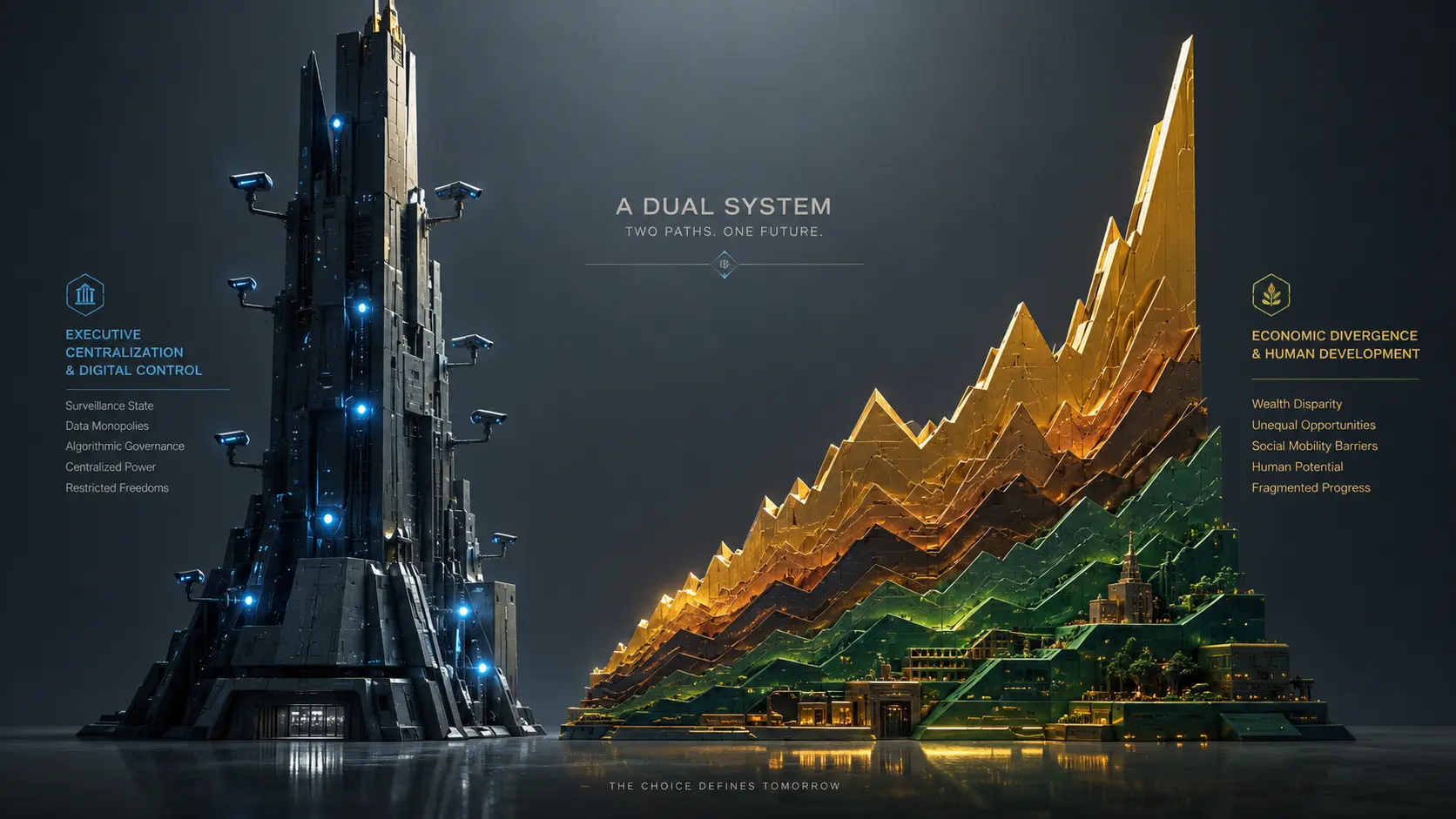
The comparative development of India and China represents the most significant socio-economic narrative of the twenty-first century. For decades, the two nations were characterized as the ultimate test cases for competing governance models: China’s centralized, one-party authoritarianism versus India’s federal, multiparty democracy. However, as of 2025, the sharp binary that once defined these two giants has become increasingly blurred. This analysis examines whether India is structurally converging toward a Chinese-style system by evaluating long-term trends in governance, civil liberties, economic architecture, and social conditions.
The structural evolution from 2000 to 2025 suggests a complex "convergence-divergence paradox." While India is adopting the tools and governance styles of the Chinese state—characterized by executive centralization, digital surveillance, and state-led industrial policy—it remains fundamentally divergent in its outcomes, particularly regarding extreme economic inequality, human capital accumulation, and institutional resilience.
Political System and Governance: The Autocratization Wave
The most significant area of structural convergence lies in the nature of political governance. Since the early 2000s, both nations have undergone internal evolutions that have brought their decision-making processes closer together, albeit from different starting points.
The Reclassification of the Indian State
The V-Dem (Varieties of Democracy) Institute’s Democracy Report 2025 provides a stark assessment of India’s political trajectory. India, which was situated in a "grey zone" as an electoral democracy in 2017, has been confirmed as an "electoral autocracy" since 2019. In this framework, while elections are still held, the foundational elements of a liberal democracy—such as the independence of the judiciary, the autonomy of election bodies, and the freedom of the press—have been systematically weakened.
China, by contrast, remains a "closed autocracy" where democratic rights and freedoms are non-existent. However, the structural gap between a "closed" and "electoral" autocracy is narrowing in practice. India’s descent into this category is a primary driver of the global "third wave" of autocratization. When India is removed from global datasets, the world’s average level of democracy appears significantly more stable, highlighting the weight of India’s structural shift.
Centralization and the Erosion of Institutional Independence
One of the hallmarks of the Chinese system is the absolute subordination of institutions—courts, the bureaucracy, and local governments—to the Communist Party of China (CPC). India’s democratic structure was designed to provide checks and balances, yet the 2000–2025 period has seen a marked centralization of executive power.
| Governance Dimension | India (2025 Status) | China (2025 Status) | Structural Trend |
|---|---|---|---|
| Regime Type | Electoral Autocracy | Closed Autocracy | Convergence in Style |
| Centralization | High (Executive-Led) | Total (CPC-Led) | Convergence |
| Judiciary | Contested/Eroding | Subordinate | Convergence in Practice |
| Bureaucracy | Increasingly Politicized | Party-Integrated | Converging |
| Federalism | Fractious/Centralizing | Unitary/Deconcentrated | Converging |
In India, the use of security, defamation, and sedition laws to silence critics has mirrored the authoritarian resilience seen in China. While India has not formally abolished its federal structure, the central government has increasingly utilized regulatory and fiscal levers to limit state-level autonomy, creating a governance model that prioritizes top-down coordination over decentralized negotiation. This centralization is often justified as necessary for "state capacity"—the ability to implement large-scale reforms and infrastructure projects with the speed and coordination once thought unique to the Chinese model.
The Role of the Bureaucracy and Courts
The independence of the bureaucracy is a critical differentiator that is currently under stress. In China, the bureaucracy is an extension of the party-state. In India, while the civil services were historically neutral, there is a growing trend of "regulatory restraint" when it comes to state-led initiatives, particularly in the tech and surveillance sectors. The Indian Supreme Court’s Puttaswamy judgment established a right to privacy, yet the enforcement of this right remains inconsistent, particularly when the state invokes national security. This reflects a structural shift where the de jure protections of a democracy are increasingly bypassed by de facto executive requirements, a pattern familiar to observers of the Chinese system.
Freedom of Speech and Civil Liberties: The Digital Mirror
If the convergence in governance is subtle, the convergence in the suppression of civil liberties is overt. Both nations have increasingly viewed the digital space as a domain to be secured rather than a forum for open discourse.
Press Freedom and the Architecture of Censorship
The 2025 World Press Freedom Index by Reporters Without Borders (RSF) ranks India 151st and China 178th. While China represents a state-owned monopoly of narrative, India’s "Partly Free" status is defined by a "difficult situation" for journalists.
| Press Freedom Metrics (2025) | India | China |
|---|---|---|
| RSF Global Rank | 151 / 180 | 178 / 180 |
| Freedom House Status | Partly Free | Not Free |
| Key Mechanism | Legal Harassment/IT Rules | Total State Censorship |
| Treatment of Dissent | Arrests/Digital Blocking | Imprisonment/Surveillance |
Structural convergence is evident in the regulatory frameworks adopted by India. The Information Technology Rules of 2021 established an onerous regulatory structure for digital news that civil society groups argue enables government-led censorship. This mirrors China’s use of administrative regulations to enforce self-censorship among private media entities. Journalists in India now face the risk of arrest and online harassment from state-aligned actors, which has exacerbated overall self-censorship—a foundational element of the Chinese media landscape.
Surveillance and the Biometric State
India’s Aadhaar system and its rapid adoption of Facial Recognition Technology (FRT) demonstrate a structural convergence toward China’s "social governance" model. By 2025, FRT has seen widespread adoption in India for everything from marking attendance to street surveillance, often with "barely any regulatory hurdles".
A significant second-order insight is that while China’s social credit system is an explicit tool of political control, India’s biometric and surveillance infrastructure is being built under the guise of "innovation" and "service delivery". However, the functional result is the same: the state exerts detailed and continuous control over its citizens. India’s "lax regulatory stance" on AI and surveillance, even in high-risk areas like law enforcement, suggests that the Indian state is prioritizing state capacity and security over individual privacy, a hallmark of the "China development model".
Internet Censorship and Transnational Influence
India has consistently led the world in internet shutdowns, a localized version of China’s "Great Firewall". Furthermore, the Indian government’s banning of over 200 Chinese-made apps (such as TikTok and WeChat) on national security grounds reflects a "state-centered and security-politics narrative" regarding digital borders. While these bans were aimed at China, they adopted the methodology of the Chinese state: using national security to unilaterally restrict the flow of information and digital services.
Media Independence and Ownership
The ownership structure of media in both countries is evolving in ways that minimize independent journalism, though the mechanisms differ.
From State Monopoly to Corporate Alignment
In China, the state owns the primary media organs (e.g., China Media Group). In India, the media landscape is vibrant and multiparty, but it is increasingly dominated by a small number of "politically connected individuals" and large corporate houses. This "Billionaire Raj" influence over media creates a structural alignment where private media interests often coincide with state interests, leading to a decline in investigative journalism and a rise in propaganda-style narratives.
| Media Aspect | India | China |
|---|---|---|
| Ownership | Private/Highly Concentrated | State-Owned |
| Influence Method | Advertising/Legal Threats | Direct Command |
| Digital Platforms | Regulated (IT Rules 2021) | Controlled (Great Firewall) |
| Radio News | State Monopoly (AIR) | State Monopoly |
The state-owned All India Radio (AIR) maintains a monopoly over radio news content, a direct structural parallel to China’s total control over broadcast media. While digital news remains a site of resistance in India, the increasing use of "economic pressures" and "ownership concentration" to weaken newsroom budgets has made the Indian media environment increasingly "difficult" and less distinguishable from an authoritarian information ecosystem.
Economic Structure: The Return of the State
The economic relationship between the two nations is defined by "asymmetric competition." As India seeks to emerge as an alternative to China in global supply chains, it is ironically adopting many of the state-led economic strategies that powered China’s rise.
The Industrial Policy Convergence: PLI and MIC 2025
The most striking economic convergence is the shift toward targeted industrial policy. India’s "Make in India" initiative and its Production Linked Incentive (PLI) schemes represent a departure from market-oriented liberalization toward a state-guided model.
| Strategy Parameter | India (PLI/Make in India) | China (Made in China 2025) |
|---|---|---|
| Launch Year | 2014 | 2015 |
| Economic Model | Facilitative/Incentive-Based | State-Guided/Direct Subsidies |
| Goal | Global Manufacturing Hub | High-Tech/Self-Reliance |
| Key Sectors | Electronics, Pharma, Solar, EVs | AI, Robotics, Aerospace, Chips |
While China’s "Made in China 2025" relies on direct subsidies, low-interest loans from state banks, and the power of State-Owned Enterprises (SOEs), India’s PLI schemes utilize fiscal incentives to encourage private sector production. However, both represent a "philosophical shift" where the state identifies "national champions" and "sunrise sectors" to receive preferential treatment. India’s focus on electronics assembly, where it surpassed China as a leading smartphone exporter to the U.S. in 2025, demonstrates the effectiveness of this Chinese-inspired targeted incentive model.
Wealth Inequality: The Great Divergence
While India converges with China in industrial strategy, it is sharply diverging in terms of equity. Data from the World Inequality Lab reveals that India’s level of inequality is now among the highest in the world, exceeding even the levels seen during the British Raj.
| Inequality Indicator (2022-23) | India | China |
|---|---|---|
| Top 1% Income Share | 22.6% | 15.7% |
| Top 1% Wealth Share | 40.1% | ~30% |
| Top 10% Income Share | 57.6% | 43.4% |
| Average Income Ratio | 1.0 | 2.5 (China is 2.5x richer) |
By 2022, China’s average income was roughly 2.5 times larger than India’s, yet India’s top 1% income share was nearly 50% larger than China’s. This suggests that while China has moved toward a "Common Prosperity" model that stabilizes top income shares, India is experiencing a "skyrocketing" concentration of wealth at the very top. This divergence is a structural risk; India’s growth is concentrated in a "Billionaire Raj," whereas China’s growth, despite its own high inequality (Gini ~43.5), has been more effectively harnessed for mass poverty alleviation.
Regulatory Burden and Ease of Doing Business
Both countries have sought to streamline regulations to attract foreign direct investment (FDI). India’s "ease of doing business" reforms, including digital portals and the 2020 Labor Codes, are intended to create a "business-friendly" environment similar to China’s Special Economic Zones (SEZs). However, India still faces structural bottlenecks that China has largely overcome: fragmented labor laws, land acquisition challenges, and an infrastructure gap. China’s world-class logistics (ranked 19th in the LPI 2023) still outperforms India’s rapidly improving system (ranked 38th).
Labor and Working Conditions: The Formalization Gap
The labor markets of both countries are massive and undergoing significant transformation, but they remain at different stages of the formalization process.
Informal Sector Dominance
India’s labor market is defined by its persistence in the informal sector. As of 2025, 83.6% of non-agricultural employment in India is informal, compared to only 32.6% in China. This stems from the size of India’s "unregistered enterprises," which account for 67.5% of employment.
| Labor Characteristic | India | China |
|---|---|---|
| Total Informal Employment | 83.6% | 32.6% |
| Urbanization Rate (2010) | 30% | 50% |
| Agri-Population (2012) | 47% | 32.6% |
| Regulatory Model | Decentralized/Older | Recent/Centralized |
China transitioned away from an agricultural economy much faster than India, moving from 60% in agriculture in 1990 to under 20% by 2018. This transition was supported by a state-led drive to create a "standard employment contract" that attaches social protections to wage labor. India, while passing the 2020 Labor Codes to consolidate its laws, still struggles to bring its vast workforce into the formal regulatory net.
Worker Rights and Unionization
In China, labor unions are largely state-controlled, and the 2008 Labor Contract Law is protective of workers on paper but implemented in a way that serves industrial stability. India has a long tradition of "workers' self-organization" and independent unions, yet the new 2020 Labor Codes have introduced "flexibility" for management that critics argue weakens collective bargaining and makes the Indian labor market more "China-like" in its prioritization of employer interests to attract FDI.
Standard of Living and Human Development
The most concrete divergence between the two nations is found in the metrics of human welfare. China’s authoritarian model has delivered a higher standard of living more consistently than India’s democratic model.
HDI and Poverty Alleviation
In the 2025 Human Development Report, China ranks 78th (High HDI) while India ranks 130th (Medium HDI). China’s life expectancy reached 78 years, while India’s recovered to 72 years post-pandemic.
| HDI Component (2023) | India | China |
|---|---|---|
| Overall HDI Value | 0.685 | 0.788 |
| Life Expectancy | 72.0 years | ~78 years |
| GNI per Capita (PPP) | $9,046 | ~$19,000+ |
| Mean Years of Schooling | 6.6 | ~8.0 |
India’s "steady strides" in HDI are notable—raising 135 million people out of multidimensional poverty between 2015 and 2021. However, the "loss" in human development due to inequality in India is 31.1%, one of the highest in the region. China’s top-down governance model enabled "aggressive poverty alleviation" through targeted programs and urban job creation at a speed unmatched by India’s decentralized and often "fragmented" welfare delivery.
Public Welfare and Dependency
Both nations utilize large-scale welfare programs, but for different structural reasons. India’s dependency on food ration programs (e.g., PMGKAY) is a response to the fact that its "jobless growth" has left a large portion of the population in low-productivity agriculture. China’s welfare programs are increasingly focused on building a "social insurance system" for an aging urban population. A significant insight is that India is using welfare to mitigate the failures of structural transformation, while China used structural transformation (industrialization) to reduce the need for basic welfare.
Environmental Governance: Capacity vs. Chaos
The environmental crisis in both nations highlights the differences in state capacity.
Air Quality and Pollution Control
South Asia remains the most polluted region in the world, with India frequently hosting the majority of the world's most polluted cities. China, following its "War on Pollution" launched in 2014, has seen a decade of "sustained decrease" in particulate concentrations, though it saw a slight 2.8% uptick in 2023.
China’s "campaign-style enforcement" allows the central government to bridge enforcement gaps by halting industrial production and traffic during major events or pollution spikes. India’s environmental governance is characterized by "overlapping responsibilities" and "bureaucratic inefficiencies". In 2025, the Indian government actually exempted certain industries from environmental consent mechanisms to "promote Ease of Doing Business," a regressive step that contrasts with China’s tightening environmental standards for corporate governance.
Decarbonization and Climate Finance
China is the world’s largest emitter (31.5%) but also the largest investor in green technology, with a green loan portfolio of $4.9 trillion. India is the third-largest emitter (8.1%) and has the highest rate of emissions growth (5.3% in 2024) among major economies. While India has set ambitious targets (500 GW of renewables by 2030), it continues to expand coal capacity, reflecting a structural "paradox" between climate rhetoric and the immediate demands of economic growth.
Social Mobility and Economic Opportunity
The ability of individuals to move up the economic ladder is a key indicator of long-term stability.
Education as a Driver of Inequality
Human capital accumulation paths in India and China have diverged fundamentally. China pursued a "bottom-up" strategy, prioritizing primary and secondary education, which created a high-skill workforce for manufacturing. India adopted a "top-down" approach, prioritizing elite higher education, which fueled the service sector but left a substantial portion of the population illiterate and trapped in low-productivity farming.
| Education Metric (2020) | India | China | | :--- | :--- | :--- | | Secondary Enrollment | 67% | 95% | | Tertiary Enrollment | 45% | 72% | | Vocational Enrollment | 2% | 25% | | Education Gini (Inequality) | Higher | Lower |
Education inequality accounts for 25% of wage inequality in India, compared to less than 12% in China. This suggests that China has achieved higher "intergenerational mobility" in education than India, where disadvantaged groups (Scheduled Castes/Tribes) still face significant barriers to occupational mobility despite modest educational convergence. India ranks 76th on the Global Social Mobility Index, reflecting a critical need for structural reform in "fair wages and education".
State Capacity vs. Individual Freedom: The Core Trade-off
The central question of the India-China comparison is whether India is sacrificing personal liberty to achieve Chinese-style state capacity.
The "China Development Model" in India
There is clear evidence that the Indian state is attempting to replicate China's "centralized governance and state-led policies" to propel itself into a global power. This is visible in:
- Resource Mobilization: The ability to enforce national projects (like the PLI or digital infrastructure) without prolonged negotiation.
- Regulatory Control: The tightening of laws over NGOs, foreign funding, and digital dissent to ensure "political stability".
- National Champions: Supporting large domestic firms (e.g., Reliance, Adani) to compete globally, mirroring China’s "national champions" like BYD or Huawei.
However, this centralization comes at the cost of the "accountability and transparency" that were the hallmarks of the Indian system. China’s authoritarian regime experienced "violent upheavals" (Cultural Revolution) before stabilizing, whereas India’s democracy has survived through "party turnovers" and "regional conflicts". By moving toward the Chinese model of centralized control, India risks losing its "resilience" without necessarily gaining China's "consistency" in economic outcomes.
Synthesis and Conclusion: Evaluating the Claim
Based on an exhaustive review of data from 2000 to 2025, the claim that India is evolving toward a political-economic system similar to China can be evaluated as follows:
1. Areas of Convergence (Resembling China)
India is increasingly similar to China in the mechanisms of governance and social control. The centralization of executive power, the confirmed status as an "electoral autocracy," the precipitous decline in press freedom, and the build-out of a high-tech surveillance state (Aadhaar, FRT) are all hallmarks of the Chinese model. Furthermore, India’s return to state-led industrial policy (PLI) and "digital sovereignty" indicates a structural shift away from liberal market principles toward strategic interventionism.
2. Areas of Divergence (Fundamentally Different)
India remains fundamentally different in its social and economic outcomes. India’s "Billionaire Raj" represents a level of wealth concentration that China has explicitly avoided through its "Common Prosperity" and state-owned infrastructure. India’s human capital strategy (top-down) and its massive informal labor sector (83%) contrast with China’s bottom-up mass education and formalized wage-labor market. Finally, India’s "fractious" democracy and federal diversity still provide localized pockets of resistance and innovation (e.g., Kerala’s health interventions) that have no equivalent in China’s unitary party-state.
3. Balanced Evaluation
The claim is Increasingly True regarding the style and tools of the state, but Partially True regarding the overall structural reality.
India is adopting the authoritarian toolkit of the Chinese state to enhance its capacity for industrial competition and social order. However, it is doing so while maintaining an economic structure that is far more unequal and a labor market that is far less developed than China’s was at a similar stage of growth. The structural trend from 2000 to 2025 shows India converging toward China’s governance model (centralized, surveillance-heavy, restrictive of dissent) but diverging in its ability to deliver mass human development and economic equity.
In conclusion, India is not "becoming China," but it is becoming a centralized electoral autocracy that uses Chinese-style surveillance and industrial policy to manage a neoliberal economy. This "hybrid model" faces the unique challenge of maintaining political stability in the face of extreme inequality—a challenge that China’s more equitable (though still autocratic) growth model did not have to confront in the same way. The next decade will determine whether this Indian adaptation can deliver the developmental outcomes of the "China model" without the institutional resilience of a true liberal democracy.
Works cited
1. Comparative Analysis of Democratic and Authoritarian ... - IJIRT, https://ijirt.org/publishedpaper/IJIRT184002\_PAPER.pdf 2. China vs. India – Key Differences – Part 4 - The IEC Group Consulting, https://theiecgroup.com/china-vs-india-key-differences-part-4/ 3. Democracy vs Authoritarianism: A Comparative Study of India and China's Governance Outcomes - ResearchGate, https://www.researchgate.net/publication/397669119\_Democracy\_vs\_Authoritarianism\_A\_Comparative\_Study\_of\_India\_and\_China's\_Governance\_Outcomes 4. INCOME AND WEALTH INEQUALITY IN INDIA, 1922-2023: - World ..., https://wid.world/wp-content/uploads/2024/03/WorldInequalityLab\_WP2024\_09\_Income-and-Wealth-Inequality-in-India-1922-2023\_Final.pdf 5. V-DEM Democracy Report 2025 25 Years of Autocratization ..., https://www.v-dem.net/documents/54/v-dem\_dr\_2025\_lowres\_v1.pdf 6. COUNTRY BRIEF INDIA - V-Dem, https://www.v-dem.net/media/publications/country\_brief\_india.pdf 7. India: Beijing's Global Media Influence 2022 Country Report ..., https://freedomhouse.org/country/india/beijings-global-media-influence/2022 8. Facial Recognition Technologies: A Window into India's Approach to AI Regulation, https://casi.sas.upenn.edu/iit/amber-sinha 9. The Application of Facial Recognition in China and India: Potential Risks and Regulation Suggestions - David Publishing, https://www.davidpublisher.com/Public/uploads/Contribute/6123074d2bb20.pdf 10. World Press Freedom Index 2025: Global Journalism Faces Alarming Decline, https://www.usthadian.com/world-press-freedom-index-2025-global-journalism-faces-alarming-decline/ 11. The Rise of Biometric Data: Security, Surveillance, and Consent in the Age of Facial Recognition, https://datasecure.ind.in/blogs/rise-biometric-data/ 12. China Social Credit System Explained - How It Works [2026] - Remote People, https://remotepeople.com/china-social-credit-system-explained/ 13. A Geopolitical Economy Analysis of China and India's Approaches to Transnational Data Governance - Cogitatio Press, https://www.cogitatiopress.com/politicsandgovernance/article/viewFile/10361/4636 14. India Vs China | PDF | China | World Politics - Scribd, https://www.scribd.com/document/893309236/India-vs-China 15. Made in China vs Make in India: Clash or Convergence?, https://tritonmaritime.com/triton-expert-corner/made-in-china-2025-vs-make-in-india-clash-or-convergence/ 16. A Decade of Made in China 2025: Lessons for India's Make in India Vision, https://www.vajiraoinstitute.com/upsc-ias-current-affairs/a-decade-of-made-in-china.aspx 17. Blog : Are China and India highly unequal countries? - UNU-WIDER, https://www.wider.unu.edu/publication/are-china-and-india-highly-unequal-countries 18. India vs China Manufacturing in 2025 – Which Is Right for Your Business?, https://www.amrepmexico.com/blog/india-vs-china-manufacturing 19. India vs China: Labour Laws Comparison | PDF | Cost Of Living | Employment - Scribd, https://www.scribd.com/document/765374967/Indian-Economy-Assignment-2115195 20. View of Comparative Analysis of Labour Codes with Existing Legislation, https://ignited.in/index.php/jasrae/article/view/14372/28548 21. India vs China Manufacturing: Which Is Better for Your Business in 2025? - AMREP's, https://amrepinspect.com/blog/india-vs-china-manufacturing 22. LABOUR LAWS, INFORMALITY, AND DEVELOPMENT ..., https://www.jbs.cam.ac.uk/wp-content/uploads/2023/05/cbrwp518.pdf 23. China vs. India: how human capital shaped two distinct economic paths - WID, https://wid.world/news-article/china-vs-india-how-human-capital-shaped-two-distinct-economic-paths/ 24. India's New Labor Codes: 9 Steps Multinational Employers Can Take Now, https://www.fisherphillips.com/en/insights/insights/indias-new-labor-codes 25. World Bank Document, https://openknowledge.worldbank.org/bitstreams/a7e06f78-a64e-5b2d-98db-d3909ccfde57/download 26. Urban labour market changes and social protection for urban informal workers: challenges for China and India - ResearchGate, https://www.researchgate.net/publication/251761094\_Urban\_labour\_market\_changes\_and\_social\_protection\_for\_urban\_informal\_workers\_challenges\_for\_China\_and\_India 27. Progress of Human Development in India: A Cross Country Comparison With Survey Data in India - ResearchGate, https://www.researchgate.net/publication/400076023\_Progress\_of\_Human\_Development\_in\_India\_A\_Cross\_Country\_Comparison\_With\_Survey\_Data\_in\_India 28. Human Development Report 2025 - Drishti IAS, https://www.drishtiias.com/daily-updates/daily-news-analysis/human-development-report-2025 29. Human Development Index- India - HDI - UNDP, https://www.undp.org/india/human-development-index-india 30. The Making of China and India in the 21st Century, https://prod.wid.world/www-site/uploads/2024/11/WorldInequalityLab\_WP2024\_24\_The-Making-of-China-and-India-in-21st-Century\_Final.pdf 31. PM2.5 Exposure | State of Global Air, https://www.stateofglobalair.org/air/pm 32. Annual Update - EPIC-India - Delhi, https://epic.uchicago.in/wp-content/uploads/2025/08/Report-English-India-View.pdf 33. Campaign-style enforcement and corporate environmental governance: evidence from China's central environmental inspection - Frontiers, https://www.frontiersin.org/journals/public-health/articles/10.3389/fpubh.2025.1688719/full 34. A Comparative Analysis Of Financing Climate Action In India And China: Is Climate Finance Working? - IMPRI Impact And Policy Research Institute, https://www.impriindia.com/insights/financing-climate-action-india-china/ 35. Environmental and climate governance in India in 2024-25, https://www.cenfa.org/environmental-and-climate-governance-in-india-in-2024-25/ 36. Decarbonising the Asian Giants: Comparing Indian and Chinese Models of Climate Action, https://csep.org/blog/decarbonising-the-asian-giants-comparing-indian-and-chinese-models-of-climate-action/ 37. CO2 Emissions – Global Energy Review 2025 – Analysis - IEA, https://www.iea.org/reports/global-energy-review-2025/co2-emissions 38. Publication: Closer, but No Cigar: Intergenerational Mobility across Caste Groups in India - Open Knowledge Repository, https://openknowledge.worldbank.org/entities/publication/1559d5b0-2b3a-544c-9219-7fb9e2ac8fe4 39. Descriptive Probability of Cyclic and Transactional Social Mobility - Zenodo, https://zenodo.org/records/13729745/files/Transactional%20and%20Cyclical%20Mobility.pdf?download=1 40. Infographic: Ranking the Social Mobility of 82 Countries - Visual Capitalist, https://www.visualcapitalist.com/ranked-the-social-mobility-of-82-countries/ 41. Two Nations, Two Paths: A Comparative Analysis of China and India, https://twonationstwopaths.hcommons.org/