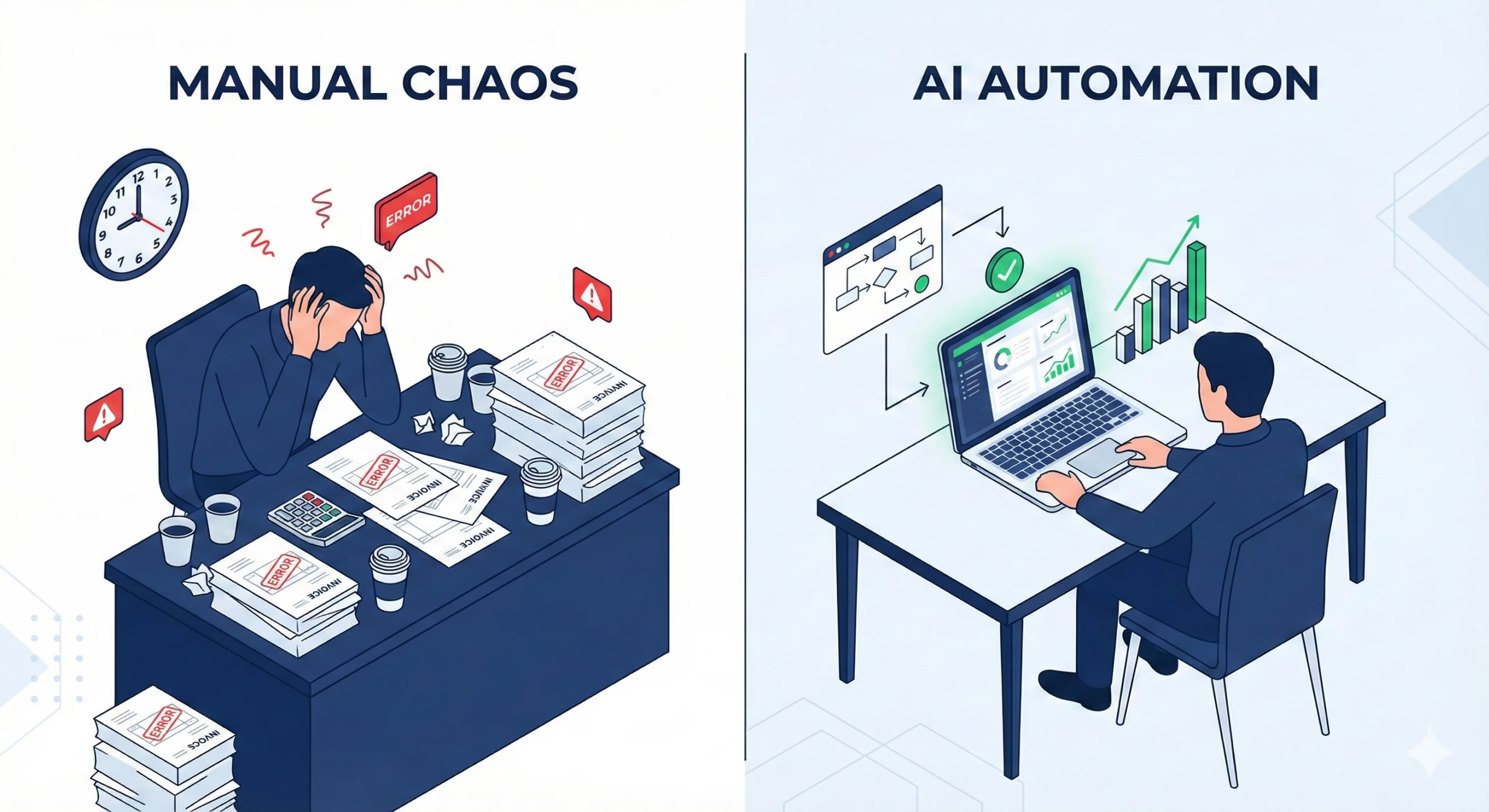
Most businesses are rushing to automate everything.
But here’s what nobody talks about:
Bad automation costs more than no automation.
I’ve seen companies burn ₹8L+ on AI projects that made their operations slower, not faster. The pattern is always the same—they automate the wrong thing, at the wrong time, for the wrong reason.
This isn’t about whether AI works. It does.
This is about knowing when not to use it.
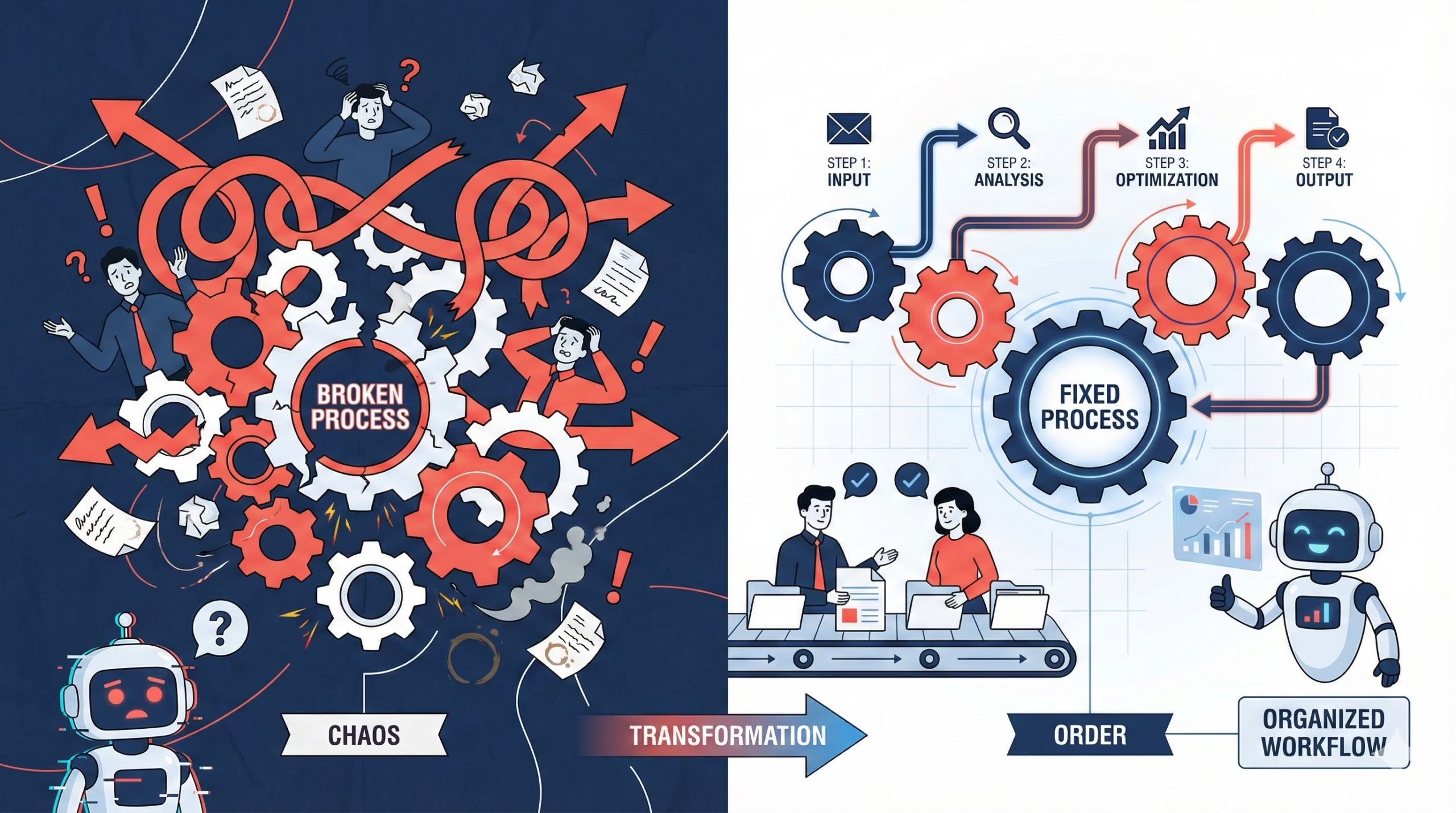
Situation 1: When the Process Itself Is Broken
The mistake: Automating a dysfunctional workflow.
What happens: You get faster dysfunction.
A mid-size e-commerce company automated their customer complaint resolution system. The AI categorized tickets and routed them to teams instantly.
Result?
Complaints were processed 3x faster—but resolution time increased by 40%.
Why?
The underlying process was broken. Teams weren’t aligned on resolution protocols. Data was incomplete. Automation just exposed the chaos faster.
The real cost:
- ₹4.2L spent on automation tools
- Customer satisfaction dropped 23%
- Team morale tanked (blamed the “stupid AI”)
The rule: Fix the process first. Automate second.
Before you build or buy automation:
- Map the current workflow (every step)
- Identify bottlenecks (where things actually break)
- Fix the logic and dependencies
- Then automate the clean version
Automation doesn’t fix problems. It scales them.
Situation 2: When Human Judgment Is the Actual Value
The mistake: Automating decisions that require nuance.
What happens: You commoditize your competitive advantage.
A consulting firm automated their client intake process. AI scored leads, qualified prospects, and scheduled initial calls.
Efficiency improved. Revenue dropped.
The founder’s intuition—reading between the lines of a prospect’s situation—was what closed deals. The AI couldn’t detect the “vibe” that signaled a high-value client versus a demanding low-payer.

When judgment matters more than speed:
- High-value sales (relationship-driven)
- Creative strategy (requires taste and context)
- Crisis management (emotional intelligence critical)
- Brand positioning (subjective, nuanced)
The rule: Automate the repetitive. Reserve judgment for humans.
Use AI to handle data preparation, research, scheduling—everything that enables judgment. Don’t automate the judgment itself.
Example: AI can summarize client background. Your expert decides if they’re the right fit.
Situation 3: When You Don’t Have Clean Data
The mistake: Building on a foundation of garbage.
What happens: Garbage in, AI-powered garbage out.
A manufacturing company built an AI system to predict equipment maintenance needs. They fed it three years of maintenance logs.
The AI confidently predicted failures—but got them wrong 60% of the time.
Why?
The logs were inconsistent. Different technicians used different codes. Data was missing for entire quarters. Some “failures” were routine checks logged incorrectly.
Cost of bad data automation:
- ₹6.8L development cost
- Unnecessary maintenance (false positives)
- Missed failures (false negatives)
- Lost trust in the entire analytics initiative
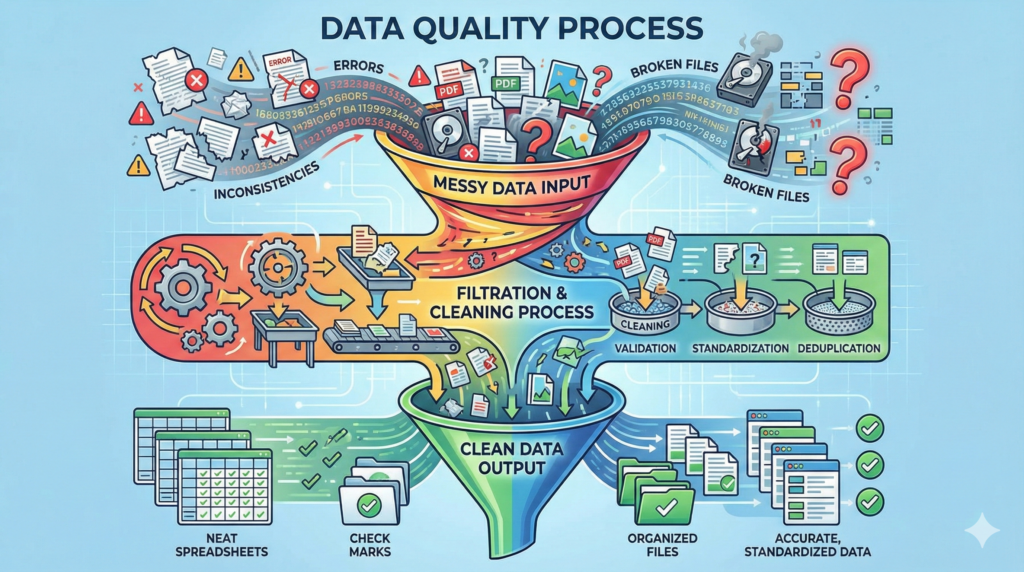
The data quality checklist before automation:
□ Consistent formats across all sources
□ Complete records (minimal missing values)
□ Standardized naming conventions
□ Validated accuracy (spot checks pass)
□ Sufficient volume (enough examples to train)
The rule: Clean your data first. Or pay for it later.
AI doesn’t create intelligence from noise. It amplifies patterns. If your data has bad patterns, you’ll get expensive bad predictions.
Situation 4: When the Task Changes Frequently
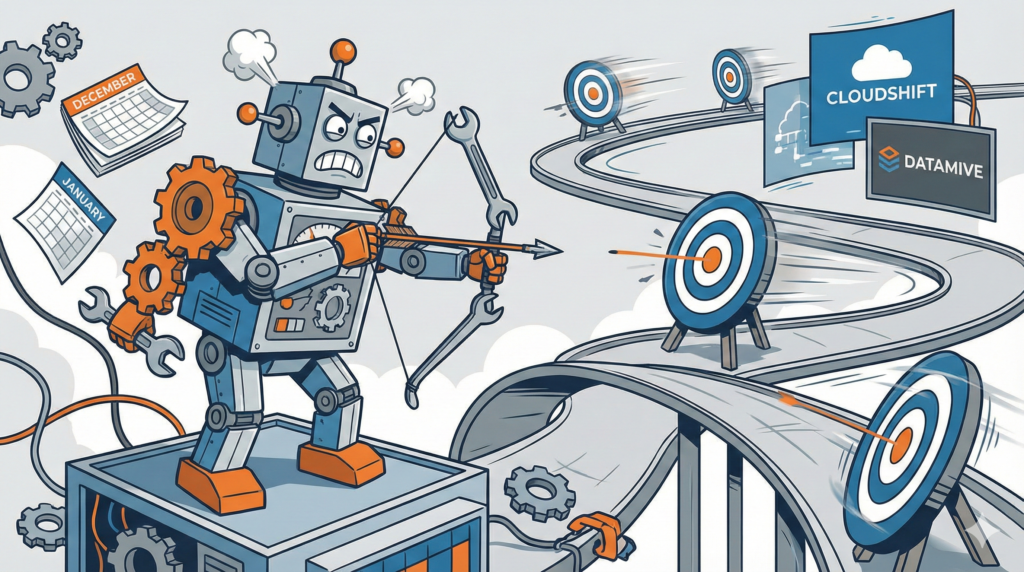
The mistake: Automating a moving target.
What happens: Constant rebuilds that cost more than doing it manually.
A marketing agency automated their social media reporting. Built custom dashboards, integrated APIs, designed templates.
Two months later, clients wanted different metrics. Platform algorithms changed. New features launched.
The automation broke. Fixing it took longer than generating reports manually.
Maintenance cost breakdown:
- Initial build: ₹2.1L
- Monthly fixes: ₹45K
- Opportunity cost: Team stuck maintaining automation instead of serving clients
When NOT to automate:
- Requirements change monthly or faster
- Industry regulations are in flux
- You’re in experimentation phase (testing different approaches)
- The task itself is being redefined
The rule: Automate stability, not volatility.
For rapidly changing tasks, build flexible templates or semi-automated workflows where humans can quickly adjust parameters. Full automation only makes sense when the process is stable for 6+ months.
Situation 5: When It’s Cheaper to Keep It Manual
The mistake: Automating for the sake of automation.
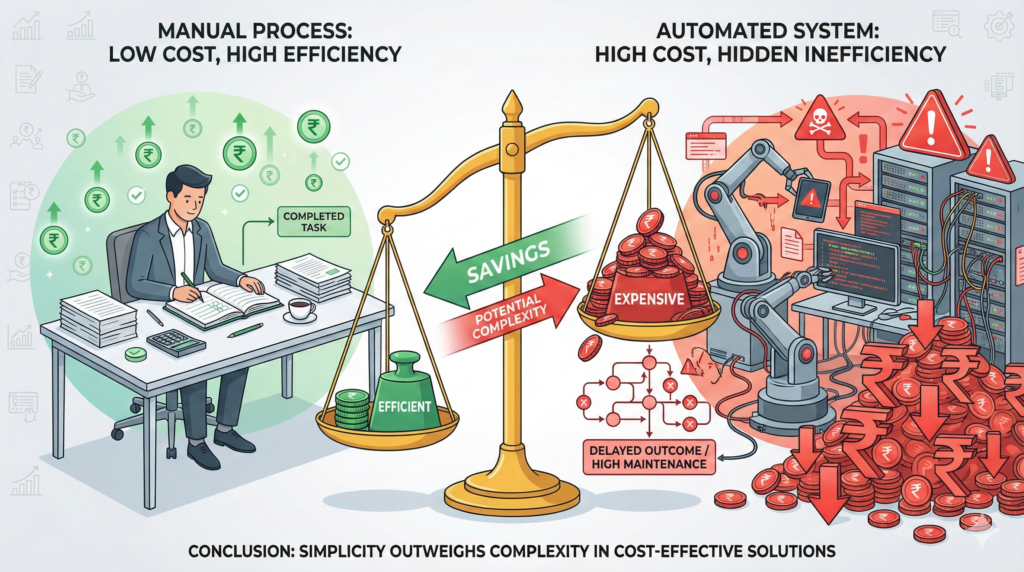
What happens: You spend ₹5L to save ₹30K annually.
A small business automated their invoice generation. The task took 2 hours per month. An intern could do it.
They spent ₹3.8L building the automation. Annual time savings? Worth about ₹24K.
Payback period: 15.8 years.
The ROI reality check:
| Manual Cost | Automation Cost | Payback Period |
| ₹2K/month | ₹50K build | 25 months |
| ₹5K/month | ₹1.2L build | 24 months |
| ₹10K/month | ₹2.5L build | 25 months |
Average payback: 2+ years
When manual wins:
- Task occurs infrequently (less than weekly)
- Process involves fewer than 5 people
- Annual cost of manual work < 40% of automation cost
- Task requires high customization each time
The rule: Do the math before you build.
Calculate total cost of ownership:
- Development cost
- Maintenance (annual)
- Training and adoption
- System updates and integrations
Then compare to: Hours × Hourly Rate × 12 months.
If the manual cost is low, keep it manual.
The Framework: When Automation Actually Works
After seeing dozens of automation projects—successful and failed—here’s the decision framework:
Automate when ALL of these are true:
✓ The process is stable and defined
✓ The task is repetitive (daily/weekly frequency)
✓ Human judgment adds minimal value
✓ Data quality is high (>85% accuracy)
✓ ROI payback < 18 months
Don’t automate when ANY of these are true:
✗ Process is broken or undefined
✗ Task requires nuanced judgment
✗ Data is incomplete or inconsistent
✗ Requirements change frequently
✗ Manual cost is already low
The Real Question
Most businesses ask: “Can we automate this?”
Better question: “Should we automate this?”
Just because AI can do something doesn’t mean it should.
The companies winning with automation aren’t the ones automating everything. They’re the ones automating strategically—only the workflows where automation compounds value instead of complexity.
Before your next automation project, answer these:
- Is the process actually stable?
- Would automation remove or relocate the bottleneck?
- Do we have the data quality this needs?
- What’s the true ROI timeline?
- What’s our Plan B if this fails?
If you can’t answer all five confidently, you’re not ready to automate.
What to Do Instead
If automation isn’t the answer right now, here’s what is:
Phase 1: Document
Map your current process. Every step. Every decision point. Every exception.
Phase 2: Optimize
Fix the logic. Remove unnecessary steps. Clarify decision criteria.
Phase 3: Standardize
Create templates. Define protocols. Clean your data.
Phase 4: Semi-Automate
Use simple tools (Zapier, Make) for basic connections. Keep humans in the loop.
Phase 5: Fully Automate
Only after Phases 1-4 are complete and the process has been stable for 6+ months.
Most companies try to jump straight to Phase 5. That’s why most automation fails.
The Bottom Line
AI doesn’t replace bad operations with good ones.
It replaces bad operations with faster bad operations.
Before you automate, ask if the process deserves to exist at all.
Then ask if it deserves to exist forever.
Only then should you ask if it deserves to be automated.
The best automation isn’t the fastest implementation. It’s the one that compounds value instead of complexity—and sometimes that means not automating at all.
If you’re evaluating an automation project and want a second opinion on whether it’s worth building, DM me “ROI check.”
I’ll walk you through the framework and tell you if you’re about to waste money—or make a smart investment.