The claim shows up in almost every piece of AI-infrastructure writing eventually: compute is becoming the new oil. A standardized, tradeable, financializable commodity, sitting underneath the AI economy the way crude sits underneath the industrial one. It's a satisfying analogy. Reading through the actual evidence on decentralized compute markets and GPU financing, I don't think it survives contact with how compute actually works.
That's not a claim that compute financialization is fake or going nowhere. Real financing is happening, at real scale, with real institutional money. It's a claim that "commodity" is the wrong word for what's being built, and the difference matters if you're trying to figure out what's actually investable, buildable, or close to real today.
What's genuinely working: financing, not fungibility
Start with what's unambiguously real. In 2024, CoreWeave secured a $7.5 billion debt facility collateralized entirely by its GPU hardware. That's a serious signal: institutional lenders looked at a pool of GPUs generating predictable cloud-compute revenue and decided it was creditworthy collateral, the same way they'd assess a fleet of aircraft or a portfolio of commercial real estate. Compute, in other words, can absolutely support debt financing.
Decentralized Physical Infrastructure Networks (DePIN) — Akash, io.net, and similar platforms — take a different approach: aggregating tens of thousands of idle consumer and enterprise GPUs into spot marketplaces, using reverse-auction pricing to offer capacity at 50% to 85% discounts versus AWS. This is also real. It's a genuine, working alternative supply channel for a specific category of workload.
Neither of these facts makes compute a commodity in the financial sense — a standardized unit that's interchangeable regardless of which specific unit you receive. They make compute a financeable, dynamically-priced service. That's a meaningfully different (and, frankly, more modest) claim.
The heterogeneity problem, specifically
Here's the technical reason the commodity analogy breaks down. A barrel of West Texas Intermediate crude is, within a tight specification, interchangeable with any other barrel of WTI. That's what makes it a commodity — you can trade a futures contract on it without caring which specific barrel eventually shows up.
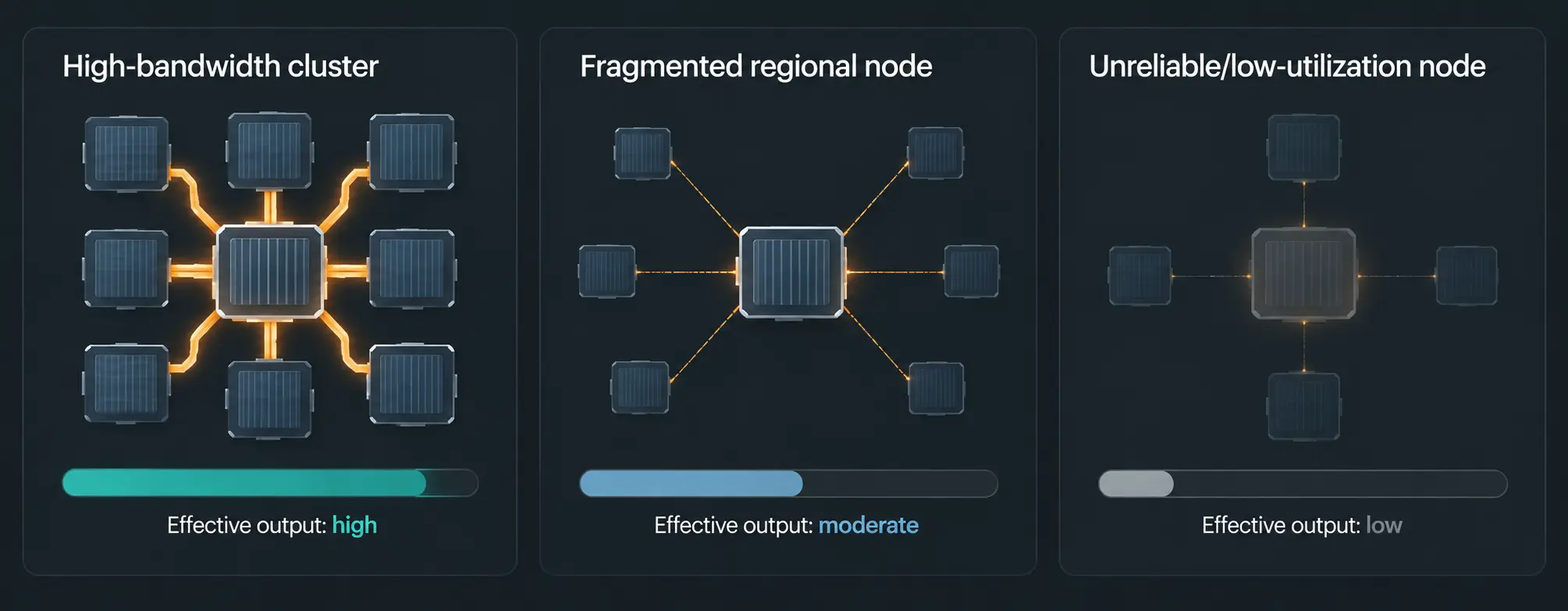
An "H100 GPU-hour" is not interchangeable in the same way, because its economic value is a function of at least ten variables that don't reduce to a single spec sheet:
None of these are solvable by "more standardization effort" in the way, say, grading systems standardized agricultural commodities. They're structural properties of distributed physical infrastructure. A GPU genuinely does perform differently depending on what it's plugged into and where it sits — that's not a market-immaturity problem, it's physics.
The utilization gap: the clearest evidence of the problem
If the heterogeneity argument sounds abstract, the utilization data makes it concrete. Akash Network — one of the more established DePIN compute marketplaces — reported just 84 active GPUs out of 334 listed as available in a single quarter of 2026, despite the network crossing $5 million in cumulative compute spend. That's roughly a 25% utilization rate on listed capacity. io.net, a comparable network, separately dealt with Sybil attacks — bad actors registering fake or duplicate provider nodes to inflate the network's apparent capacity — before tightening its provider-auditing process.
This gap is the practical consequence of heterogeneity: listed capacity and usable capacity for a given workload are different numbers, because so much depends on whether a specific node's location, interconnect, and reliability profile actually match what a given customer needs. A commodity market doesn't have this problem, almost by definition — if oil is fungible, there's no such thing as "technically available but not usable" oil. Compute, right now, has exactly that problem at meaningful scale.
Where compute markets actually sit: the financialization ladder
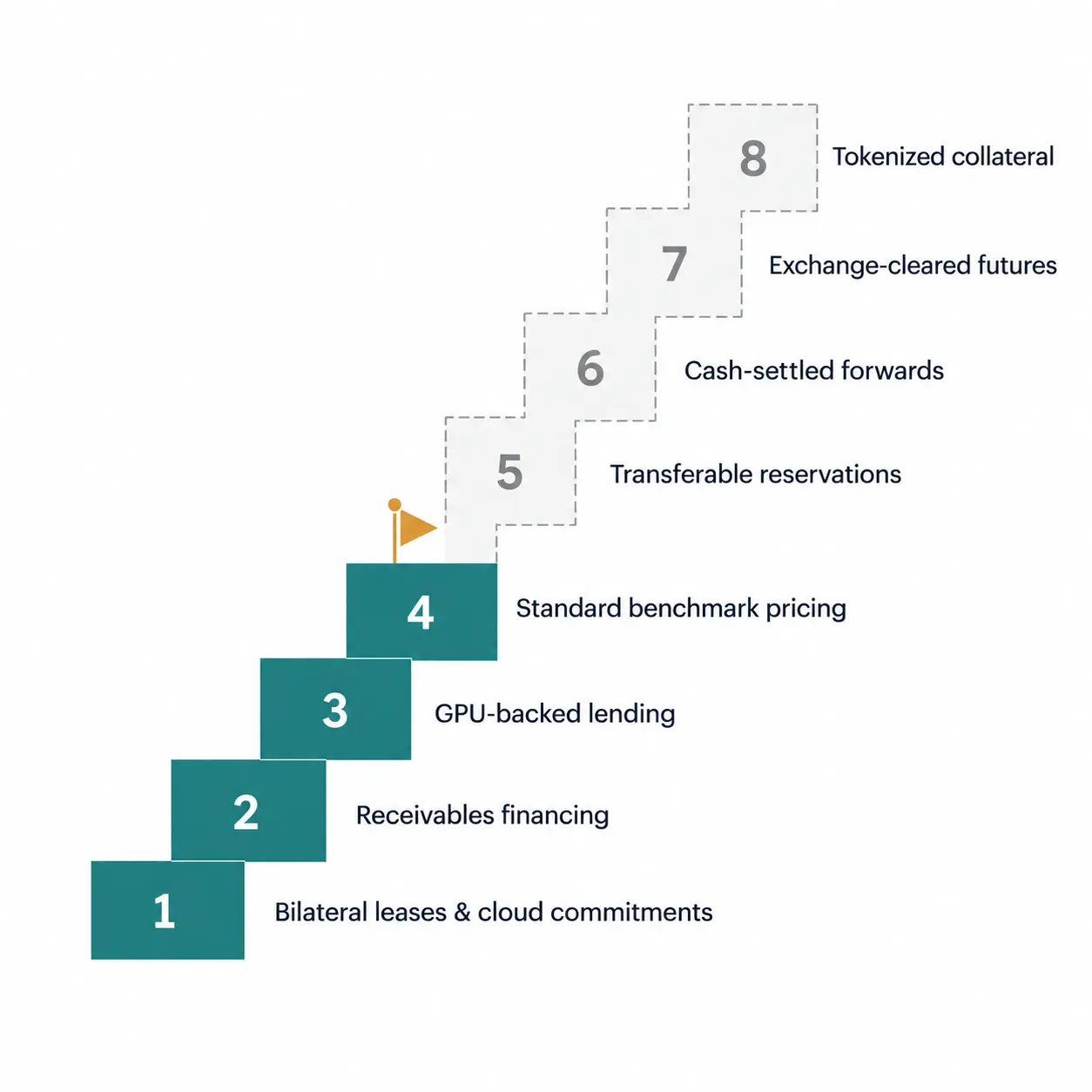
A useful way to calibrate how far along compute financialization actually is: think of it as an eight-stage ladder.
By the evidence available in this research, the market sits concentrated at stages one through four. Stage three (GPU-backed debt) is well-established. Stage four (benchmark pricing for specific configurations) is emerging but not standardized across providers. Stages five through eight — the stages that would actually make compute a liquid, tradeable asset the way the "compute is the new oil" framing implies — remain experimental or purely theoretical. Nobody in the research reviewed here has built a credible stage-six instrument yet, let alone a stage-eight one.
What would actually have to change
For compute to move up that ladder, a specific and demanding set of conditions would need to hold, roughly in this order:
That last point is worth dwelling on, because it suggests compute financialization might not converge into one market at all. It's more likely to bifurcate: large-scale training will likely remain the domain of centralized hyperscalers with bespoke, bilateral contracts (not a liquid market, by design, because the workload doesn't tolerate substitution), while commodity-style standardization is genuinely plausible for inference — the more divisible, substitutable, and increasingly dominant share of AI compute demand. McKinsey's modeling, cited in the BlackRock report, projects inference will account for 43% of global data-center power demand by 2030, versus 28% for training — which is exactly the workload category where standardization has the best chance of working.
The honest verdict
Compute is not becoming "the new oil." It's becoming something closer to electricity, freight, or bandwidth — a genuinely essential, financeable, dynamically-priced input, with real localized contracts, basis risk between regions and configurations, and multiple parallel sub-markets rather than one universal commodity. That's a less dramatic story than the oil analogy. It's also, based on the available evidence, the more accurate one — and it doesn't preclude serious financial innovation. Freight and electricity both support enormous derivatives markets today. They just took the specific, patient work of building benchmarks, standard contracts, and delivery verification first. Compute is early in that same process, not exempt from it.
Key takeaways
FAQ
Can GPU compute be traded like a commodity?
Not yet, and not in the same way as oil or wheat. It can be financed (debt, leasing) and dynamically priced (spot marketplaces), but true commodity trading requires standardized, interchangeable units — and a GPU's real economic value depends on interconnect, location, and workload fit in ways that resist standardization today.
What is DePIN and does it solve compute commoditization?
DePIN (Decentralized Physical Infrastructure Networks) refers to platforms like Akash and io.net that aggregate distributed GPU capacity into marketplaces. They provide real, working spot-market access at meaningful discounts, but they don't solve the underlying heterogeneity problem — Akash's own utilization data (84 of 334 GPUs active in a 2026 quarter) shows the gap between listed and usable capacity.
Will there be a compute futures market like oil futures?
It's plausible for inference workloads specifically, which are more divisible and substitution-tolerant, over a multi-year timeline requiring independently governed benchmark pricing and verifiable delivery standards that don't yet exist. It's much less plausible for training workloads, which structurally require tightly-coupled, homogeneous clusters that resist substitution.
What does CoreWeave's GPU-backed debt facility prove?
It proves compute can generate predictable enough cash flows to serve as loan collateral — a genuine and important form of financialization. It doesn't prove compute is a liquid, tradeable commodity; debt financing and commodity trading are different financial mechanisms with different requirements.