The Agentic Inflection Point
A strategic analysis of where autonomous AI systems actually are, the capability gaps that remain, and what the trajectory implies for organizations.
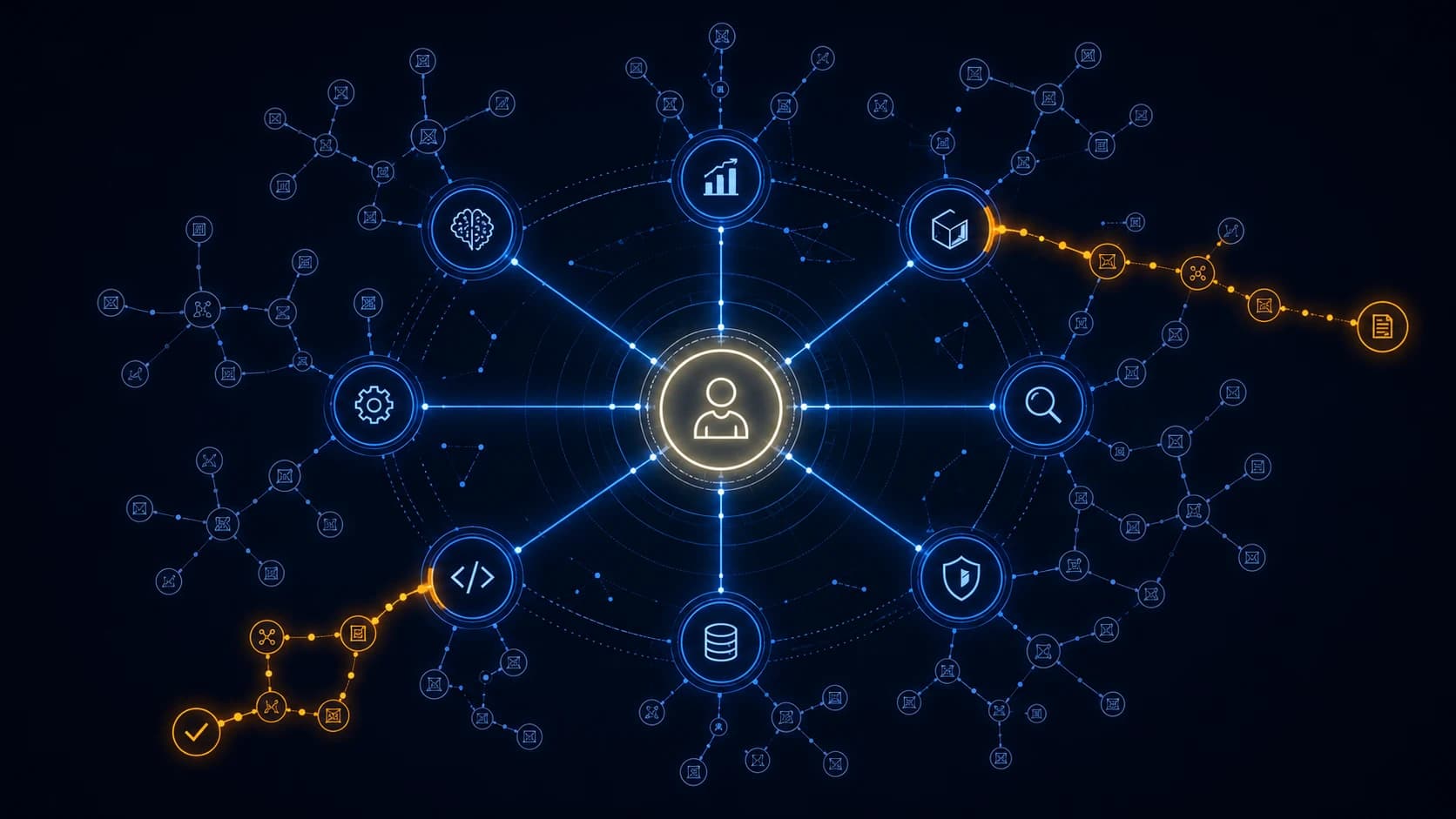
A strategic analysis of where autonomous AI systems actually are, and what the trajectory implies.
Published on goutamprusty.com
The most consequential shift in AI over the next three to four years won't be in model intelligence. It will be in architecture.
The dominant mode of AI deployment today is still fundamentally reactive: a user poses a query, a model responds, a human evaluates. The model is a very sophisticated tool that responds to prompts. It doesn't take actions, maintain goals, or recover from errors on its own.
Agentic AI systems change the architecture. They wrap language models in scaffolding that handles tool invocation, planning, multi-step execution, memory, and error recovery. The result is a system that can be handed a goal and pursue it across a sequence of actions, rather than waiting to be asked each step.
This transition is happening now. The question is how far it goes, at what pace, and what it actually means for how work gets done.
Where Agents Actually Are
The benchmark numbers are useful here. Stanford's 2026 AI Index reports that top agentic systems can complete roughly 66% of complex real-world computer tasks under certain time constraints. Eighteen months earlier, that number was approximately 12%.
A 5x improvement in 18 months is real and significant. It's also incomplete as a description of current capability.
The "certain time constraints" clause matters. Current agents work reliably on tasks measured in minutes to hours. They handle well-defined workflows with clear success criteria, tools that behave predictably, and limited need for long-horizon goal maintenance.
What they don't do well: tasks that unfold over days, scenarios where unexpected situations require real judgment about whether to continue or escalate, environments where the tools don't behave as expected, and projects requiring coherent memory across many separate interactions.
Production deployments reflect this accurately. Customer service triage, engineering ticket resolution, claims processing, report generation from structured data: these are live, in production, at major enterprises. They work under heavy human supervision, with constrained action spaces and defined escalation paths.
The more ambitious framing, autonomous agents handling complex multi-day projects, is real as a research direction and limited as a current deployment reality.
The Capability Gap That Actually Matters
The technical bottleneck is not intelligence in the narrow sense. On well-defined tasks with clear success criteria, current models perform well. The gap is in what researchers call "long-horizon reliability."
Three things break over extended task horizons:
Memory architecture. Current systems don't maintain coherent context well over long sequences of actions and events. Information that was available at step 3 may not be reliably accessible at step 47. The architectures for persistent, retrievable, organized memory in agent systems are active research areas but not solved.
Goal coherence under uncertainty. When an agent encounters an unexpected situation, it needs to decide whether to adapt its approach, pause for human input, or escalate. Current systems tend to either continue inappropriately (hallucinating a path forward) or thrash (repeatedly revising plans without progress). The calibrated uncertainty judgment that makes a human worker reliable in ambiguous situations is harder to produce in systems trained on prediction.
Error recovery. Humans recover from errors by noticing them, understanding their cause, and adjusting. AI agents often don't reliably detect their own errors, especially errors of omission or subtle misalignment with the original goal. When they do detect errors, recovery can compound rather than resolve the problem.
These are active research areas. They will improve. But "will improve" and "solved in three years" are different claims.
The Enterprise Deployment Gap
There's a pattern in McKinsey's survey data worth attending to.
Organizations report high rates of AI adoption: roughly 65-72% of firms report using AI in at least one business function. But the organizations achieving genuinely strong ROI, attributing more than 10% of EBIT to AI, represent a much smaller fraction.
The difference between the two groups is not access to better models. It's process redesign.
The organizations capturing large gains have done the harder work of redesigning workflows from the ground up, rather than bolting AI onto existing processes. They've changed how tasks are scoped, how outputs are verified, and how humans and AI systems interact throughout a workflow.
This is organizationally difficult. It requires change management that most firms are not set up to execute quickly. And it takes longer than adopting a new tool.
The practical implication: the gap between what current AI systems can do in principle and what most organizations are extracting from them is substantial. The bottleneck is not AI capability. It is organizational change management.
This is, paradoxically, both good news and bad news for any specific organization. Good news: there's significant untapped value available from current systems without waiting for more capable models. Bad news: capturing that value requires exactly the kind of organizational transformation that most enterprises find difficult.
What the Software Engineering Case Study Shows
Software engineering is the most data-rich domain for studying agentic AI deployment because the tools are most mature and most widely deployed.
The headline productivity number is 20-45% improvement in controlled studies. GitHub Copilot, Claude Code, Cursor, and similar tools are widely deployed across engineering teams at major technology companies.
What does the evidence suggest about the nature of that improvement?
The gains are concentrated in specific task categories: boilerplate generation, test writing, documentation, bug identification in well-tested codebases, initial implementation of well-specified APIs. These are tasks with clear success criteria, rich context, and measurable outputs.
Complex systems architecture, cross-repository refactoring, novel algorithm design, security review for ambiguous threat models: these remain substantially human-led. Not because AI can't contribute, it often can, but because the human judgment required to evaluate AI output in these domains is as demanding as doing the work would have been.
The deeper structural shift is in what software teams can build with fewer people. A small team with AI coding tools can produce what previously required a much larger engineering organization. The economic barrier to building software products is falling by what looks like an order of magnitude over a fairly short time horizon.
For solo founders, small teams, and early-stage companies, this is probably the most significant near-term effect. For large engineering organizations, the question is more about what the role of human engineers becomes as the tool layer matures.
The Three-Year Signal to Watch
I'd focus on one empirical signal above the others for tracking where the agentic transition is: whether any system reliably completes complex, multi-step tasks over 24-hour autonomous operation in production environments.
Not in demos. Not in controlled research settings. In real production use, with real ambiguity, real tool failures, and real consequences for errors.
That crossing, if and when it happens, represents a qualitative change in what agents can handle. Not just faster task completion on existing task categories, but genuinely new categories of work that a human would have needed to manage over a day's sustained effort.
Current systems can't do this reliably. The research directions that would enable it are active. Whether those research directions converge into something deployable in the next two to three years or the next five to eight is the key uncertainty.
My honest read: the closer time horizon requires the long-horizon memory and goal coherence problems to be substantially solved, which requires architectural innovations that are not yet on a clear timeline. The longer horizon feels more grounded, but by that point other capability improvements will have compounded in ways that are hard to predict.
The right posture is probably to track the signal rather than bet on a specific timeline, and to have the organizational capability to move quickly when the evidence warrants it.
What This Means Strategically
For individuals working in knowledge fields: the valuable skill is not using AI tools. It's directing AI systems precisely enough, and evaluating their output critically enough, to catch errors before they compound. That requires genuine domain expertise plus what might be called AI system literacy. Not either alone.
For organizations: the bottleneck is process redesign and governance infrastructure, not model access. Every organization has access to good models. The ones that will lead by 2030 are building the organizational muscle to redesign workflows, verify outputs, and manage AI systems as operational infrastructure rather than experimental tools.
For anyone thinking about the longer horizon: the agentic transition is real, on a meaningful timeline, and significantly underappreciated in most organizational planning horizons. But the path from where we are to where it's headed has genuine obstacles, not just capability gaps.
The transition will take longer than optimists expect and happen faster than skeptics assume. That's about as specific as the evidence warrants.
Sources: Stanford AI Index 2025-2026; McKinsey State of AI 2024-2025; Anthropic Claude 4 technical documentation; SWE-bench Verified benchmark data; IEA data center energy projections.
Related Writing
- technology
AI's Physical Limits
Semiconductor concentration, energy constraints, and water scarcity are physical limits on AI progress that most analysis overlooks.
- technology
I Used AI to Find the Ceiling
I used Claude to run an honest capability assessment on my last project before planning my next SaaS build — and let the findings shape the spec.
- technology
I Built My WordPress Theme to Be Read by Machines
Why designing a WordPress theme for AI agents instead of humans produced a cleaner, faster, more honest architecture.