AI's Physical Limits
Semiconductor concentration, energy constraints, and water scarcity are physical limits on AI progress that most analysis overlooks.
AI's Physical Limits
The semiconductor concentration, energy constraint, and water problem that most AI analysis ignores.
Published on goutamprusty.com
There's a version of the AI progress narrative that treats capability advancement as essentially unconstrained. Moore's Law equivalent scaling, increasingly capable models, and eventually some meaningful fraction of economically valuable work becoming AI-executable. The limits in this narrative are primarily institutional: governance, trust, adoption friction.
That narrative is incomplete. AI development has physical constraints that are as binding as any regulatory framework, and in some cases more so. Understanding them changes the strategic picture considerably.
The three that matter most: semiconductor manufacturing concentration, energy infrastructure, and increasingly, water.
The TSMC Dependency
Every major AI model trained in the last several years runs on chips manufactured at or near the frontier of semiconductor technology. TSMC, the Taiwan Semiconductor Manufacturing Company, manufactures the overwhelming majority of those chips.
The numbers are stark. TSMC's advanced nodes, 3nm and below, account for roughly 70% of TSMC's revenue. Samsung and Intel's advanced foundries exist but are limited and years behind in yield and performance. TSMC Arizona is being built and expanded, but it represents a small fraction of TSMC's global capacity and is years away from matching the scale of TSMC's Taiwan facilities.
What this means concretely: there is no adequate short-term substitute for TSMC at the frontier. If TSMC's Taiwan operations were disrupted, by conflict, natural disaster, or supply chain breakdown, the global AI development pipeline would be disrupted for a minimum of 18-36 months before alternatives could begin to compensate.
This is not a theoretical concern. Taiwan's geopolitical situation is a matter of ongoing attention from every government with significant AI programs. The risk is structural: the single most strategically important chokepoint in AI development is located in one of the most geopolitically sensitive regions on earth.
The probability of meaningful disruption within the next five years is probably in the 20-30% range, not negligible. The consequence if it occurs is severe enough that it's treated as a material risk in every serious geopolitical AI analysis. Yet it's almost entirely absent from most mainstream coverage of AI progress and strategy.
Organizations building long-term AI infrastructure strategies that don't account for this risk are missing a significant input.
The Electricity Problem
Data centers consumed approximately 415 terawatt-hours globally in 2024. The IEA projects this could reach 800+ TWh by 2030 without significant efficiency improvements. For context, 415 TWh is close to the total electricity consumption of some mid-sized European countries.
This growth is being driven primarily by AI workloads. Training frontier models requires clusters of tens of thousands of high-end GPUs running continuously over periods of days to months. Serving those models at scale, across millions of daily queries with increasingly long context windows, adds inference demand on top of training demand.
The immediate consequence: data center expansion is already power-constrained in specific markets. Northern Virginia, the dominant hub for U.S. east coast data center capacity, has faced power availability constraints. Dublin, Singapore, and parts of the Netherlands have similar situations.
These are not obscure, secondary markets. They're the geographies where much of the world's commercial AI infrastructure lives.
The medium-term consequence is more significant. Power grid expansion, new generation capacity, and the permitting processes required for both operate on timelines measured in years, not quarters. The mismatch between AI infrastructure demand growth (quarterly) and grid expansion timelines (multi-year) creates a gap that efficiency improvements alone may not close.
What this does to development concentration: regions with cheaper power, fewer permitting constraints, and more available grid capacity gain structural advantages as training compute demand grows. The American Midwest. Parts of the Middle East, where massive AI data center investments are being announced. Certain parts of Southeast Asia. This is already reshaping where frontier compute concentrates.
For individual organizations: energy costs and availability are increasingly relevant inputs to AI infrastructure decisions. The assumption that compute is the constraint and power is an afterthought is becoming less accurate.
The Water Problem Most People Haven't Heard Of
This one surprised me when I started tracking it.
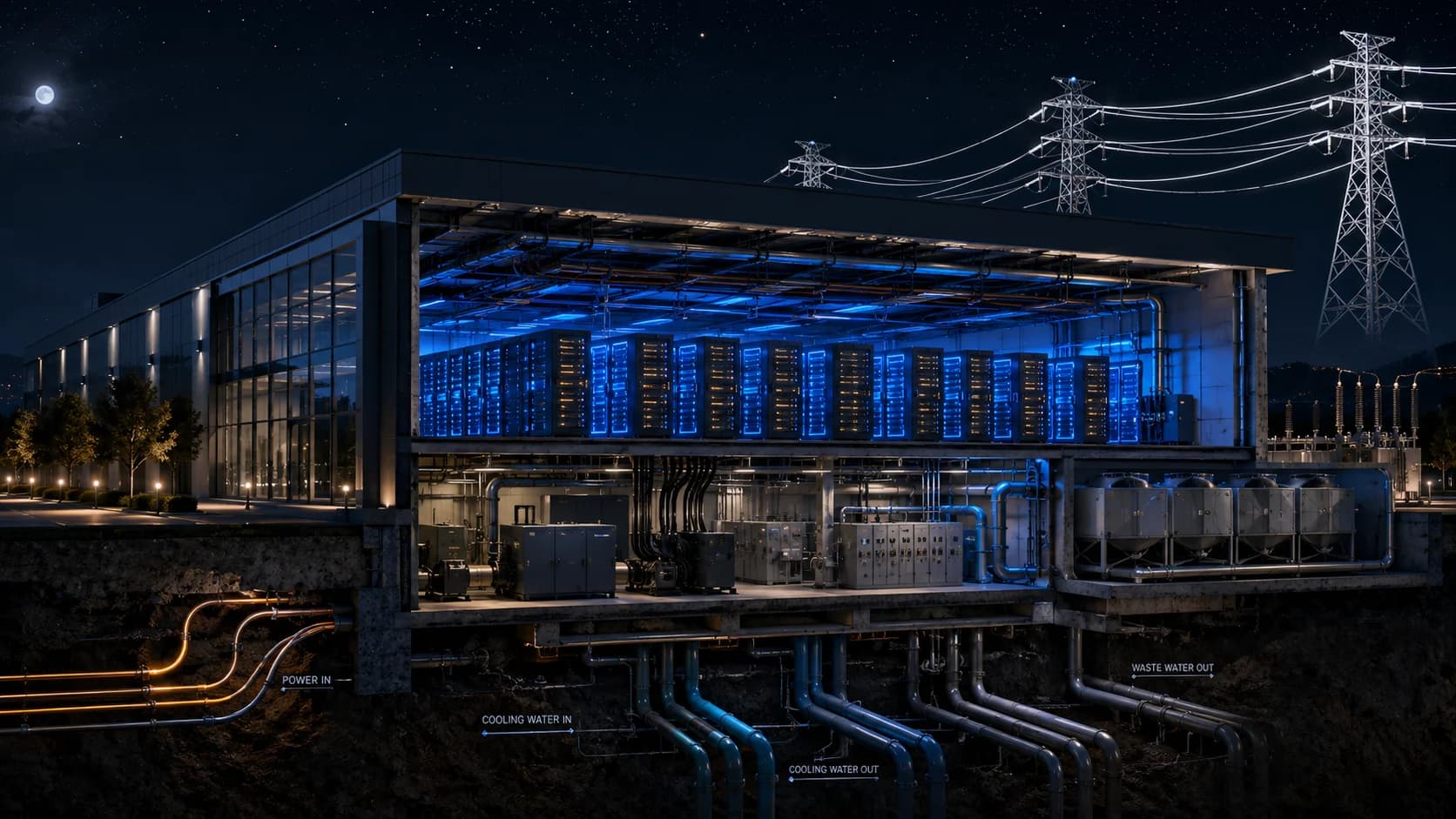
Data centers require substantial water for cooling. The relationship varies by cooling architecture: air cooling, liquid cooling, and evaporative cooling have different water consumption profiles. But at the scale of large AI data centers, the numbers become significant.
A Greenpeace estimate projects data centers will consume 664 billion liters of water annually by 2030. For reference, that's more water than some countries' total agricultural use.
This matters geographically. Data centers are increasingly being built in regions that are simultaneously the locations of the most available cheap power and the regions under the most significant water stress. The Middle East, the American Southwest, and parts of Asia all combine high AI infrastructure investment with real water scarcity concerns.
The operational constraint this creates is real: water-constrained data center locations face limitations on cooling capacity that either cap the density of computing that can be housed there or require more expensive cooling infrastructure that consumes less water.
More broadly, as AI infrastructure scales, its resource footprint becomes a factor in the regulatory and social license to operate. Several European jurisdictions have already imposed water impact assessments on large data center proposals.
The Geopolitical Layer
These three physical constraints, semiconductor manufacturing concentration, energy, and water, interact with each other and with the geopolitical dynamics of AI development in ways that are worth making explicit.
The U.S. leads in AI investment by a wide margin: $109.1 billion in private AI investment in 2024, according to Stanford's AI Index, compared to China's $9.3 billion. But raw investment is conditioned on access to frontier compute, which is conditioned on TSMC access, which is subject to export control regimes and geopolitical dynamics.
China's development of competitive open-weight models, DeepSeek V3 and V4, at significantly lower training cost than Western equivalents demonstrates that compute efficiency can partially substitute for raw scale. This is strategically significant: if highly capable models can be trained with less frontier compute, the leverage that semiconductor access controls provide diminishes.
Simultaneously, several countries, the EU, UK, UAE, Saudi Arabia, India, are announcing sovereign compute facilities designed to reduce foreign AI platform dependence. These facilities require the same power grid and water infrastructure investments that constrain commercial data centers.
The net picture: AI geopolitics and conventional infrastructure geopolitics are increasingly the same policy domain. Countries that treat them separately are missing the connection.
What This Changes
For AI development strategy: the assumption that capability improvements compound indefinitely, limited only by algorithmic progress and model architecture, misses the physical constraint layer. Algorithmic efficiency improvements matter enormously, not just as cost reductions but as the mechanism for staying ahead of energy and infrastructure scarcity.
For policy: energy permitting, grid investment, semiconductor diversification, and water planning are now directly linked to AI competitiveness. Countries with slow infrastructure permitting are inadvertently constraining their AI development potential, often without understanding the connection.
For organizations: vendor dependency on closed-model providers carries supply chain risk that traces back, ultimately, to semiconductor and power infrastructure. The open-weight ecosystem as a hedge against this dependency makes more sense when you trace the supply chain back to its physical foundations.
The AI narrative tends to be told as a story about intelligence, capability, and algorithms. The physical substrate matters more than the discourse reflects. Understanding it changes what you should be watching and what you should be building for.
Sources: IEA Data Center Energy Report 2025; TSMC 2024 Annual Report; Stanford AI Index 2025-2026; Brookings Institution data center water analysis; Greenpeace data center environmental assessment.
Related Writing
- technology
The Agentic Inflection Point
A strategic analysis of where autonomous AI systems actually are, the capability gaps that remain, and what the trajectory implies for organizations.
- business strategy
Six Months, Twelve Domains, One Uncomfortable Conclusion
Six months of deep research into India's institutions reveals interconnected systemic failures, real successes, and six high-leverage reforms.
- technology
I Used AI to Find the Ceiling
I used Claude to run an honest capability assessment on my last project before planning my next SaaS build — and let the findings shape the spec.
- technology
I Built My WordPress Theme to Be Read by Machines
Why designing a WordPress theme for AI agents instead of humans produced a cleaner, faster, more honest architecture.
- business strategy
India Is Borrowing China's Playbook
A structural comparison of India and China's economies from 2000-2025, examining inequality, surveillance, and industrial policy.